




























Views
Downloads

Grade 8 Star Life Cycle — Printable No-Prep Worksheet

Paste this activity's link or code into your existing LMS (Google Classroom, Canvas, Teams, Schoology, Moodle, etc.).
Students can open and work on the activity right away, with no student login required.
You'll still be able to track student progress and results from your teacher account.
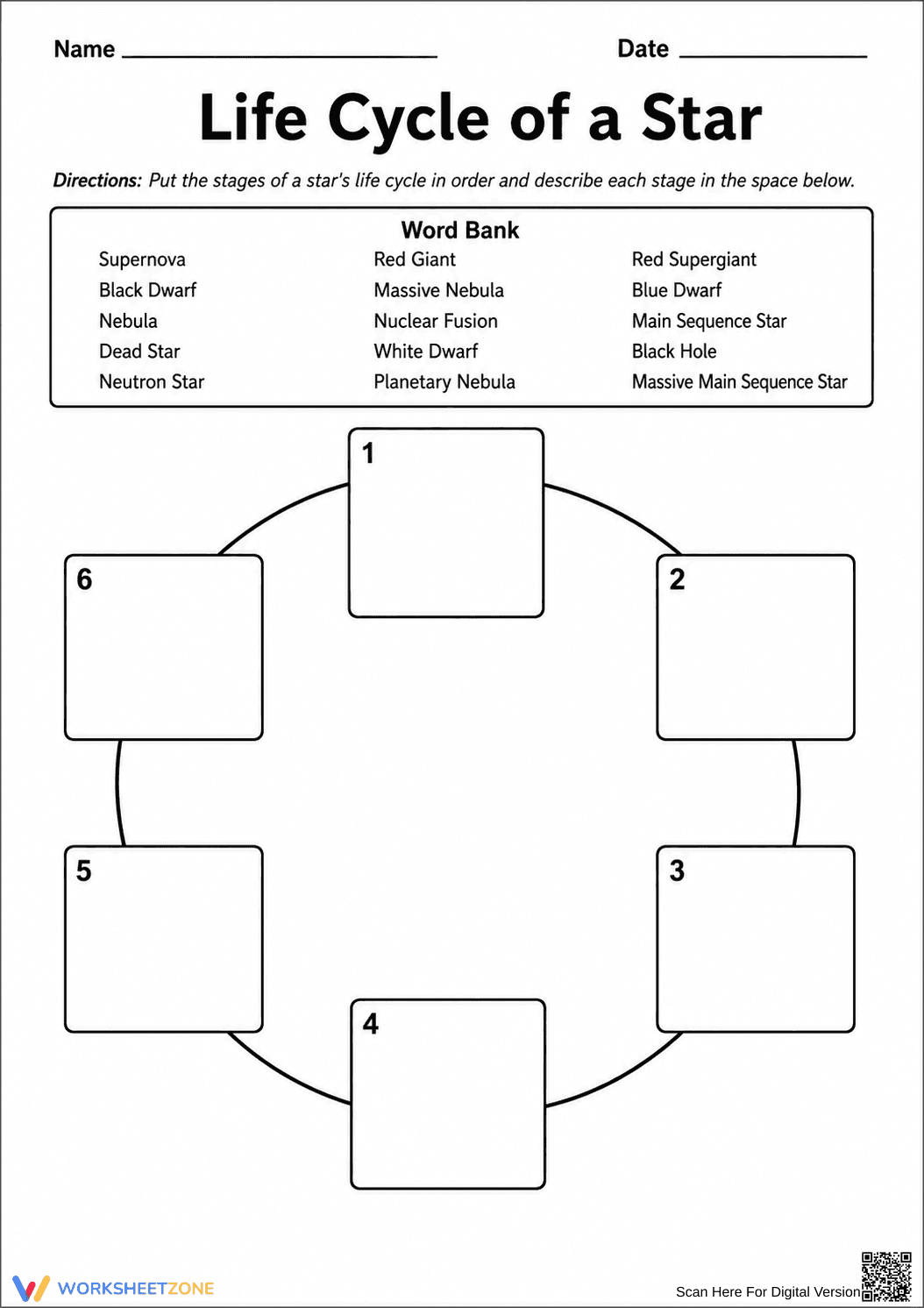
This Grade 8 science worksheet helps students master the life cycle of a star by sequencing and describing key stellar evolution stages. By organizing terms from a comprehensive word bank into a circular flow map, learners build a concrete understanding of how stars form, evolve, and eventually collapse.
At a Glance
- Grade: 8 · Subject: Science
- Standard:
HS-ESS1-1— Illustrate the life span of a star- Skill Focus: Sequencing Stellar Evolution
- Format: 1 page · 6 problems · Answer key included · PDF
- Best For: Independent practice or review
- Time: 15–20 minutes
What's Inside
This single-page resource features a clear, circular diagram containing six blank boxes connected by arrows to represent a continuous cycle. A robust 15-term word bank is provided at the top, including vocabulary such as Supernova, Nebula, Red Giant, Black Hole, and Nuclear Fusion. Students must select the correct sequence of six stages for a specific type of star, write the term in the box, and provide a brief description of the physical processes occurring during that phase. A complete answer key is included for easy grading.
Zero-Prep Workflow
- Print (1 minute): Simply print the PDF and copy a class set. No special materials or cutting required.
- Distribute (1 minute): Hand out the worksheet after your initial lesson on stellar evolution or astronomy.
- Review (3 minutes): Use the included answer key to quickly check student sequences or project it on the board for self-correction.
Total teacher prep time is under two minutes, making this an excellent emergency sub plan or quick formative assessment.
Standards Alignment
Aligned to HS-ESS1-1: "Develop a model based on evidence to illustrate the life span of the sun and the role of nuclear fusion in the sun’s core to release energy." This worksheet directly supports this standard by having students construct a visual model of a star's life span. Both standard codes can be copied directly into lesson plans, IEP goals, or district curriculum mapping tools.
How to Use It
Assign this worksheet immediately following a direct instruction lesson on the life cycle of stars. It serves as a structured way for students to synthesize their notes and apply new vocabulary. As a formative assessment, use the completed diagrams to check for misconceptions. If students confuse a White Dwarf with a Black Dwarf or misplace the Supernova stage, you can quickly identify and address the gap. Expect completion to take 15 to 20 minutes.
Who It's For
This resource is designed for 8th-grade and early high school science students studying astronomy. The included word bank provides built-in scaffolding, making it accessible for English Language Learners and students who need vocabulary support. It pairs perfectly with a visual anchor chart of the universe or a digital simulation of stellar life cycles.
Understanding the sequence of stellar evolution is a foundational component of modern astronomy education. By aligning with HS-ESS1-1 to illustrate the life span of a star, this activity reinforces critical scientific modeling skills. According to a ScienceDirect TpT Analysis, visual sequencing tasks significantly improve middle and high school students' retention of complex, multi-step scientific processes. Organizing abstract concepts like nuclear fusion, red giants, and planetary nebulas into a concrete visual framework reduces cognitive load and helps learners transition from rote memorization to deep conceptual understanding. When students actively map out these astronomical phenomena, they build stronger neural connections regarding cause and effect in the universe. This structured approach ensures that students can accurately trace the pathway from a massive nebula to a black hole, providing a solid foundation for advanced physics and earth science coursework.


