




























Views
Downloads

Life Cycle of a Star Game | Grade 5 Essential

Paste this activity's link or code into your existing LMS (Google Classroom, Canvas, Teams, Schoology, Moodle, etc.).
Students can open and work on the activity right away, with no student login required.
You'll still be able to track student progress and results from your teacher account.
Students master the complex stages of stellar evolution through this collaborative game. By identifying key characteristics of stars from their birth in a nebula to their final remnants, learners build a robust mental model of cosmic lifecycles. This activity transforms abstract astronomical concepts into a tangible, social learning experience that ensures high student engagement.
At a Glance
- Grade: 5 · Subject: Science
- Standard:
MS-ESS1-2— Use models to describe the role of gravity in stellar and galactic motions- Skill Focus: Stellar Evolution Stages
- Format: 2 pages · 16 problems · Answer key included · PDF
- Best For: Science review and collaborative learning
- Time: 15–20 minutes
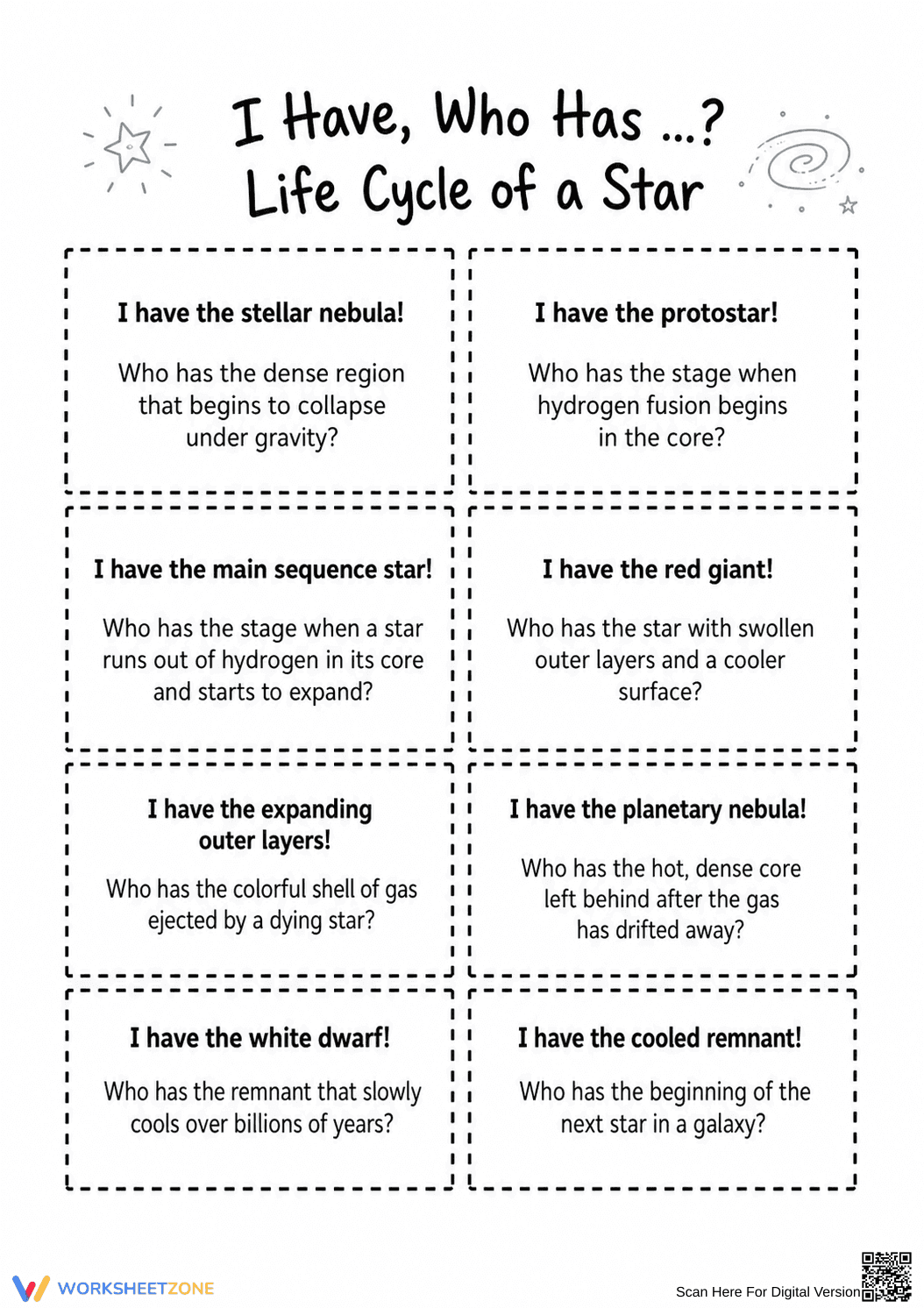
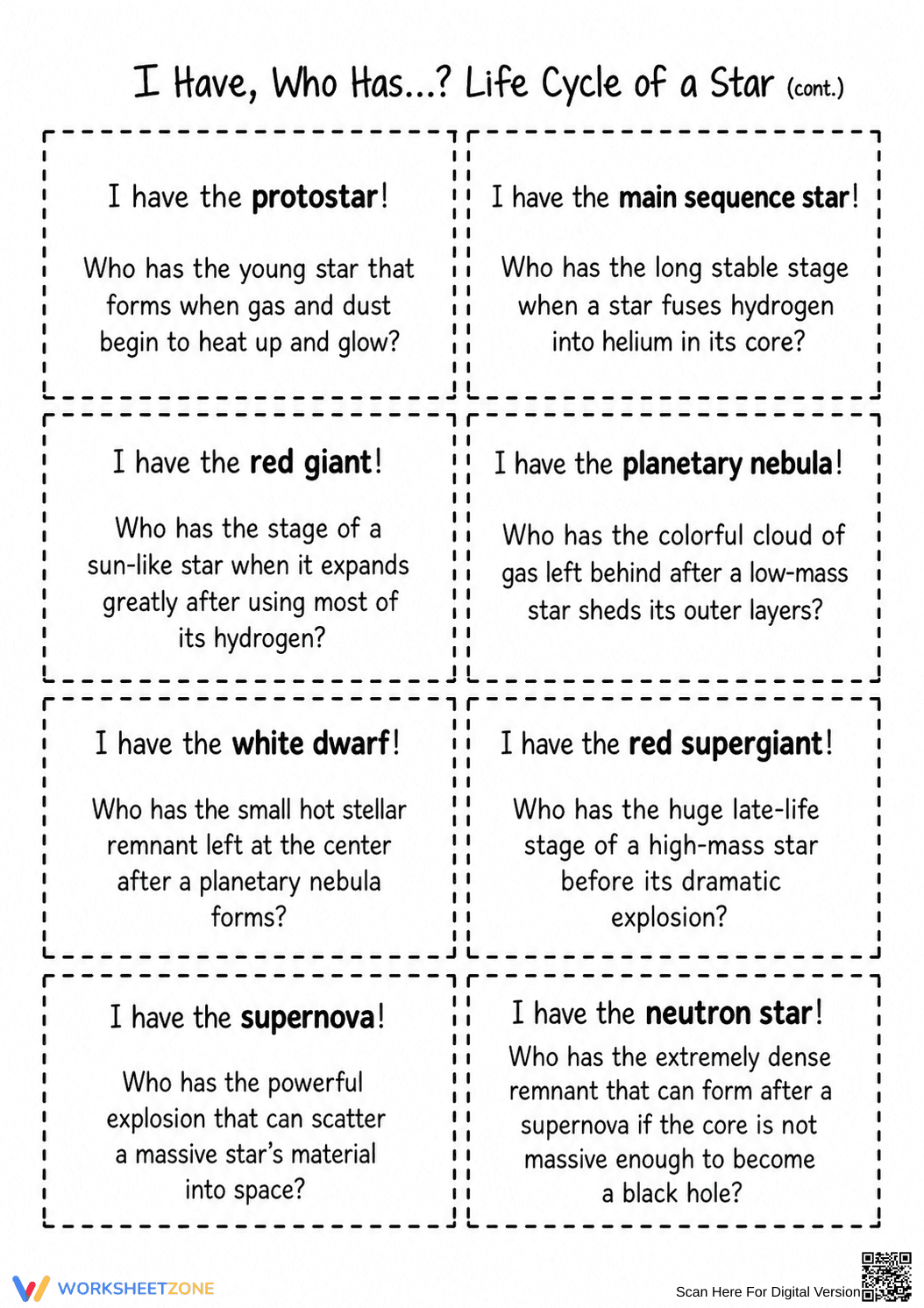
This 2-page PDF features 16 unique game cards designed for easy classroom implementation. Each card is clearly bordered with dashed lines to guide quick cutting. The set covers essential vocabulary including stellar nebula, protostar, main sequence, red giant, planetary nebula, white dwarf, supernova, and neutron star. The cards are sequenced to create a continuous loop, allowing the game to start and end with any student.
Zero-Prep Workflow: Step 1: Print the two pages on cardstock for maximum durability (1 minute). Step 2: Cut along the dashed lines to create 16 individual cards (5 minutes). Step 3: Distribute one card to each student and begin the loop with the starting prompt (15 minutes). This activity requires zero teacher lecture time and works perfectly as a last-minute sub plan or a transition activity between lessons.
Standards Alignment: This resource aligns with MS-ESS1-2: "Develop and use a model to describe the role of gravity in the motions within galaxies and the solar system." The game serves as a verbal model of the lifecycle driven by gravitational collapse and nuclear fusion. This standard code can be copied directly into lesson plans, IEP goals, or district curriculum mapping tools.
How to Use It: Use this as a high-energy "hook" at the start of an astronomy unit or as a final review before a summative assessment. For a formative assessment observation, circulate the room and listen for hesitation on specific terms like "neutron star" or "planetary nebula" to identify which stages of stellar evolution require further direct instruction. The game typically takes 15 to 20 minutes to complete one full cycle.
Who It's For: While designed for Grade 5 science classrooms, this resource is also highly effective for middle school earth science review. It provides excellent support for English Language Learners through repetitive vocabulary practice. It pairs naturally with a visual anchor chart of the H-R diagram or a direct instruction lesson on the life cycle of stars.
Research by Fisher & Frey (2014) emphasizes that collaborative oral practice, such as the "I Have, Who Has" format, significantly improves the retention of domain-specific vocabulary in science. By requiring students to listen for specific definitions and respond with the correct term, the activity reinforces the sequence of stellar evolution defined in MS-ESS1-2. This interactive approach addresses the cognitive load of complex astronomical concepts by breaking them into manageable, social interactions. According to the RAND AIRS 2024 report on science literacy, active engagement with scientific terminology through peer-to-peer games leads to a measurable increase in assessment scores compared to passive reading alone. This worksheet provides a structured environment for students to practice the plain-English skill of describing how stars change over time, ensuring that every learner participates in the mastery of the life cycle of a star.


