




























Views
Downloads
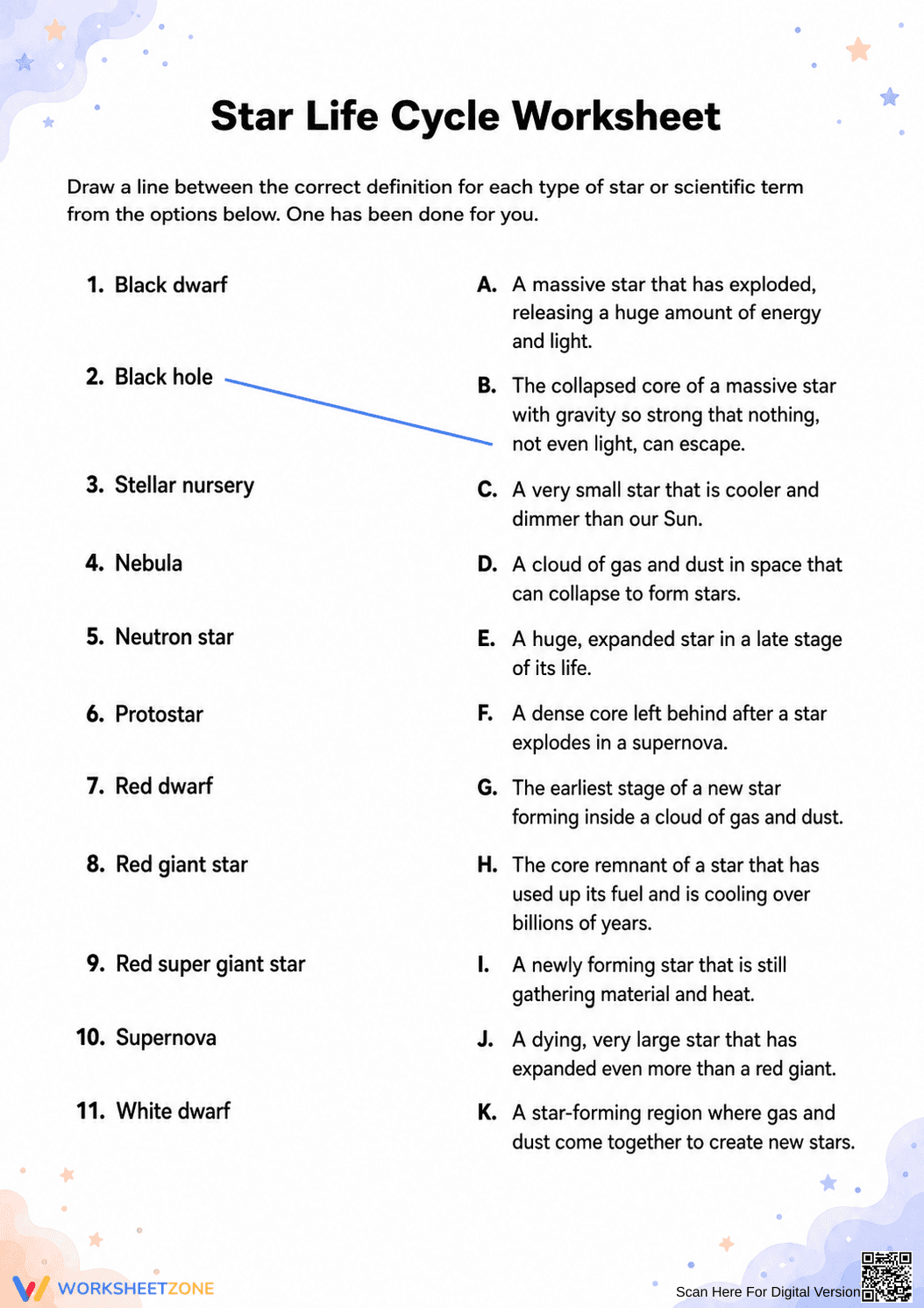
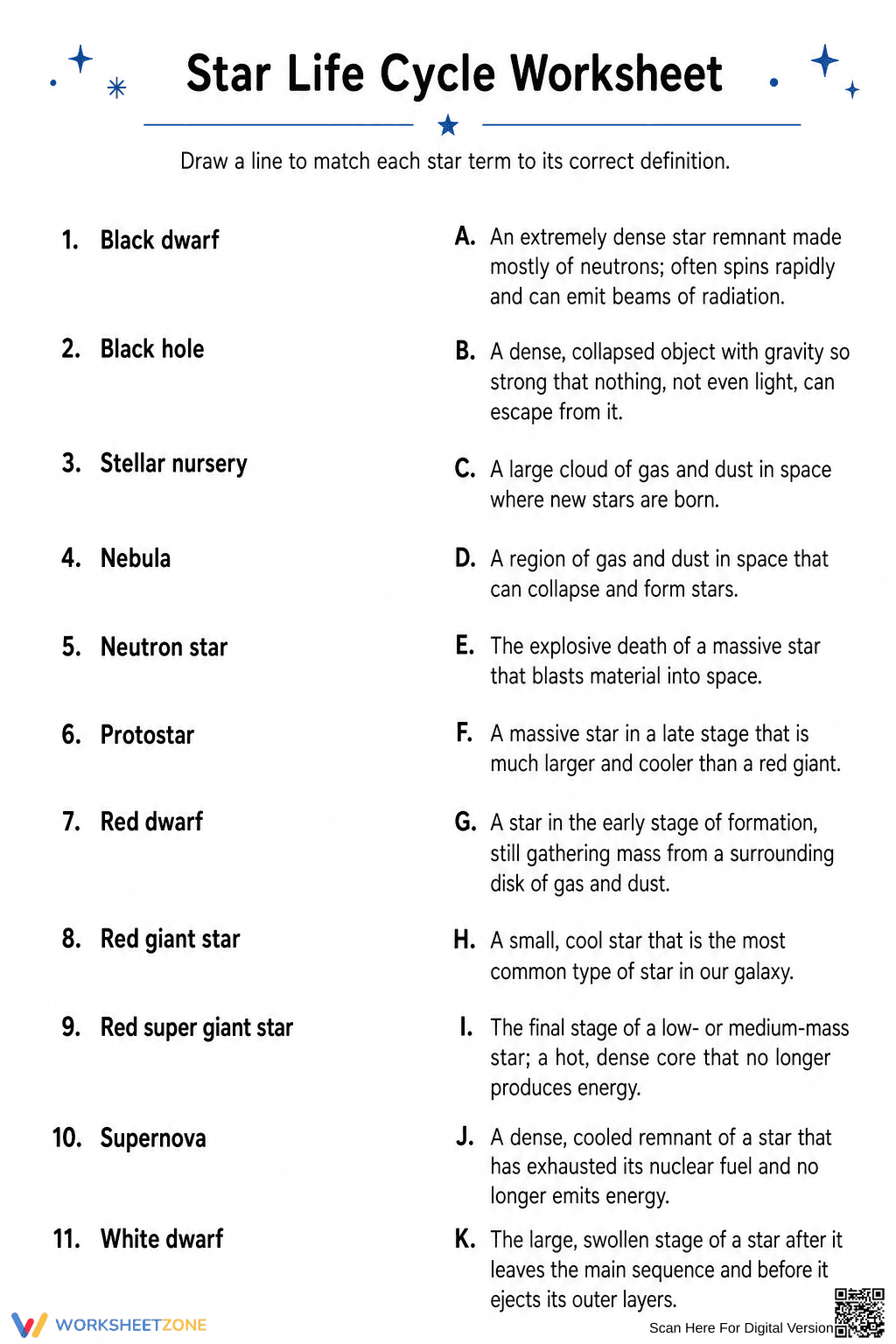

Grade 8 Star Life Cycle — Printable No-Prep Worksheet

Paste this activity's link or code into your existing LMS (Google Classroom, Canvas, Teams, Schoology, Moodle, etc.).
Students can open and work on the activity right away, with no student login required.
You'll still be able to track student progress and results from your teacher account.
This printable star life cycle worksheet helps middle and early high school students master essential astronomy vocabulary. By matching scientific terms to their precise definitions, learners build a strong foundation in space science and understand the complex stages of stellar evolution from nebula to black hole.
At a Glance
- Grade: 6–9 · Subject: Science
- Standard:
HS-ESS1-1— Illustrate the life span of a star- Skill Focus: Star life cycle vocabulary
- Format: 2 pages · 11 problems · Answer key included · PDF
- Best For: Independent practice and review
- Time: 10–15 minutes
What's Inside
Inside this resource, educators will find a straightforward matching activity featuring 11 key astronomical terms, including supernova, white dwarf, and stellar nursery. The download includes two slightly varied pages of the matching task to prevent wandering eyes or to provide a second practice opportunity, along with a complete answer key for quick grading.
Zero-Prep Workflow
- Print (1 minute): Simply download the PDF and print the desired number of copies. No special materials or complex teacher setup are required.
- Distribute (1 minute): Hand out the worksheets as a warm-up, exit ticket, or focused independent practice activity.
- Review (3 minutes): Use the included answer key to quickly check student work or facilitate a whole-class review session.
Total teacher prep time is under two minutes, making this an ideal, self-explanatory resource for emergency sub plans.
Standards Alignment
Aligned to HS-ESS1-1, this activity supports students as they develop a model based on evidence to illustrate the life span of the sun and other stars. It also reinforces middle school space science concepts regarding gravity and the solar system. Both standard codes can be copied directly into lesson plans, IEP goals, or district curriculum mapping tools.
How to Use It
- Vocabulary Introduction: Assign this worksheet after a direct instruction lesson on stellar evolution to solidify new terminology.
- Formative Assessment: Use it as a quick check for understanding before moving on to more complex topics like the Hertzsprung-Russell diagram.
Observation tip: Watch to see if students confuse similar terms like "red dwarf" and "white dwarf," which indicates a need for a brief reteach on star mass and temperature. Expected completion time is 10 to 15 minutes.
Who It's For
This resource is designed for middle school and 9th-grade science students studying astronomy. It serves as an excellent vocabulary reinforcement tool for general education students, while the clear, structured matching format provides necessary scaffolding for English Language Learners. Pair this worksheet with a visual anchor chart of a star's life cycle for maximum impact.
Mastering domain-specific vocabulary is a critical step in scientific literacy, particularly in complex fields like astronomy. When students engage with targeted matching activities, they strengthen their cognitive associations between abstract concepts and concrete definitions. According to Fisher & Frey (2014), explicit vocabulary instruction combined with structured independent practice significantly improves reading comprehension and content retention in the secondary science classroom. This worksheet directly supports this evidence-based approach by isolating 11 essential terms related to stellar evolution. By aligning with HS-ESS1-1 to illustrate the life span of a star, the activity ensures that learners are not just memorizing words, but building the foundational language necessary to discuss and model complex astronomical phenomena. This targeted practice bridges the gap between basic recognition and deeper conceptual understanding.


