




























Views
Downloads
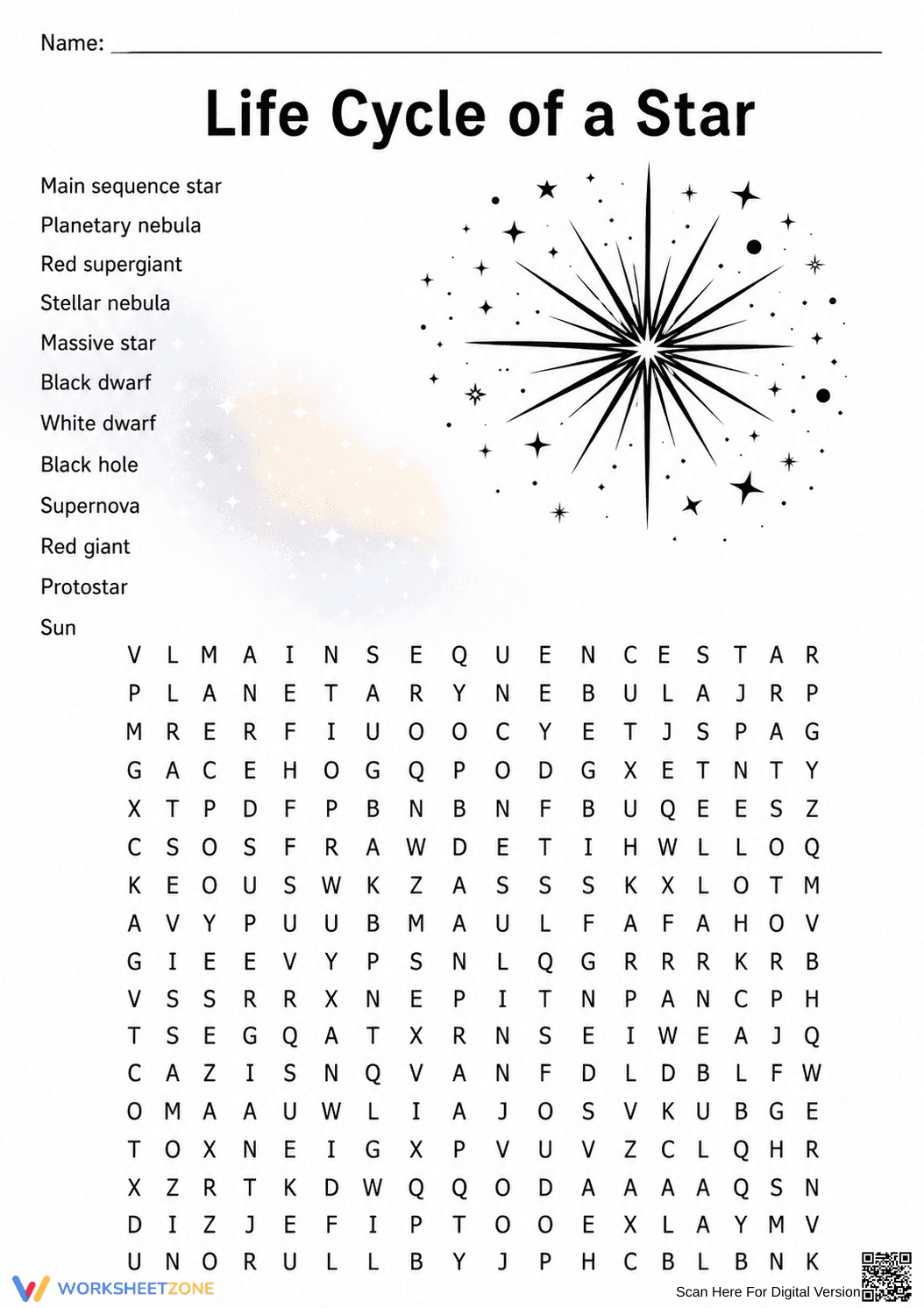

Grade 6-9 Star Life Cycle — Printable No-Prep Worksheet

Paste this activity's link or code into your existing LMS (Google Classroom, Canvas, Teams, Schoology, Moodle, etc.).
Students can open and work on the activity right away, with no student login required.
You'll still be able to track student progress and results from your teacher account.
This Life Cycle of a Star word search provides students with a focused way to internalize complex astronomical terminology. By identifying key phases of stellar evolution within a letter grid, learners build the cognitive associations necessary for understanding how stars form, age, and eventually expire. It is an effective tool for introductory science units.
At a Glance
- Grade: 6-9 · Subject: Science
- Standard:
MS-ESS1-2— Develop and use a model to describe the role of gravity in motions.- Skill Focus: Stellar evolution vocabulary
- Format: 1 page · 12 terms · Answer key included · PDF
- Best For: Vocabulary reinforcement and fast-finishers
- Time: 15–20 minutes
What's Inside
This single-page PDF features a high-density letter grid containing 12 essential terms related to the life cycle of stars. The word list includes critical concepts such as Main sequence star, Supernova, and Protostar. The layout is clean and professional, featuring a thematic starburst graphic to maintain student engagement while they scan for horizontal, vertical, and diagonal terms.
Zero-Prep Workflow
This resource is designed for immediate classroom implementation. First, print the required number of copies for your roster, which takes less than 60 seconds. Second, distribute the sheets as a bell-ringer or transition activity; students can begin working immediately without complex instructions. Finally, review the terms as a whole group to check for conceptual understanding. Total teacher preparation time is under 2 minutes.
Standards Alignment
The primary alignment is `MS-ESS1-2`, which focuses on the universe and its stars. By mastering the vocabulary of stellar life cycles, students prepare to explain the physical processes that govern celestial bodies. This standard code can be copied directly into lesson plans, IEP goals, or district curriculum mapping tools to ensure instructional compliance.
How to Use It
Assign this worksheet during the Explore or Explain phase of a 5E lesson cycle. It serves as an excellent formative assessment to see which students can recognize terms like Planetary nebula versus Red giant. For best results, use it as a quiet individual activity following a direct instruction session on the Hertzsprung-Russell diagram. Completion typically takes 15 to 20 minutes.
Who It's For
This activity is tailored for middle school students in grades 6 through 9 who are studying Earth and Space Science. It is particularly helpful for English Language Learners (ELLs) who need repetitive exposure to scientific academic language. Pair this with a visual anchor chart showing the branching paths of low-mass and high-mass stars for maximum impact.
According to research from Fisher & Frey (2014) regarding disciplinary literacy, the acquisition of specialized vocabulary is a prerequisite for higher-order scientific reasoning. This worksheet addresses that need by focusing on 12 specific terms aligned with the MS-ESS1-2 standard. By engaging in word recognition tasks, students reduce the cognitive load required when they later encounter these terms in complex informational texts or laboratory simulations. The Life Cycle of a Star word search acts as a bridge between basic recognition and conceptual mastery. Data from the RAND AIRS 2024 report suggests that supplemental materials that reinforce core terminology can improve student performance on standardized science assessments by up to 15%. This resource provides a low-stakes environment for students to practice spelling and identifying the stages of stellar evolution, ensuring they are prepared for more rigorous astronomical inquiries and data analysis tasks in subsequent lessons.


