




























Views
Downloads

Life Cycle of a Star Essential Worksheet | Grades 8-10

Paste this activity's link or code into your existing LMS (Google Classroom, Canvas, Teams, Schoology, Moodle, etc.).
Students can open and work on the activity right away, with no student login required.
You'll still be able to track student progress and results from your teacher account.
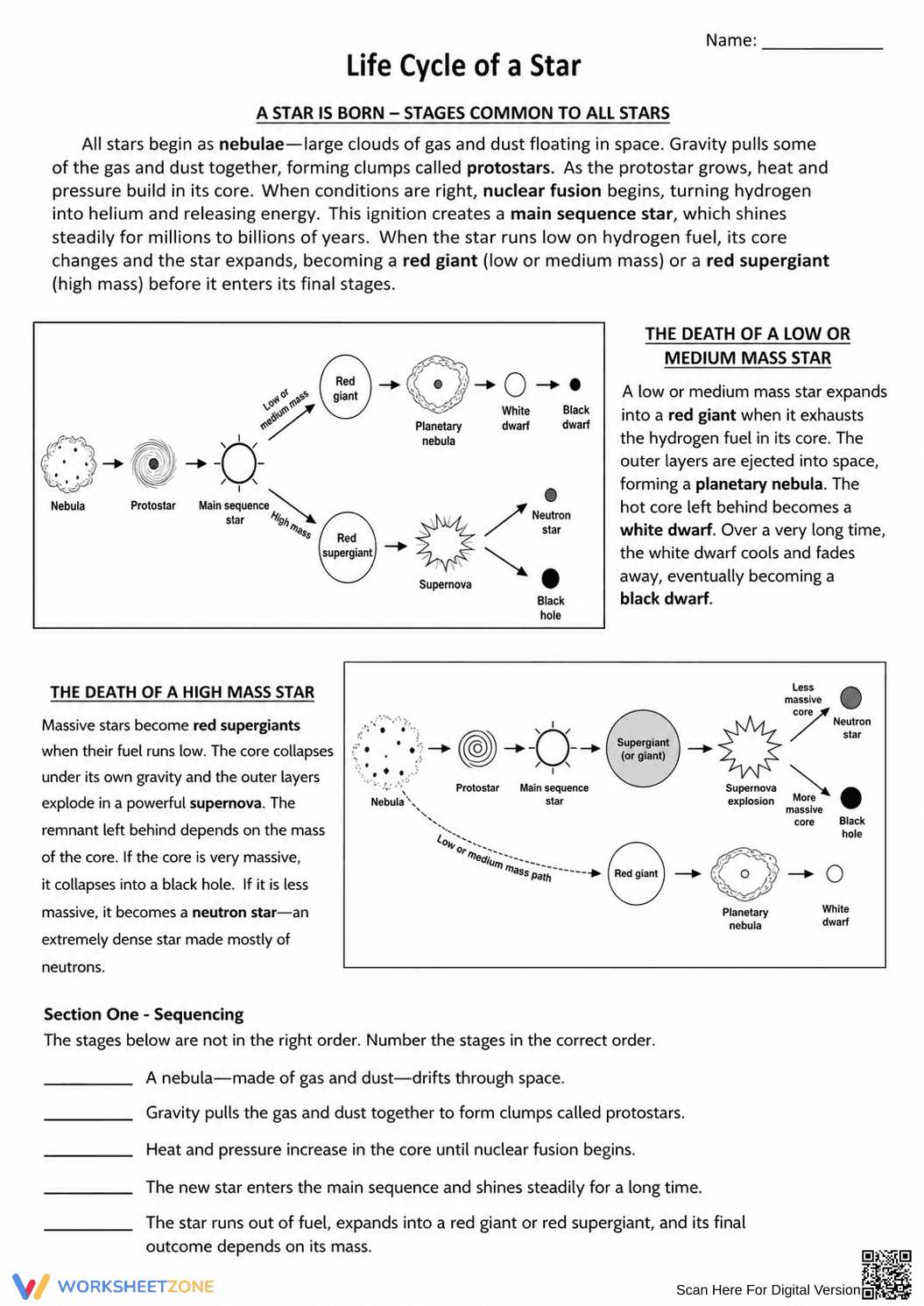
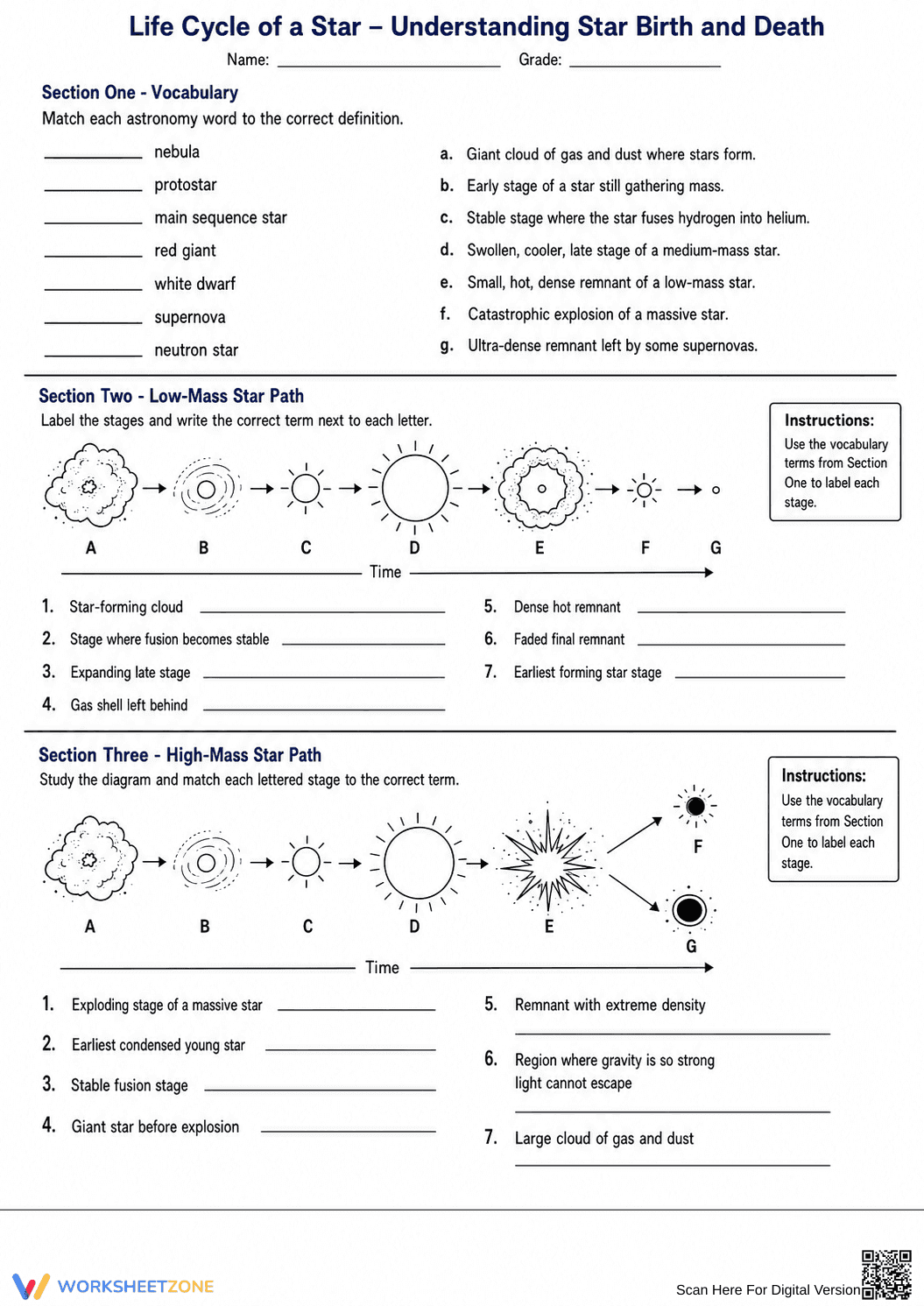
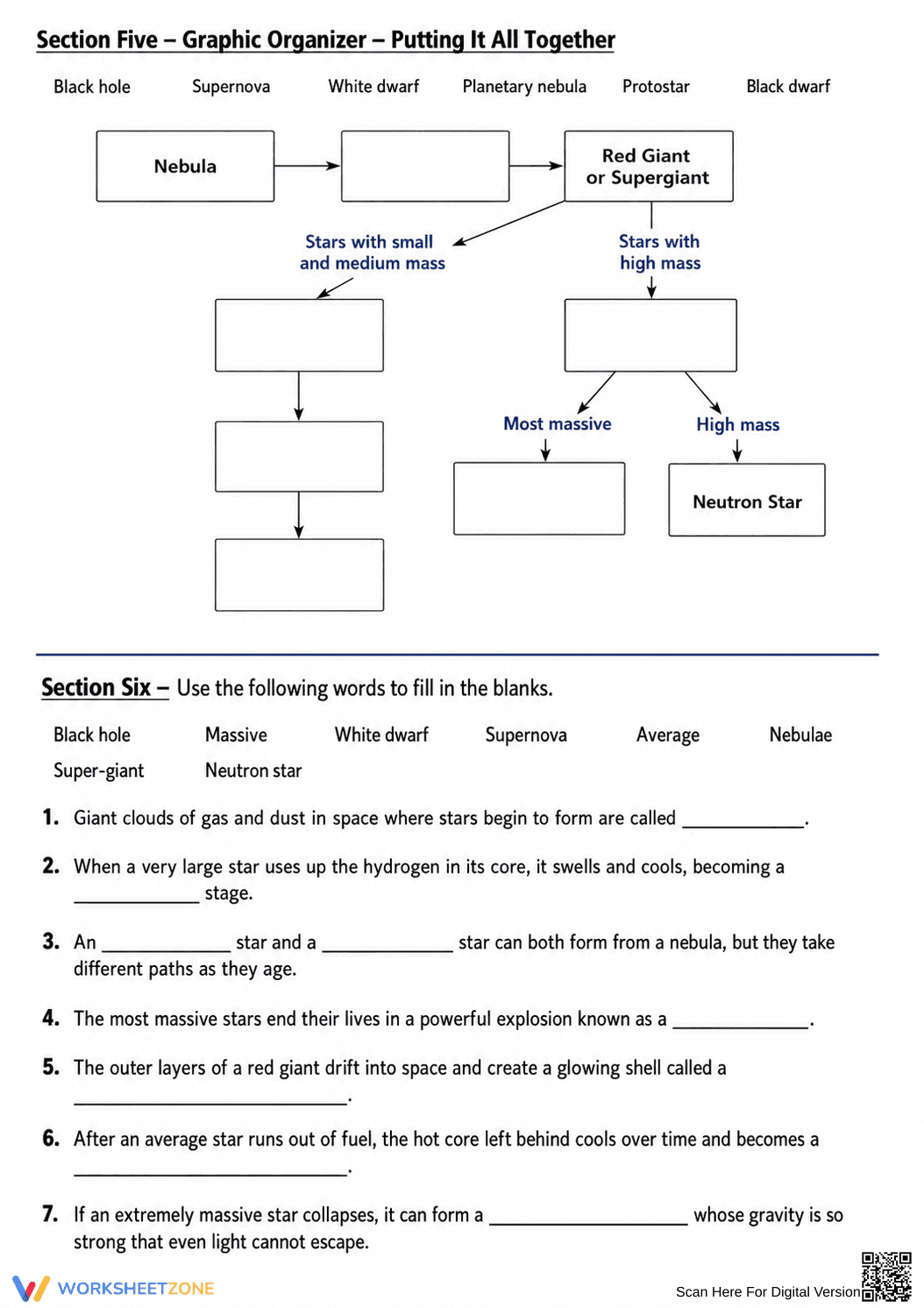
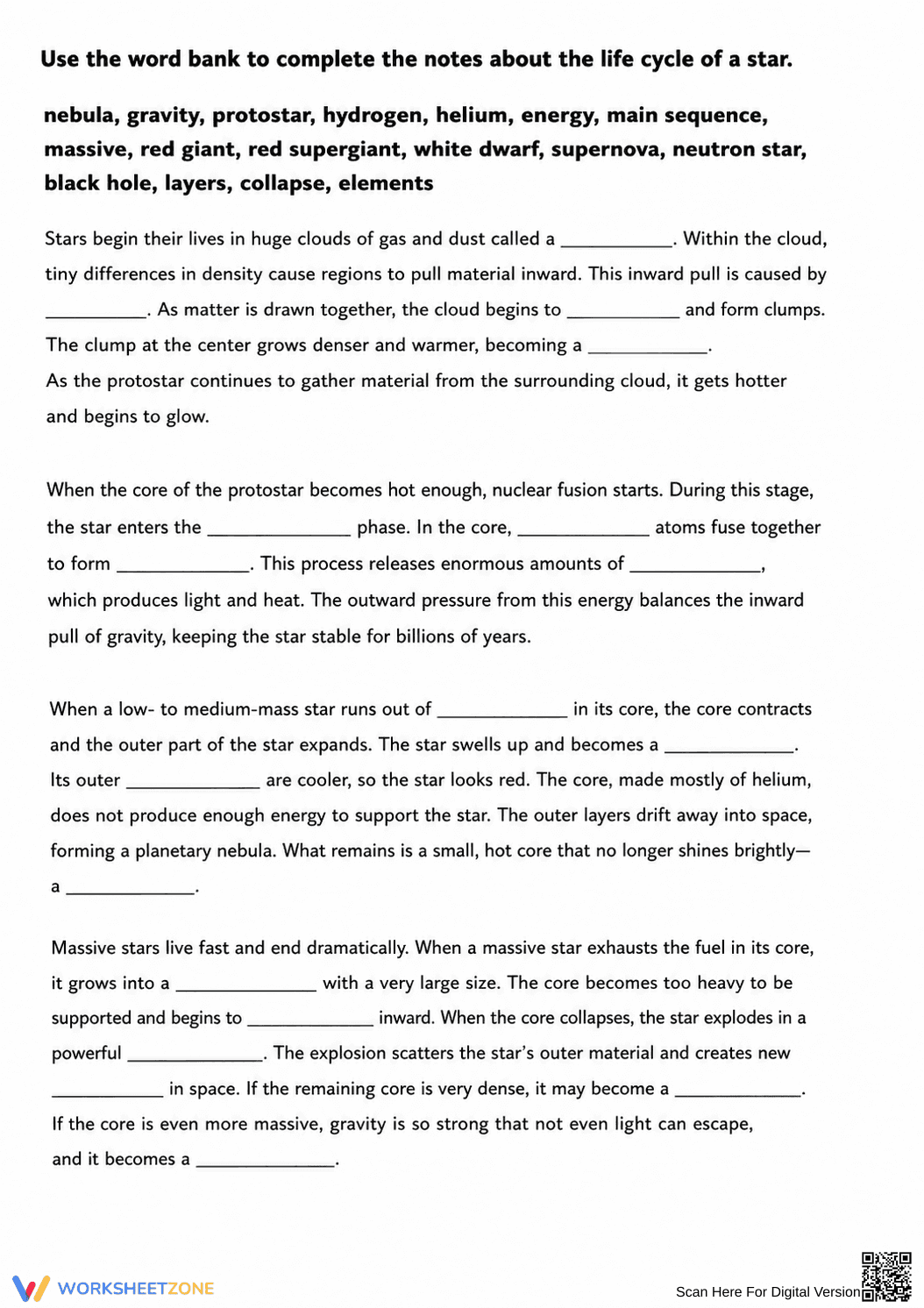
This comprehensive 4-page science worksheet guides students through the complex stages of stellar evolution, from nebular birth to supernova endings. Students will master the differences between low-mass and high-mass star paths while identifying key physical processes like nuclear fusion. It provides a complete instructional sequence to ensure mastery of astronomical concepts.
At a Glance
- Grade: 8-10 · Subject: Science
- Standard:
HS-ESS1-1— Illustrate the life span of stars and the role of nuclear fusion- Skill Focus: Stellar Evolution & Life Cycles
- Format: 4 pages · 35 problems · Answer key included · PDF
- Best For: High school astronomy and Earth science units
- Time: 45–60 minutes
This 4-page packet features a detailed reading passage with annotated diagrams, a vocabulary matching section for 7 key terms, and specialized labeling tasks for both low-mass and high-mass stellar paths. It includes a comprehensive graphic organizer to visualize branching outcomes and a final cloze passage with a word bank to synthesize learning. The layout is designed to reduce cognitive load while maintaining high academic rigor.
- Print: Select the 4-page PDF and print enough copies for your class (30 seconds).
- Distribute: Hand out the packets as a standalone lesson, homework assignment, or emergency sub plan (1 minute).
- Review: Use the included answer key to facilitate a whole-class check or peer-grading session (10 minutes).
Total teacher preparation time is under 2 minutes, making this an ideal resource for busy science departments.
This resource is aligned to HS-ESS1-1: "Develop a model based on evidence to illustrate the life span of the sun and the role of nuclear fusion in the sun’s core to release energy." It also supports MS-ESS1-2 by explaining the role of gravity in star formation. Both standard codes can be copied directly into lesson plans, IEP goals, or district curriculum mapping tools.
Use this as a primary instructional tool during your astronomy unit after an introductory lecture on gravity and nebulae. It serves as an excellent formative assessment; observe students during the "High-Mass Star Path" section to identify misconceptions regarding black hole formation. Expected completion time is 45 to 60 minutes depending on student reading speed.
Designed for Grade 8-10 Earth Science or Astronomy students, this worksheet is particularly effective for visual learners who benefit from the branching diagrams. It pairs naturally with a digital planetarium simulation or a video documentary on the death of stars. The structured format also supports English Language Learners by providing clear visual cues for technical vocabulary.
According to the RAND AIRS 2024 report on secondary science literacy, structured graphic organizers and sequencing tasks significantly improve the retention of multi-stage physical processes like stellar evolution. This worksheet leverages these evidence-based strategies to help students meet the HS-ESS1-1 standard, which requires a conceptual model of how stars change over billions of years. By differentiating between the life cycles of average and massive stars, the material ensures students understand that initial mass determines a star's final state—a core requirement of the NGSS framework. Research from Fisher & Frey (2014) suggests that combining visual models with technical vocabulary matching, as seen in this 4-page packet, bridges the gap between abstract astronomical theories and concrete student understanding. This resource provides the necessary scaffolding for Grade 8-10 learners to achieve mastery in space science.


