




























Views
Downloads
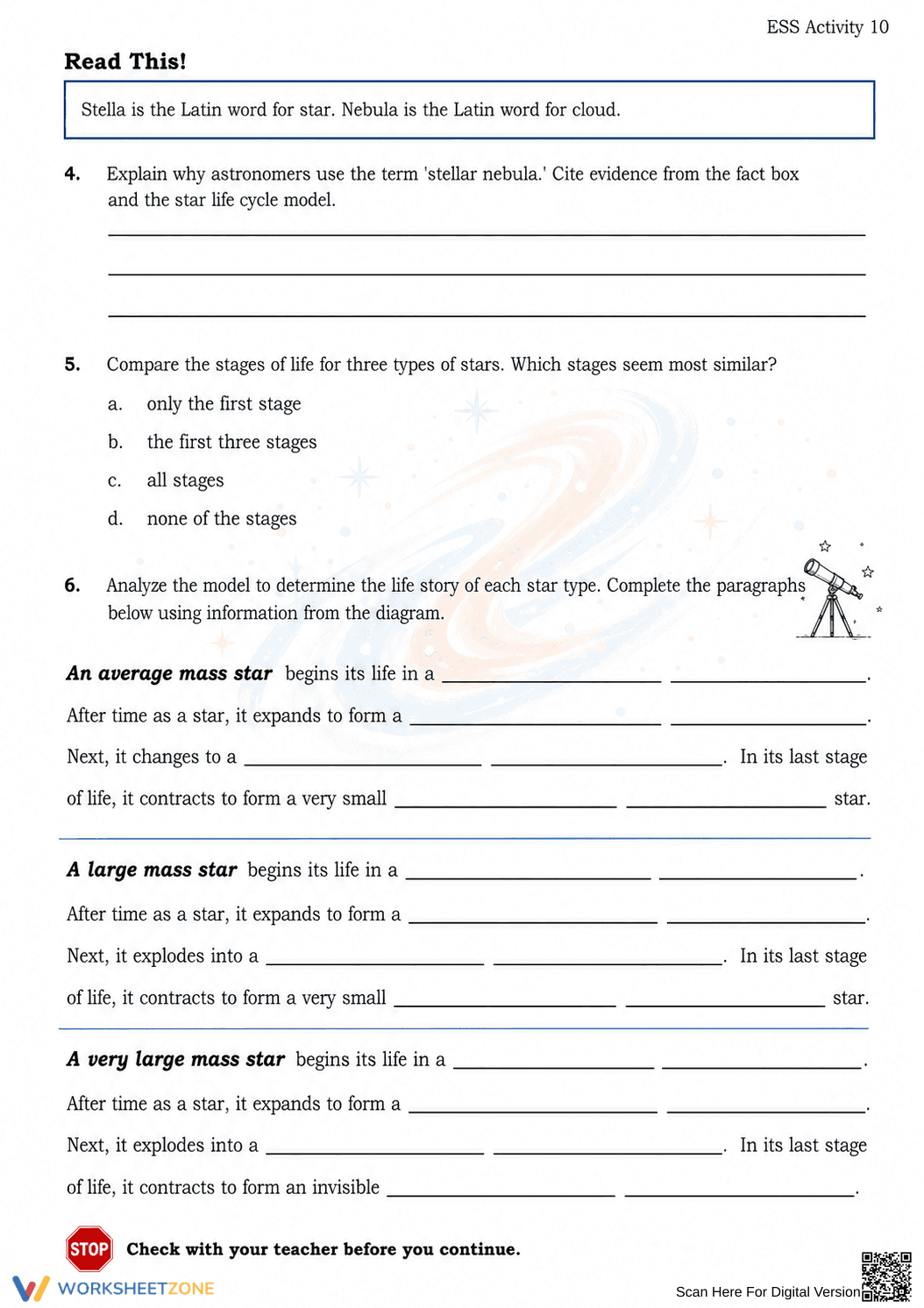


Printable Star Life Cycle Worksheet | Grade 5 Science

Paste this activity's link or code into your existing LMS (Google Classroom, Canvas, Teams, Schoology, Moodle, etc.).
Students can open and work on the activity right away, with no student login required.
You'll still be able to track student progress and results from your teacher account.
This comprehensive science worksheet guides students through the fascinating process of stellar evolution. By analyzing detailed diagrams of average, large, and very large mass stars, learners will extract evidence to understand how a star's mass determines its lifespan and ultimate fate, building essential data interpretation skills.
At a Glance
- Grade: 5 · Subject: Science
- Standard:
5-ESS1-1— Analyze models to understand star properties and life cycles.- Skill Focus: Analyzing stellar evolution
- Format: 5 pages · 16 problems · PDF
- Best For: Independent practice and group discussion
- Time: 30–45 minutes
Inside this five-page packet, students find visual models illustrating stellar evolution, from nebulas to black holes. The resource includes 16 tasks ranging from multiple-choice to fill-in-the-blank paragraphs. An extension section challenges students to compare scientific terminology with everyday language and sketch their own diagrams.
- Guided practice: The first few tasks require students to simply read the provided diagrams, identifying core temperatures, mass changes, and basic vocabulary like "stellar nebula."
- Supported practice: Students then transition to comparing the lifespans and stages of different star types, using the visual models to complete structured sentence frames and paragraphs.
- Independent practice: The final questions demand higher-order thinking, asking learners to predict the fate of our sun, formulate their own scientific questions, and sketch independent models.
This gradual-release approach ensures students build confidence with the data before applying it to complex astronomical concepts.
This material aligns with 5-ESS1-1, supporting students as they support an argument that differences in the apparent brightness of the sun compared to other stars is due to their relative distances from Earth, while extending into broader stellar properties. It also touches on crosscutting concepts of scale, proportion, and quantity. Both standard codes can be copied directly into lesson plans, IEP goals, or district curriculum mapping tools.
Deploy this worksheet during the core instructional phase of a space science unit. After a brief introductory lesson, have students work in pairs to decode the diagrams. As a formative assessment tip, observe how students interpret the core temperature key (in Kelvins) on the first page; this quickly reveals their data literacy levels. The activity takes 30 to 45 minutes.
This resource is ideal for fifth-grade science students, though its rigorous vocabulary and detailed models make it highly adaptable for middle school astronomy units. For learners needing extra support, teachers can pre-teach terms like "supernova" and "neutron star" using an anchor chart. It pairs perfectly with a direct instruction lesson on the solar system or a hands-on scale model activity of the universe.
Integrating visual models into science instruction is critical for developing robust analytical skills in young learners. Aligned with 5-ESS1-1, this resource requires students to analyze models to understand star properties and life cycles. According to a ScienceDirect TpT Analysis, instructional materials that combine explicit visual diagrams with progressive questioning techniques significantly improve student retention of complex STEM concepts. By asking learners to translate visual data into written explanations, this worksheet bridges the gap between abstract astronomical phenomena and concrete comprehension. The structured progression from basic observation to predictive modeling ensures that students are not just memorizing facts, but actively engaging in the scientific method. This approach fosters deeper cognitive connections, allowing young astronomers to confidently discuss stellar evolution, mass, and lifespan with academic precision and scientific rigor.


