




























Views
Downloads

Star Stages Worksheet | Essential Grade 6-9 Science

Paste this activity's link or code into your existing LMS (Google Classroom, Canvas, Teams, Schoology, Moodle, etc.).
Students can open and work on the activity right away, with no student login required.
You'll still be able to track student progress and results from your teacher account.
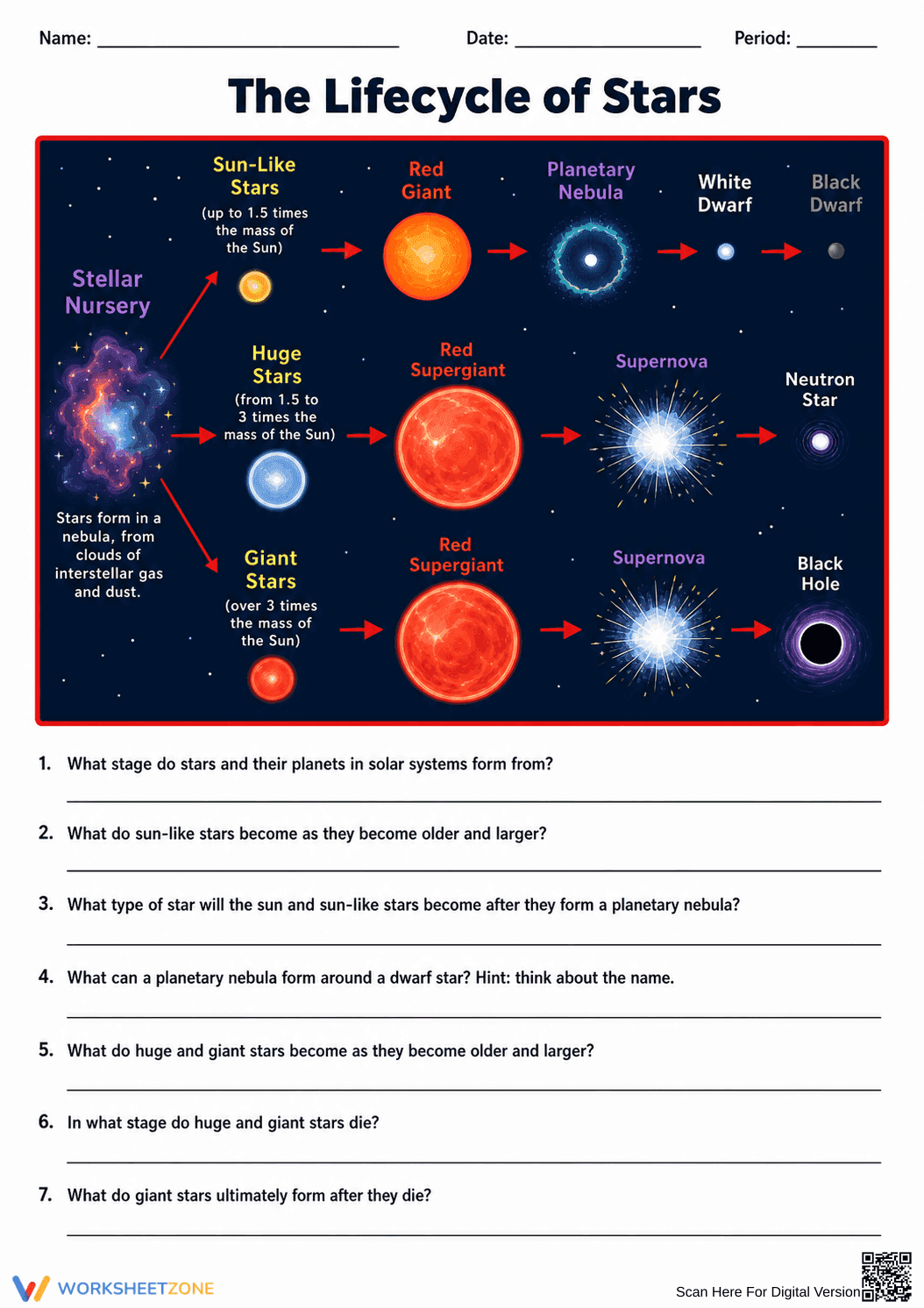
This comprehensive stellar evolution worksheet helps students visualize and identify the complex transitions stars undergo from formation to death. By analyzing a detailed flow diagram, learners track the divergent paths of sun-like, huge, and giant stars. This resource ensures students master the vocabulary and conceptual sequence of astronomy units through evidence-based observation.
At a Glance
- Grade: 6-9 · Subject: Earth & Space Science
- Standard:
MS-ESS1-3— Analyze and interpret data to determine scale properties of objects in the solar system- Skill Focus: Stellar evolution and life cycle stages
- Format: 1 page · 7 problems · Answer key included · PDF
- Best For: Independent practice or formative assessment
- Time: 15–20 minutes
The worksheet features a high-resolution infographic illustrating the three primary evolutionary tracks of stars based on their initial mass. It includes specific terminology such as planetary nebula, red supergiant, and neutron star. Below the visual aid, seven open-ended comprehension questions prompt students to extract data from the diagram and apply their knowledge of astronomical physics.
This resource is designed for a seamless classroom experience. First, print the single-page PDF (30 seconds). Next, distribute the sheets as a warm-up or main activity (1 minute). Finally, review the seven answers using the provided key to check for misconceptions (5 minutes). The total teacher preparation time is under two minutes, making it an ideal sub plan or last-minute review.
Aligned to `MS-ESS1-3`, this activity requires students to interpret models of celestial objects. While the standard focuses on scale, understanding the life cycle is foundational to comprehending the composition and age of the universe. Both standard codes can be copied directly into lesson plans, IEP goals, or district curriculum mapping tools.
Use this worksheet as a formative assessment after a lecture on nuclear fusion and stellar mass. It works effectively as a "silent gallery walk" station where students must find the answers using only the provided visual evidence. Expected completion time is 15 to 20 minutes, allowing for a quick transition to peer-grading or class discussion.
This resource is tailored for middle school students in Earth Science and high schoolers in introductory Astronomy. It provides necessary scaffolding for English Language Learners through clear visual cues and direct labeling. It pairs naturally with a short video on supernovae or a physical model of the solar system.
According to the RAND AIRS 2024 report on science literacy, visual-spatial reasoning is a critical component of student success in Earth and Space Science. This worksheet leverages dual-coding theory by pairing a complex infographic with targeted inquiry, a method shown by Fisher & Frey (2014) to improve long-term retention of scientific vocabulary. By requiring students to trace the path from a stellar nursery to a black hole or white dwarf, the activity reinforces the concept that initial mass dictates a star's ultimate fate. Research from EdReports 2024 suggests that high-quality instructional materials must provide clear evidence-based tasks that align with NGSS MS-ESS1-3. This printable resource meets those criteria by focusing on the observable stages of stellar evolution, ensuring that students in grades 6 through 9 develop a robust mental model of the universe's lifecycle.


