


























Views
Downloads

Grade 8 Genetics Vocabulary — Printable No-Prep Worksheet
Paste this activity's link or code into your existing LMS (Google Classroom, Canvas, Teams, Schoology, Moodle, etc.).
Students can open and work on the activity right away, with no student login required.
You'll still be able to track student progress and results from your teacher account.
This Grade 8 science worksheet helps students master essential genetics vocabulary by defining key terms and creating visual representations. By engaging with foundational concepts like genotype, phenotype, and heredity, learners build the academic language necessary to understand complex genetic variations and inheritance patterns.
At a Glance
- Grade: 8 · Subject: Science
- Standard:
MS-LS3-2— Describe how sexual reproduction results in genetic variation- Skill Focus: Genetics vocabulary acquisition
- Format: 4 pages · 6 problems · Answer key included · PDF
- Best For: Independent practice and sub plans
- Time: 15–20 minutes
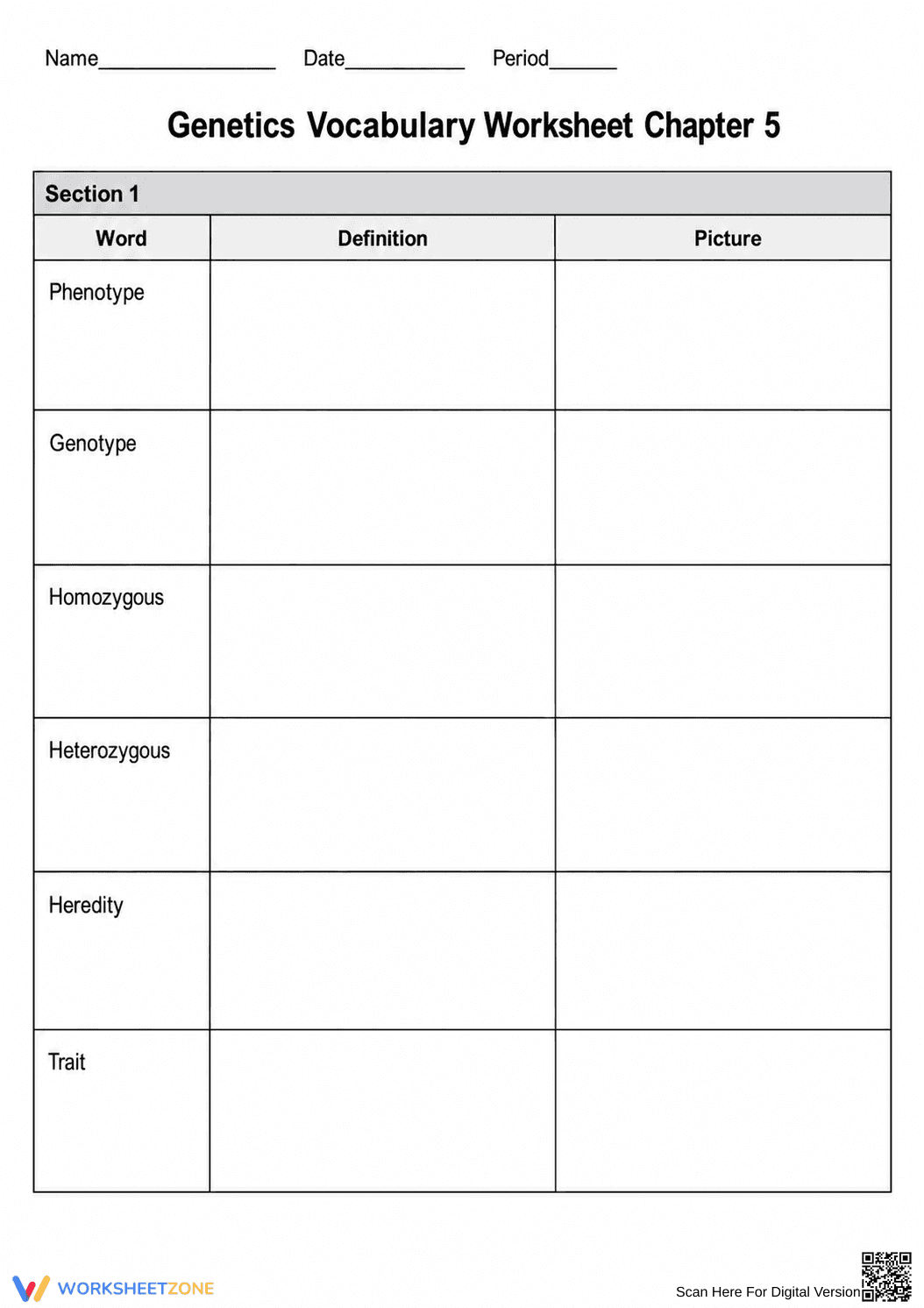
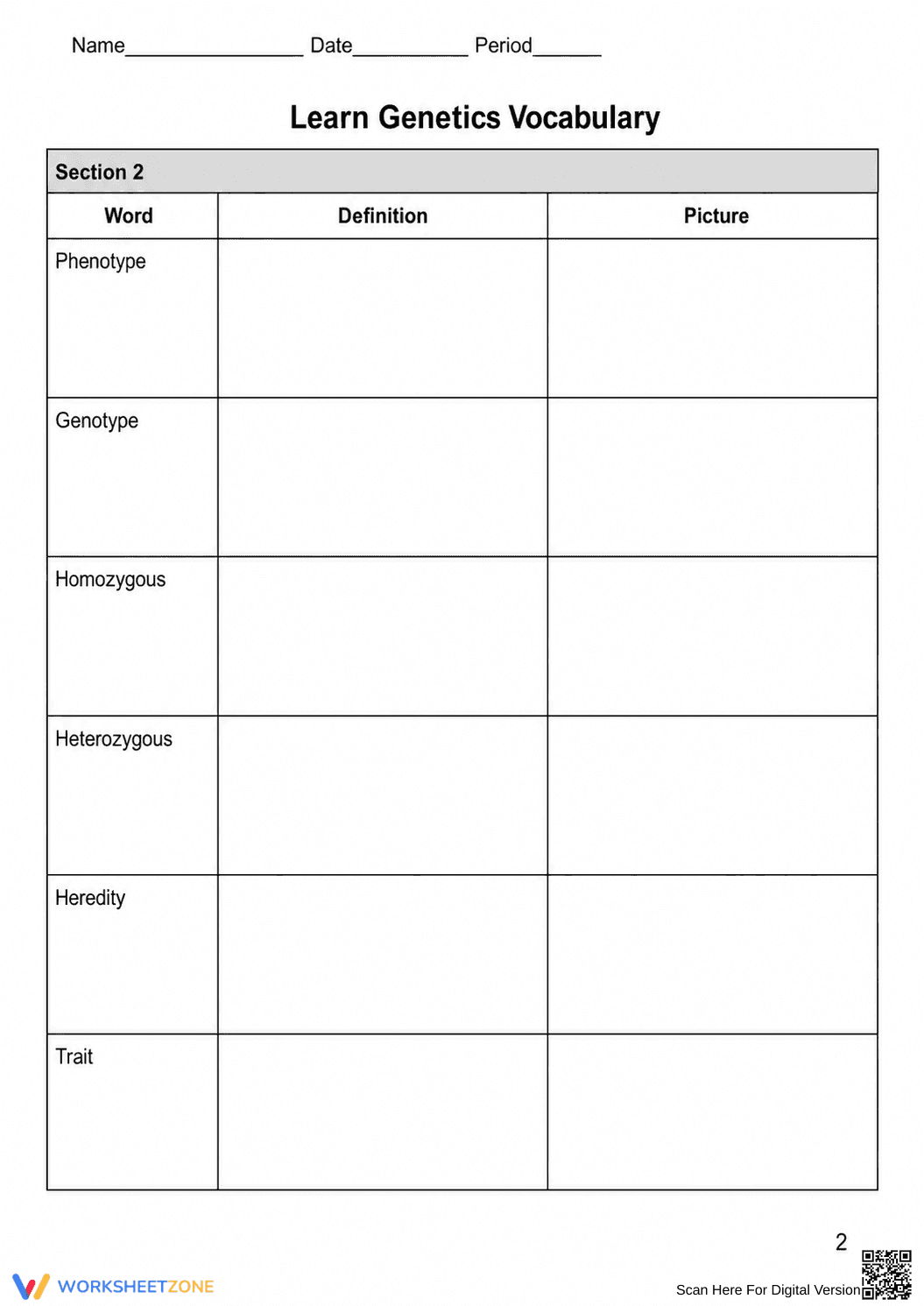
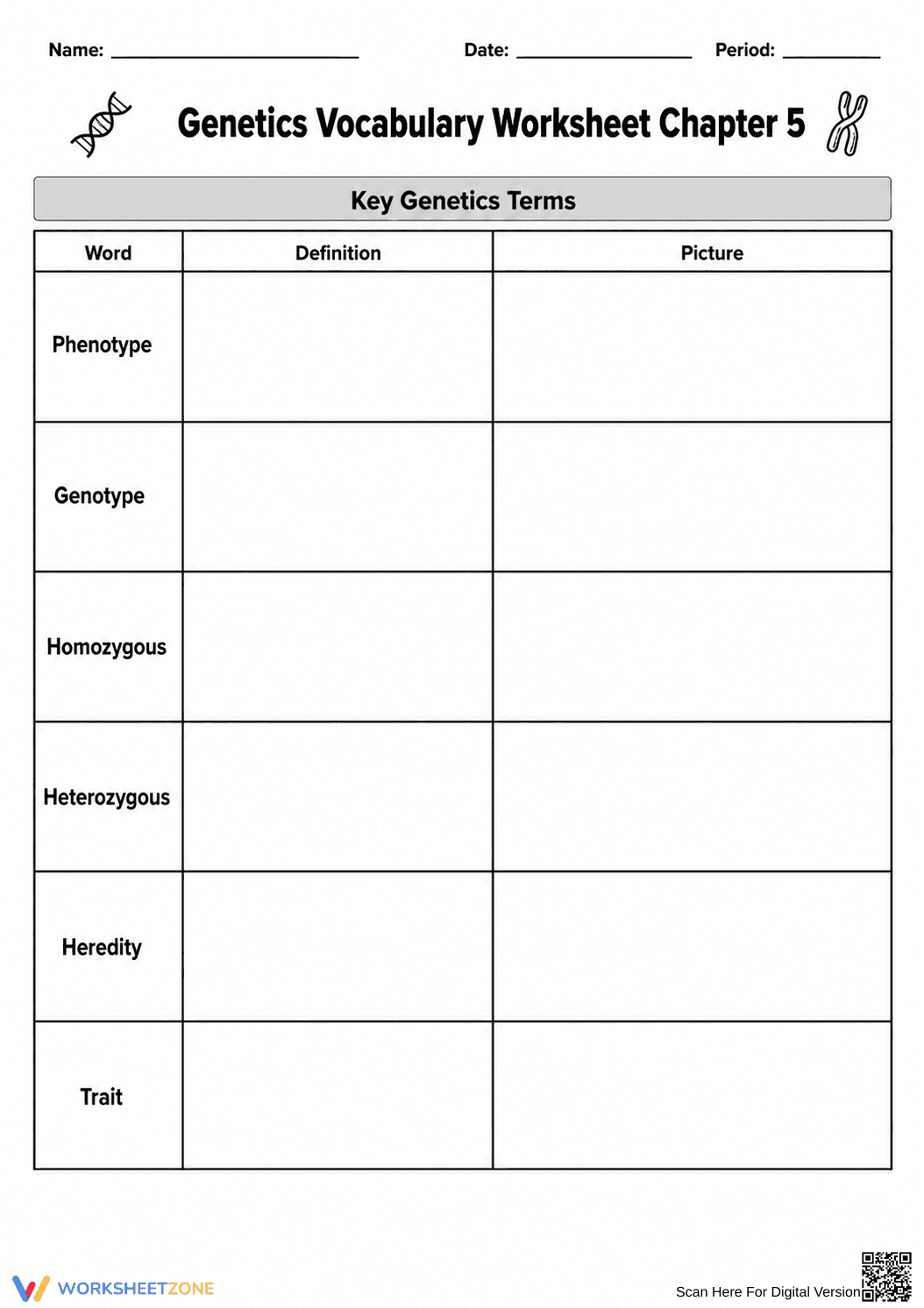
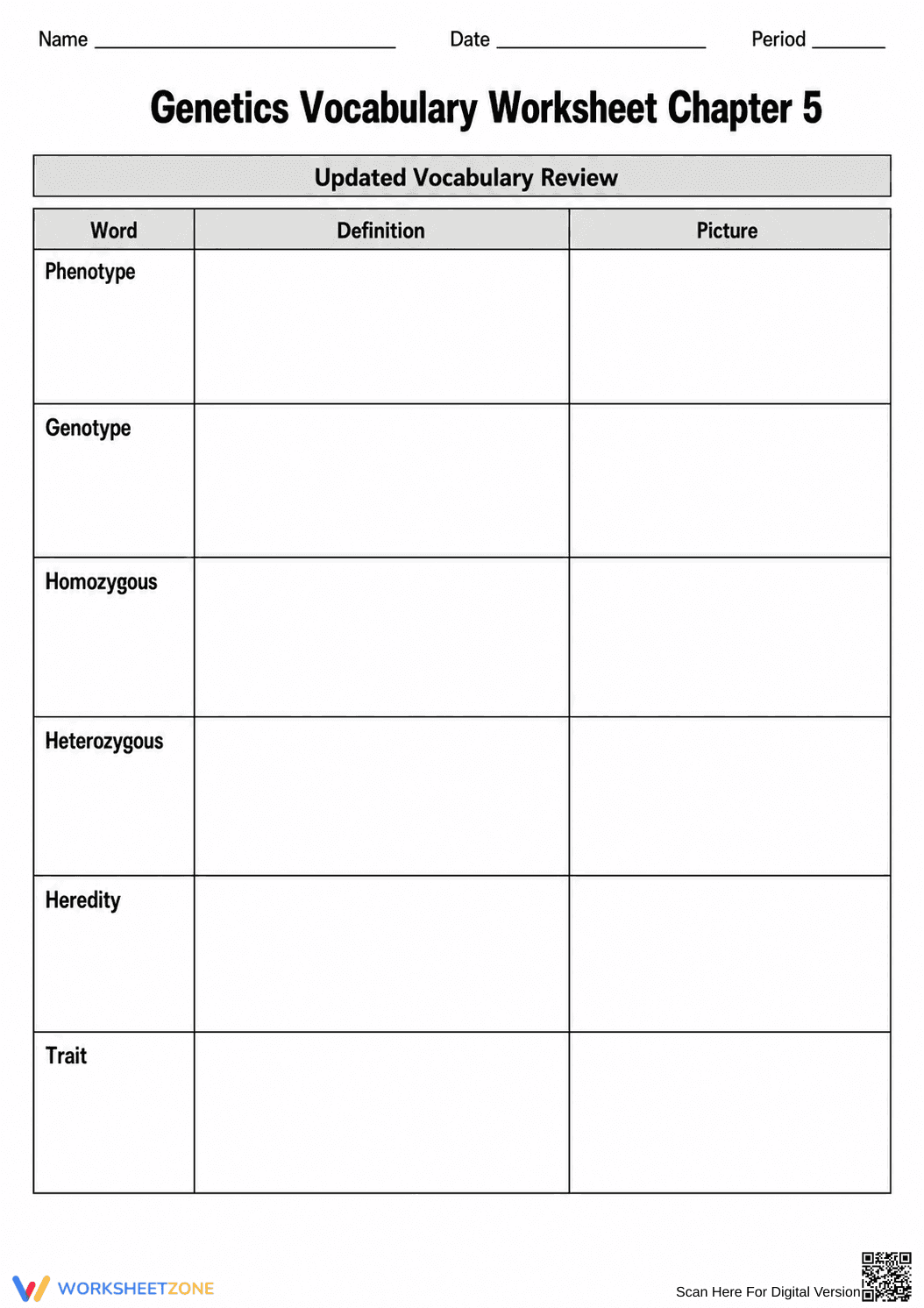
This resource features a straightforward graphic organizer designed to reinforce six critical genetics terms: phenotype, genotype, homozygous, heterozygous, heredity, and trait. Students write the formal definition for each word and draw a corresponding picture. This dual-coding approach ensures students conceptualize the biological mechanisms visually. The structured table format provides clear boundaries for student work.
Designed for immediate classroom implementation, this resource requires under two minutes of teacher prep time.
- Print (1 minute): Print a class set directly from the PDF.
- Distribute (1 minute): Hand out as an immediate bell-ringer or independent task.
- Review (5 minutes): Share student drawings as a class to check for understanding.
Because the instructions are self-explanatory, this worksheet is an ideal addition to any sub plan.
This activity aligns to MS-LS3-2: Develop and use a model to describe why asexual reproduction results in offspring with identical genetic information and sexual reproduction results in offspring with genetic variation. It also supports CCSS.ELA-LITERACY.RST.6-8.4 by helping students determine the meaning of domain-specific words. Both standard codes can be copied directly into lesson plans, IEP goals, or district curriculum mapping tools.
Teachers can deploy this worksheet before direct instruction as an inquiry-based vocabulary preview, asking students to research the terms using their textbooks or digital devices. Alternatively, it serves as an excellent formative assessment after a lecture on Mendelian genetics. As students work through the 15 to 20-minute activity, circulate the room and observe their illustrations; a student's drawing of heterozygous versus homozygous alleles will quickly reveal whether they truly grasp the distinction between the two concepts.
This resource is primarily designed for middle school science students in general education classrooms, but the visual component makes it highly effective for English Language Learners (ELLs) and students with IEPs who benefit from multimodal learning. To differentiate, teachers can provide a pre-filled word bank or sentence frames for the definitions. This worksheet pairs perfectly with an introductory direct instruction lesson on Punnett squares or a reading passage about Gregor Mendel's pea plant experiments.
Mastering scientific terminology is a critical step in developing broader scientific literacy, particularly when addressing complex topics like inheritance and cellular biology. This worksheet directly supports MS-LS3-2 by helping students describe how sexual reproduction results in genetic variation through targeted vocabulary acquisition. According to a ScienceDirect TpT Analysis, instructional materials that require students to process information through both textual definitions and visual representations significantly improve long-term retention of domain-specific academic language. By prompting learners to draw pictures alongside their written definitions, this graphic organizer leverages dual-coding theory to solidify their understanding of abstract genetic concepts. Providing structured, self-contained vocabulary practice ensures that students have the foundational knowledge required to engage in higher-order modeling and analytical tasks later in the unit, ultimately leading to more robust scientific reasoning skills.


