


























Views
Plays


Printable Punnett Square Worksheet | Grade 8 Science
Paste this activity's link or code into your existing LMS (Google Classroom, Canvas, Teams, Schoology, Moodle, etc.).
Students can open and work on the activity right away, with no student login required.
You'll still be able to track student progress and results from your teacher account.
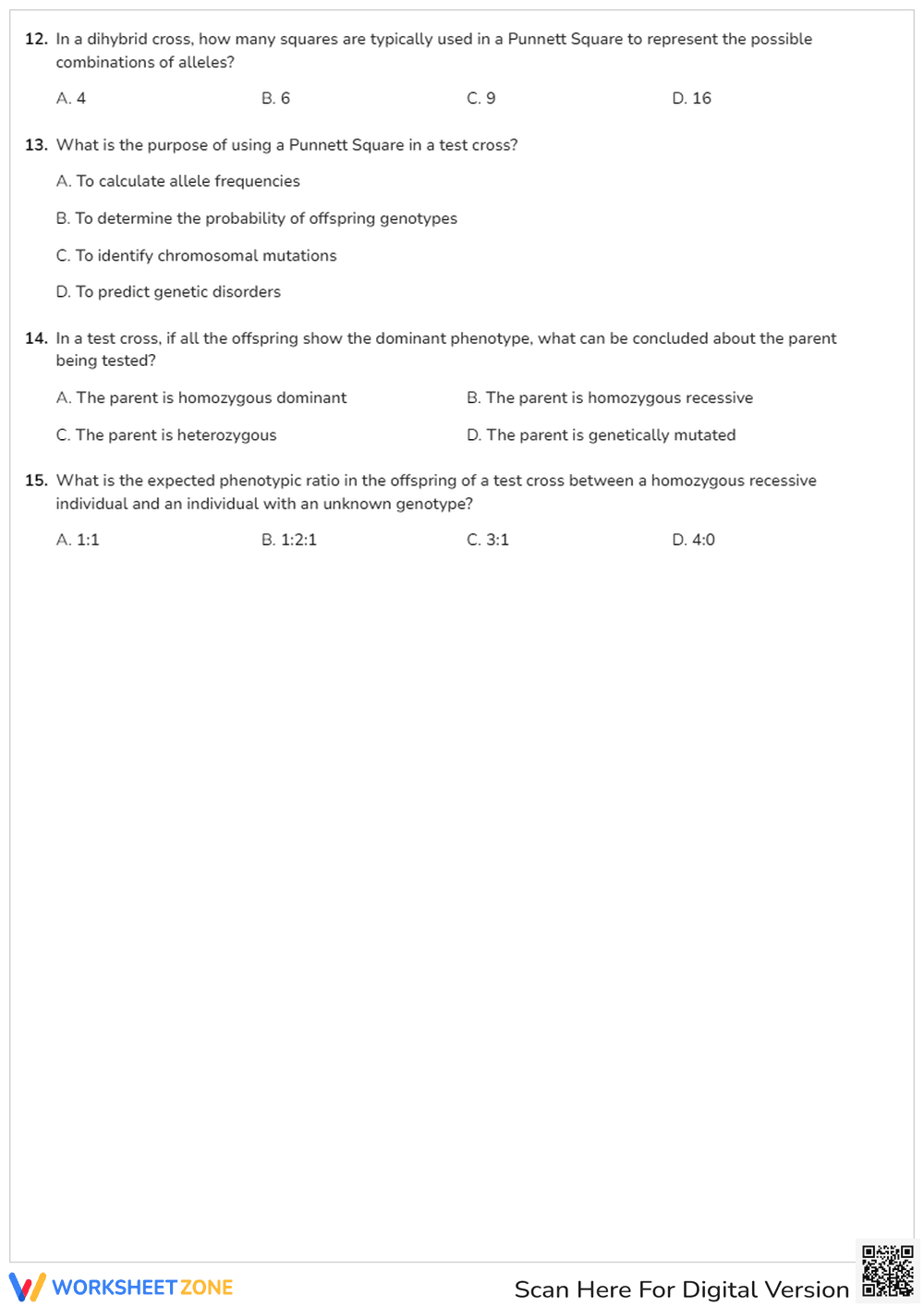
This middle school science worksheet provides targeted practice to help students master genetic inheritance and probability. By working through these targeted questions, eighth graders will confidently predict offspring genotypes and phenotypes using monohybrid and dihybrid crosses, solidifying their foundational understanding of Mendelian genetics.
At a Glance
- Grade: 8 · Subject: Science
- Standard:
MS-LS3-2— Use a model to describe how sexual reproduction results in genetic variation.- Skill Focus: Punnett Squares & Genetic Crosses
- Format: 2 pages · 15 problems · Answer key included · PDF
- Best For: Independent practice or formative assessment
- Time: 15–25 minutes
This two-page resource features 15 multiple-choice questions that thoroughly assess student comprehension of genetic principles. The task types range from identifying basic vocabulary, such as alleles and gametes, to calculating specific phenotypic and genotypic ratios for both monohybrid and dihybrid crosses. The straightforward layout minimizes distractions, while the included answer key ensures quick and accurate grading for educators.
Skill Progression
- Guided practice: The initial questions focus on foundational vocabulary and the basic purpose of a Punnett square, allowing students to activate prior knowledge with minimal cognitive load.
- Supported practice: Students transition into applying concepts, determining gametes for specific genotypes, and identifying standard ratios for heterozygous crosses.
- Independent practice: The final section challenges learners with dihybrid crosses and test cross scenarios, requiring higher-order application of independent assortment principles.
This structured approach mirrors the I Do, We Do, You Do gradual-release model, ensuring students build confidence before tackling complex genetic probabilities.
Standards Alignment
This resource is directly aligned to MS-LS3-2: Develop and use a model to describe why asexual reproduction results in offspring with identical genetic information and sexual reproduction results in offspring with genetic variation. By utilizing Punnett squares as predictive models, students demonstrate exactly how alleles combine to create diverse traits. Both standard codes can be copied directly into lesson plans, IEP goals, or district curriculum mapping tools.
How to Use It
Deploy this worksheet immediately after direct instruction on Mendelian genetics to reinforce new concepts. It serves perfectly as a 20-minute independent classwork assignment or a structured homework task. For a formative assessment observation tip, circulate the room while students work on the dihybrid cross questions; watch to see if they correctly identify the 16-square requirement, which quickly indicates their grasp of independent assortment.
Who It's For
This material is designed for general education eighth-grade science students studying heredity and genetics. To support learners who need accommodations, teachers can reduce the number of answer choices or provide a completed monohybrid cross as a visual reference. It pairs excellently with a hands-on trait-flipping coin lab or a visual anchor chart detailing dominant and recessive alleles.
Mastering genetic models requires repeated, structured exposure to probability scenarios. Aligned with MS-LS3-2, this resource requires students to use a model to describe how sexual reproduction results in genetic variation. According to a ScienceDirect TpT Analysis, explicit instruction combined with targeted multiple-choice practice significantly improves student retention of complex scientific vocabulary and abstract processes like allele segregation. When students actively calculate genotypic and phenotypic ratios, they transition from passive listeners to active scientific modelers. This specific sequence of 15 questions ensures that learners do not just memorize terms like heterozygous or homozygous, but actually apply them to predict biological outcomes. By integrating these foundational exercises into the science curriculum, educators provide the exact cognitive scaffolding necessary for long-term mastery of middle school heredity concepts.


