


























Views
Downloads


Essential Genetics Vocabulary Worksheet | Grade 7-10
Paste this activity's link or code into your existing LMS (Google Classroom, Canvas, Teams, Schoology, Moodle, etc.).
Students can open and work on the activity right away, with no student login required.
You'll still be able to track student progress and results from your teacher account.
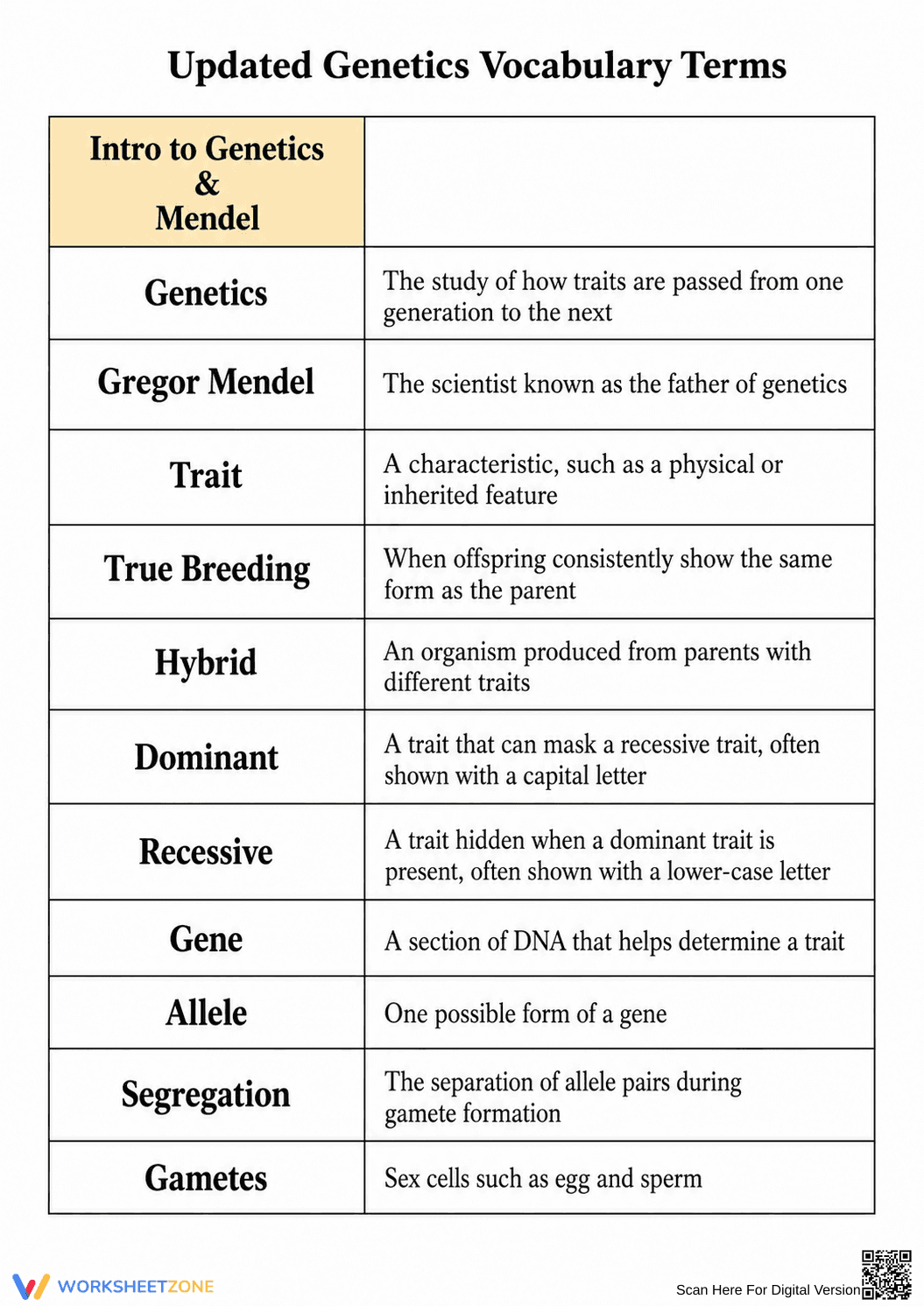
This genetics vocabulary worksheet provides a comprehensive glossary and practice set to help students master the foundational language of heredity. By connecting terms like alleles, genotypes, and phenotypes to their scientific definitions, learners build the conceptual framework necessary for complex Punnett square analysis and biological inquiry.
At a Glance
- Grade: 7-10 · Subject: Biology
- Standard:
MS-LS3-2— Describe why sexual reproduction results in offspring with genetic variation- Skill Focus: Genetics Vocabulary
- Format: 4 pages · 35 items · Answer key included · PDF
- Best For: Introductory biology units and test prep
- Time: 30–45 minutes
The resource contains three pages of detailed reference material and one page of independent practice. It covers Mendelian genetics, probability terms, and complex inheritance patterns like co-dominance and polygenic traits. The structured layout includes 24 pre-defined terms and 11 practice lines for student assessment, ensuring students have a reliable reference before being tested on their knowledge.
This resource is designed for immediate classroom implementation. Teachers can print the PDF in 30 seconds, distribute the glossary as a reference tool in 1 minute, and assign the final page for a 15-minute formative check. Total teacher prep time is under 2 minutes, making it an ideal sub plan or a quick addition to a busy lesson block. The clear headings and organized tables allow students to work through the material with minimal teacher intervention.
Aligned to `MS-LS3-2`, this worksheet focuses on the terminology required to explain genetic variation. It also supports high school standards by clarifying the relationship between DNA, genes, and chromosomes. Both standard codes can be copied directly into lesson plans, IEP goals, or district curriculum mapping tools to ensure all instructional minutes are accounted for in your tracking systems.
Use this as a front-loading tool before starting a unit on Punnett squares to ensure students understand the difference between homozygous and heterozygous. Alternatively, use the final page as an exit ticket to gauge retention after a lecture on Mendel’s Principles. Expected completion time for the full packet ranges from 30 to 45 minutes depending on the depth of discussion. Teachers should observe students during the practice phase to identify common misconceptions between genotype and phenotype.
This is designed for middle school life science and high school biology students. It is particularly effective for English Language Learners (ELL) who require explicit vocabulary support and clear definitions. Pair this with a Punnett square practice sheet or a direct instruction lesson on Mendelian inheritance for a complete, high-impact instructional sequence.
According to research by Fisher & Frey (2014), explicit vocabulary instruction is a critical component of disciplinary literacy in science. This worksheet addresses that need by providing clear, concise definitions for 24 high-frequency genetics terms, including the Principle of Independent Assortment and Polygenic Traits. By moving from a provided glossary to independent definition writing, the resource follows a scaffolded approach that supports long-term retention of complex biological concepts. The inclusion of Mendel’s Principles ensures that students are not just memorizing words but are understanding the laws that govern heredity. This alignment with MS-LS3-2 provides the necessary scaffolding for students to eventually model genetic variation. Such structured vocabulary tools are essential for bridging the gap between basic observation and the high-level scientific reasoning required by modern standards like the NGSS and NAEP frameworks.


