


























Views
Downloads

Essential Genetics Vocabulary Worksheet | Grade 7-10 Ready
Paste this activity's link or code into your existing LMS (Google Classroom, Canvas, Teams, Schoology, Moodle, etc.).
Students can open and work on the activity right away, with no student login required.
You'll still be able to track student progress and results from your teacher account.
Students often struggle with the distinction between genotype and phenotype during introductory biology units. This worksheet provides a structured environment to master these essential heredity terms through active categorization and visual modeling. By the end of these two pages, learners will confidently identify dominant, recessive, and codominant traits within Punnett squares and narrative texts.
At a Glance
- Grade: 6–10 · Subject: Science / Biology
- Standard:
MS-LS3-2— Develop and use models to describe how sexual reproduction results in genetic variation.- Skill Focus: Genetics terminology and Punnett square shading
- Format: 2 pages · 33 problems · Answer key included · PDF
- Best For: Independent practice or emergency sub plans
- Time: 30–45 minutes
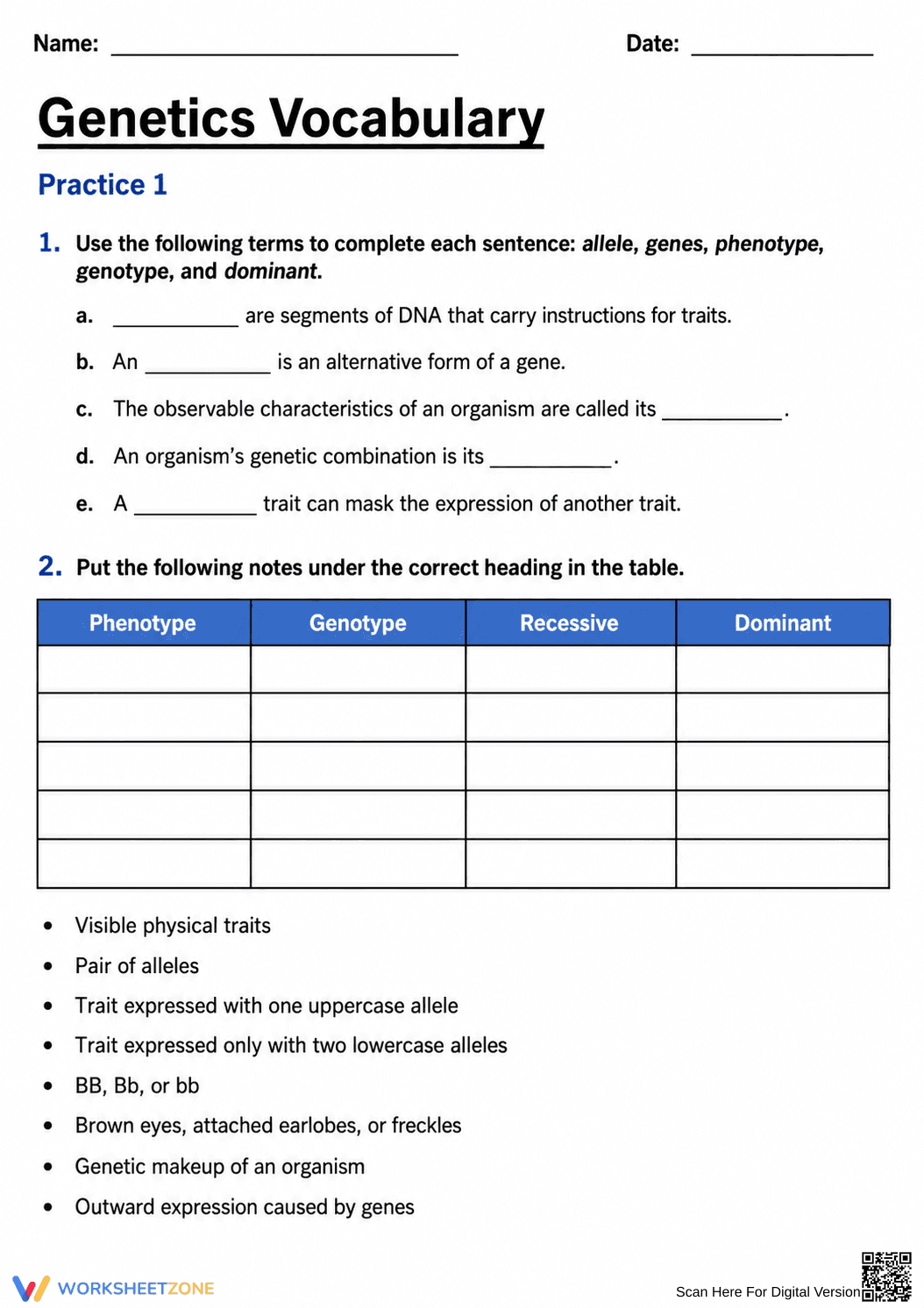
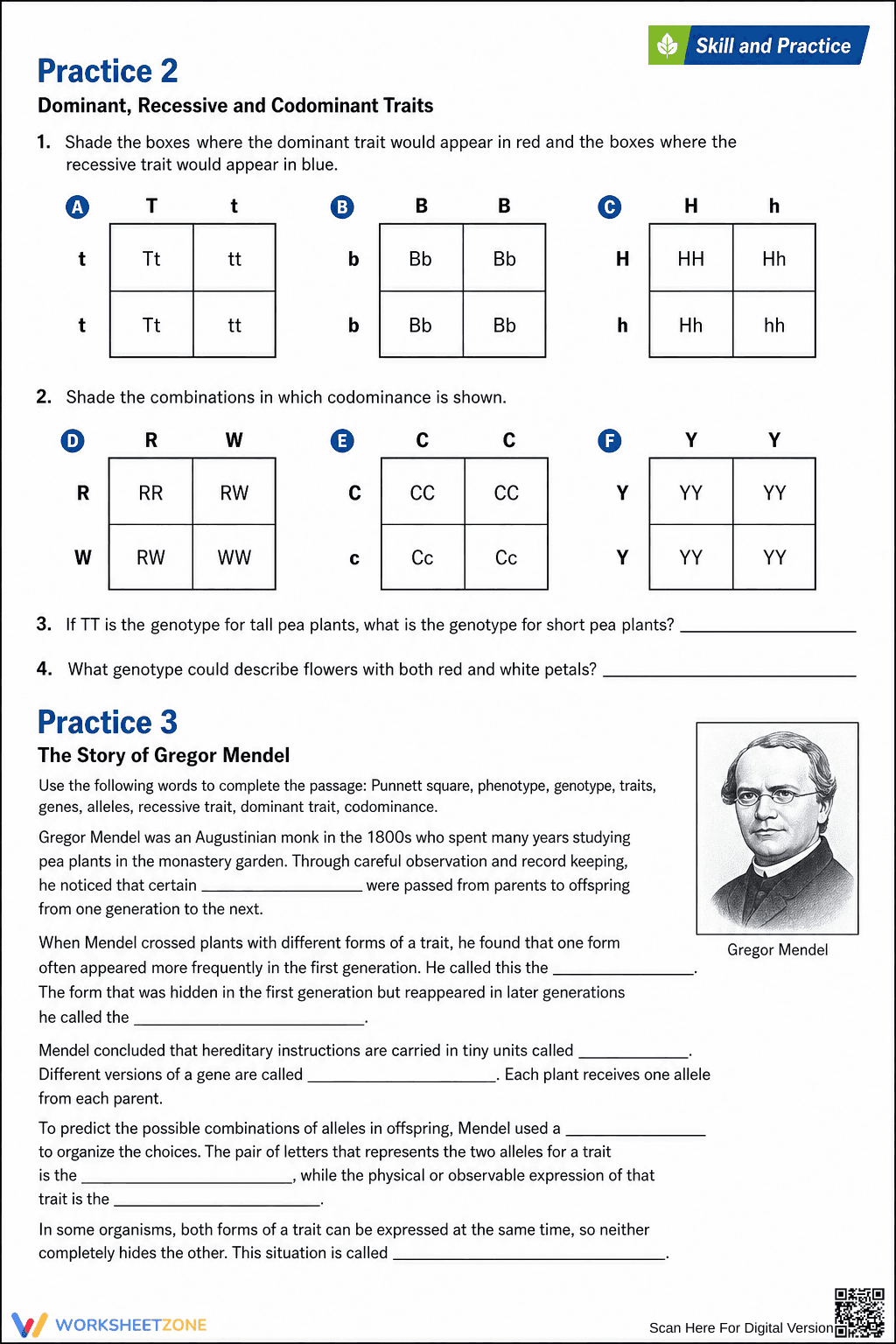
This resource features 33 tasks divided into three practice modules. Section one utilizes a targeted word bank for definition matching and a sorting table for phenotypic and genotypic traits. Section two moves into visual modeling, requiring students to shade Punnett squares to identify trait expression. The final section features a biography of Gregor Mendel for a technical cloze passage.
Zero-Prep Workflow
- Print (1 Minute): Select the two-page PDF and print copies for your roster. No additional materials are required.
- Distribute (1 Minute): Hand out the sheets as a bell-ringer or independent practice for your heredity lesson.
- Review (5 Minutes): Use the included answer key for a rapid whole-class check or peer-grading.
This resource is an ideal choice for high-quality sub plans or reinforcement activities.
Standards Alignment: This resource aligns to `MS-LS3-2`, focusing on genetic variation. It also supports `HS-LS3-3` by using probability to explain trait distribution. Both standard codes can be copied directly into lesson plans, IEP goals, or curriculum mapping tools.
How to Use It: Use this during the "You Do" phase of a gradual release model, following instruction on Mendelian genetics. For formative assessment, walk the room during Section 2; students struggling to shade boxes often have misconceptions about homozygous versus heterozygous genotypes. Expect completion within 45 minutes.
Who It's For: This resource is for middle school life science and high school biology students. It provides scaffolding for general education while maintaining rigor for honors courses. It pairs naturally with a Punnett square anchor chart or a video on Mendel's experiments.
According to research by Fisher & Frey (2014), the acquisition of domain-specific vocabulary is a primary predictor of success in secondary science. This worksheet addresses that need by requiring students to move beyond rote memorization into the application of terms like codominance within visual models. By integrating a biographical narrative of Gregor Mendel, the resource reinforces the historical context of scientific discovery, aligning with the Nature of Science (NOS) tenets in the NGSS framework. The 33 tasks provided offer sufficient repetition to move these terms from short-term memory into long-term conceptual understanding. This structured approach ensures that students are not just reading about genetics but are actively manipulating the language of the field to solve problems and describe biological phenomena accurately. This resource serves as a reliable tool for building the foundational literacy required for complex genetic engineering and biotechnology units later in the curriculum.


