


























Views
Downloads

Genetics Vocabulary Worksheet (3 Levels) | Grade 7 Ready
Paste this activity's link or code into your existing LMS (Google Classroom, Canvas, Teams, Schoology, Moodle, etc.).
Students can open and work on the activity right away, with no student login required.
You'll still be able to track student progress and results from your teacher account.
This genetics vocabulary worksheet provides tiered practice for students to master essential biological terms. By matching definitions to key concepts like alleles, genotypes, and codominance, learners build the foundational literacy required for complex heredity units. It ensures students can accurately communicate scientific findings regarding inheritance and genetic variation.
At a Glance
- Grade: 7–10 · Subject: Biology
- Standard:
MS-LS3-1— Define and use specific terminology to describe gene structure and inheritance- Skill Focus: Genetics Vocabulary
- Format: 3 pages · 18 problems · Answer key included · PDF
- Best For: Tiered vocabulary instruction and review
- Time: 15–25 minutes
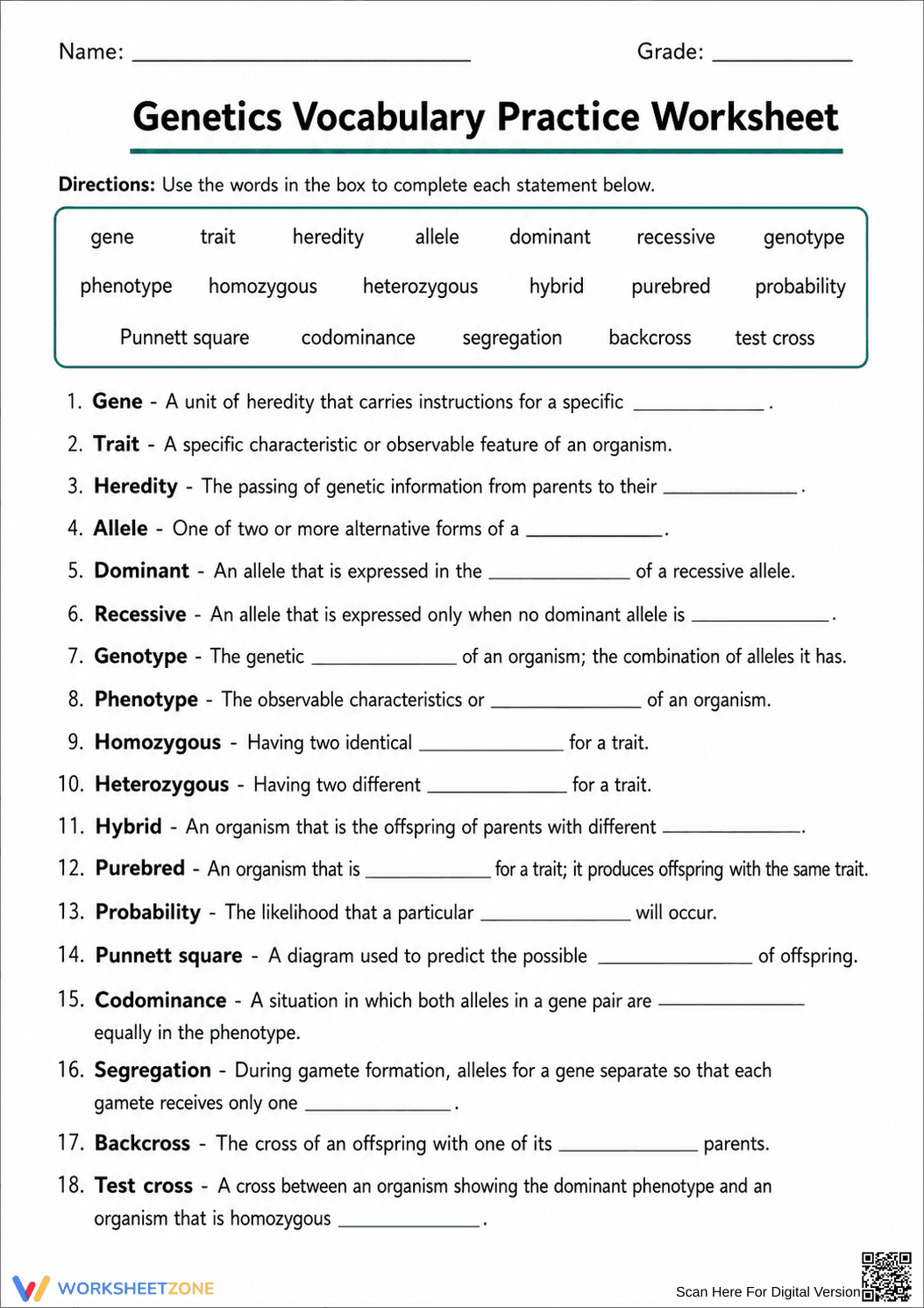
What's Inside: The download contains three distinct versions of the practice set. The most comprehensive version features 18 high-level terms including Punnett squares, codominance, and test crosses. Each page includes a clear word bank and structured sentence-completion tasks. The layout is designed for clarity, with ample space for student writing and a professional, distraction-free aesthetic.
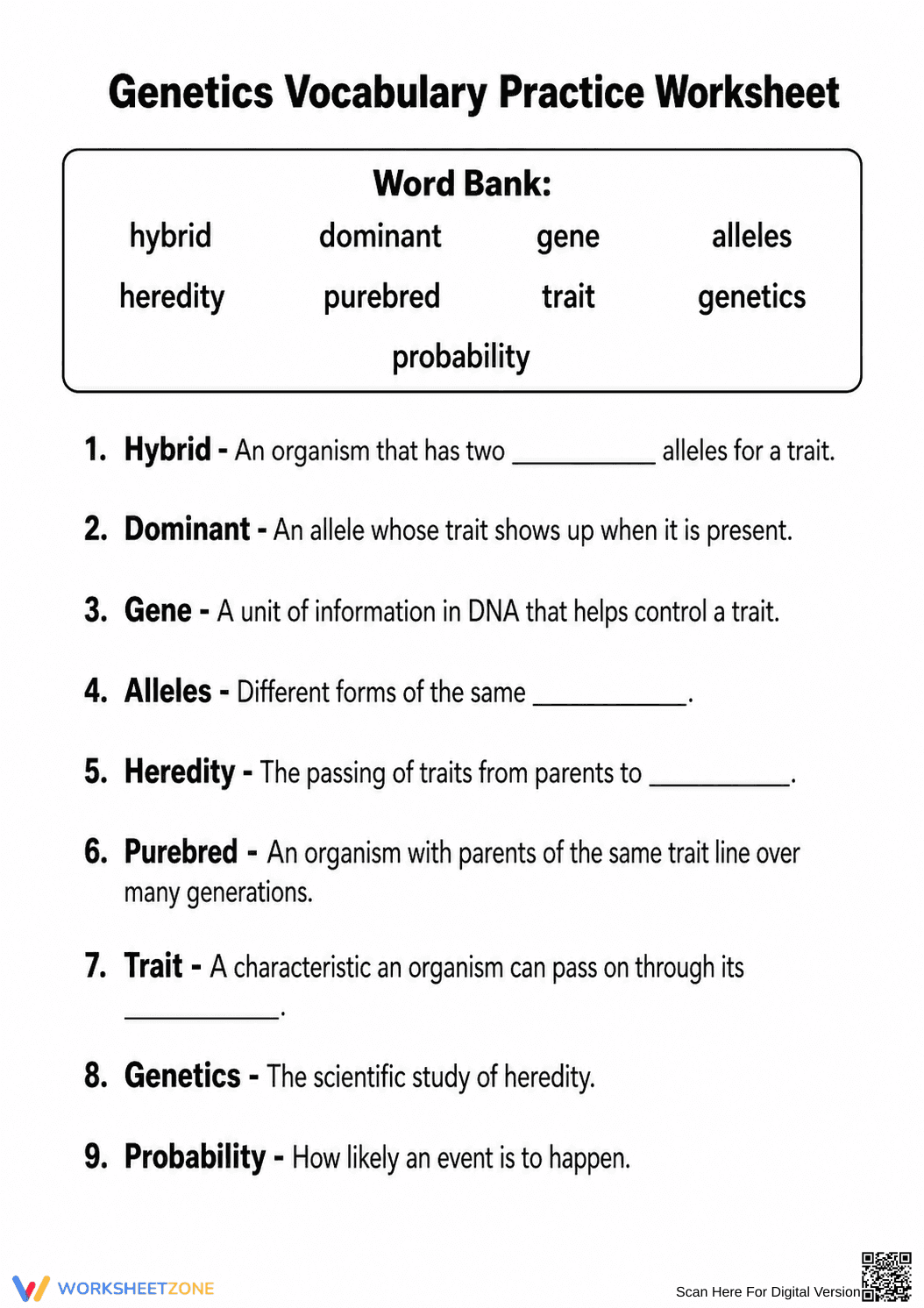
- Below Grade: Focuses on 9 foundational terms like gene, trait, and heredity with simplified definitions and high-frequency visual cues.
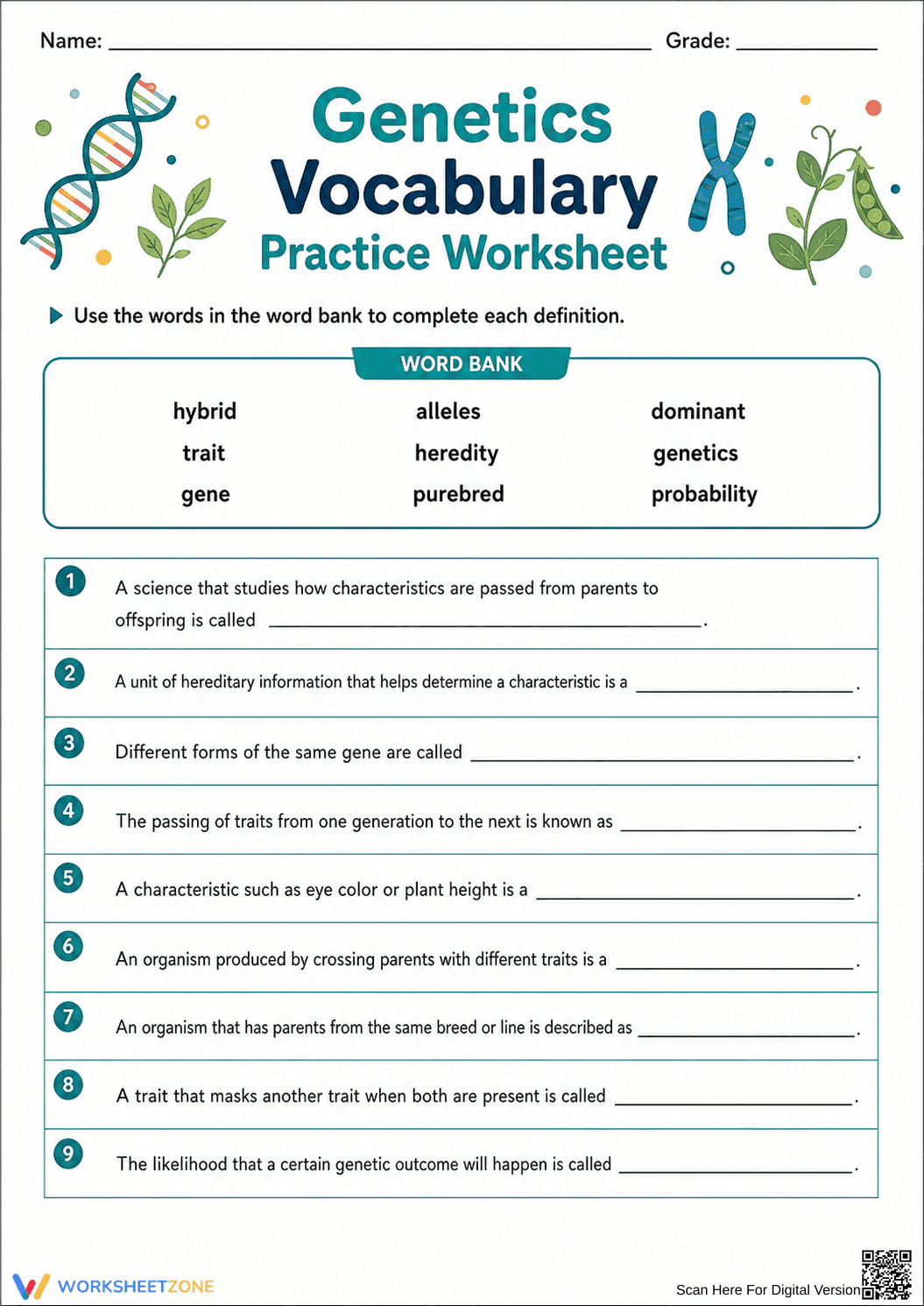
- On Grade: Expands to 12-15 terms, introducing the distinction between genotype and phenotype and the mechanics of probability in inheritance.
- Above Grade: Challenges students with 18 complex concepts, including backcross, segregation, and specific inheritance patterns like codominance.
Standards Alignment: This resource is aligned to MS-LS3-1, which requires students to understand how structural changes to genes located on chromosomes affect organisms. Mastery of this vocabulary is a prerequisite for explaining the relationship between genes and proteins. Both standard codes can be copied directly into lesson plans, IEP goals, or district curriculum mapping tools.
How to Use It: Use the basic version as a pre-assessment before starting your heredity unit to gauge prior knowledge. Assign the advanced version as a summative vocabulary check or a fast-finisher extension for students who demonstrate early mastery of Mendelian genetics. Expect students to complete the 18-item set in approximately 20 minutes.
Who It's For: This resource is ideal for middle and high school life science students, including English Language Learners (ELL) who benefit from the word bank scaffolds. It pairs naturally with a Punnett square anchor chart or a direct instruction lesson on Gregor Mendel’s experiments.
According to the RAND AIRS 2024 report, explicit vocabulary instruction in science is a critical factor in closing the achievement gap for secondary students. This worksheet addresses MS-LS3-1 by providing the linguistic scaffolding necessary for students to describe complex genetic interactions. By utilizing a tiered approach, educators can ensure that all students—regardless of their starting point—gain the technical fluency required for high-stakes biology assessments. Research from Fisher & Frey (2014) emphasizes that word banks and cloze activities are effective tools for reinforcing domain-specific language in the sciences. This 3-level resource provides 18 distinct opportunities for students to engage with the language of genetics, ensuring that the transition from basic heredity to complex inheritance patterns is supported by a robust conceptual vocabulary.


