


























Views
Downloads


Printable Genetics Vocabulary Worksheet | Grade 9 Science
Paste this activity's link or code into your existing LMS (Google Classroom, Canvas, Teams, Schoology, Moodle, etc.).
Students can open and work on the activity right away, with no student login required.
You'll still be able to track student progress and results from your teacher account.
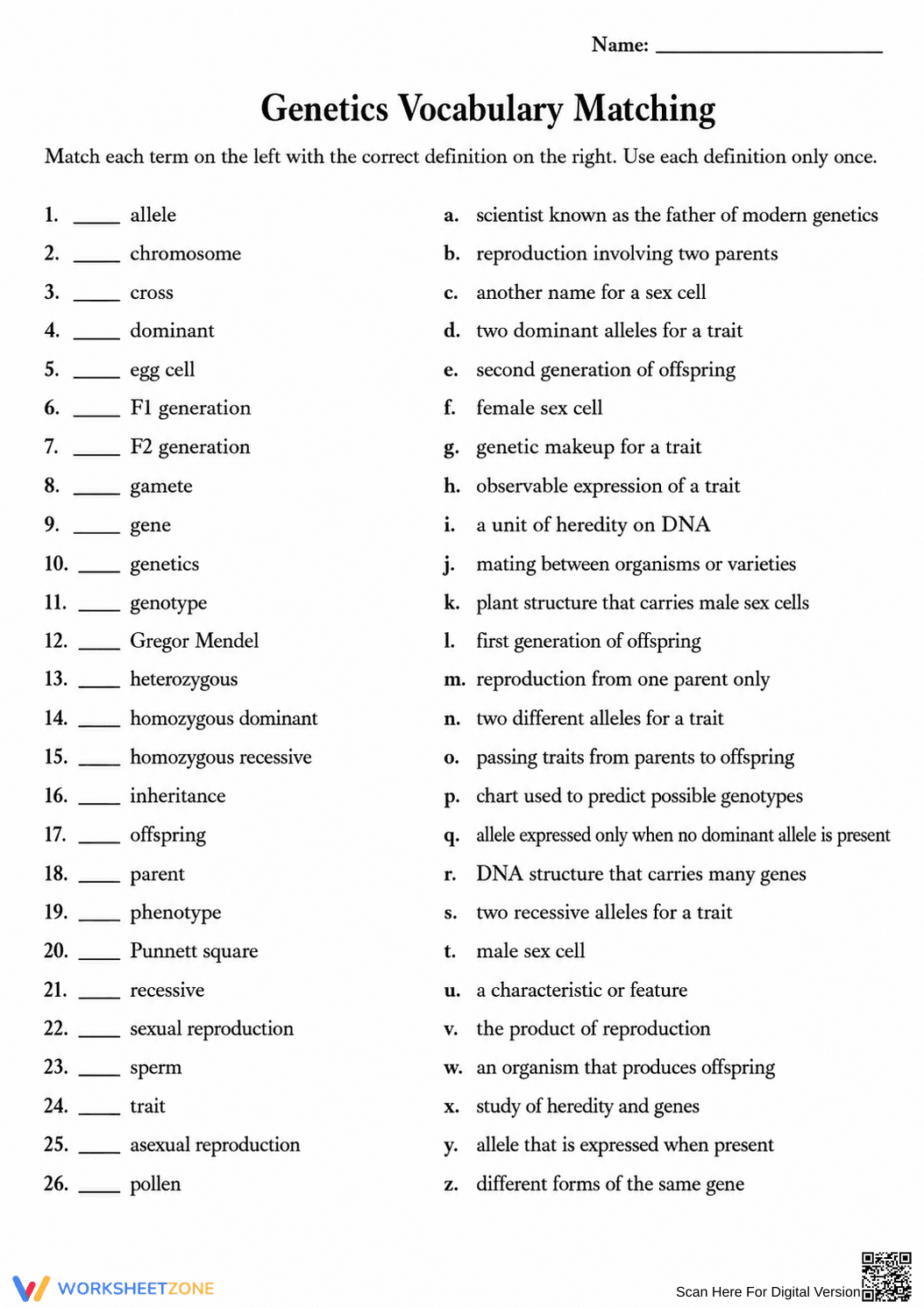
This genetics vocabulary worksheet equips students with the terminology needed to master heredity. By matching key terms to precise definitions, learners build the academic language required to analyze genetic inheritance and cellular reproduction.
At a Glance
- Grade: 9 · Subject: Biology
- Standard:
HS-LS3-1— Understand the role of DNA and chromosomes in traits- Skill Focus: Genetics vocabulary matching
- Format: 2 pages · 52 problems · Answer key included · PDF
- Best For: Independent practice and sub plans
- Time: 20–30 minutes
This two-page resource features 52 matching tasks across two sections. Students pair genetics terms—like allele, chromosome, heterozygous, and meiosis—with their corresponding definitions. A complete answer key is included to ensure accurate grading and provide immediate feedback.
Designed for maximum efficiency, this zero-prep resource streamlines your workflow:
- Print (1 minute): Download the PDF and print the student handout.
- Distribute (1 minute): Hand out the worksheets or leave them for a substitute teacher.
- Review (5 minutes): Use the answer key to quickly verify responses.
With under two minutes of total teacher prep time, this is an ideal emergency sub plan.
This activity aligns to HS-LS3-1: Ask questions to clarify relationships about the role of DNA and chromosomes in coding instructions for traits. By mastering these terms, students prepare for complex genetic modeling. Both standard codes can be copied directly into lesson plans, IEP goals, or district curriculum mapping tools.
Use this matching activity as an introductory homework assignment before direct instruction on Mendelian genetics, or as a formative assessment. As students work, observe whether they struggle to differentiate between related terms like genotype and phenotype. This allows you to clarify misconceptions immediately. Expected completion time is 20 to 30 minutes.
Designed for high school biology and advanced middle school life science students, this worksheet provides essential scaffolding for English Language Learners. Pair this resource with a visual anchor chart detailing dominant and recessive traits to support diverse needs.
Mastering scientific terminology is a critical prerequisite for conceptual understanding in secondary science courses. This worksheet directly aligns with HS-LS3-1, helping students understand the role of DNA and chromosomes in traits by securing their foundational vocabulary before moving to application. According to Fisher & Frey (2014), explicit vocabulary instruction and repeated exposure to academic language significantly improve reading comprehension and content retention in complex subjects like biology. By engaging in these targeted matching exercises, students move beyond rote memorization to active recall, strengthening their cognitive pathways for long-term memory. This structured approach ensures that learners can confidently navigate the rigorous demands of high school genetics, ultimately leading to higher achievement in scientific literacy and analytical reasoning. Providing students with clear, organized vocabulary practice is an evidence-based strategy that supports long-term academic success across all STEM disciplines.


