




























Views
Downloads

Printable Binomial Theorem Worksheet | Grade 11 Math

Paste this activity's link or code into your existing LMS (Google Classroom, Canvas, Teams, Schoology, Moodle, etc.).
Students can open and work on the activity right away, with no student login required.
You'll still be able to track student progress and results from your teacher account.
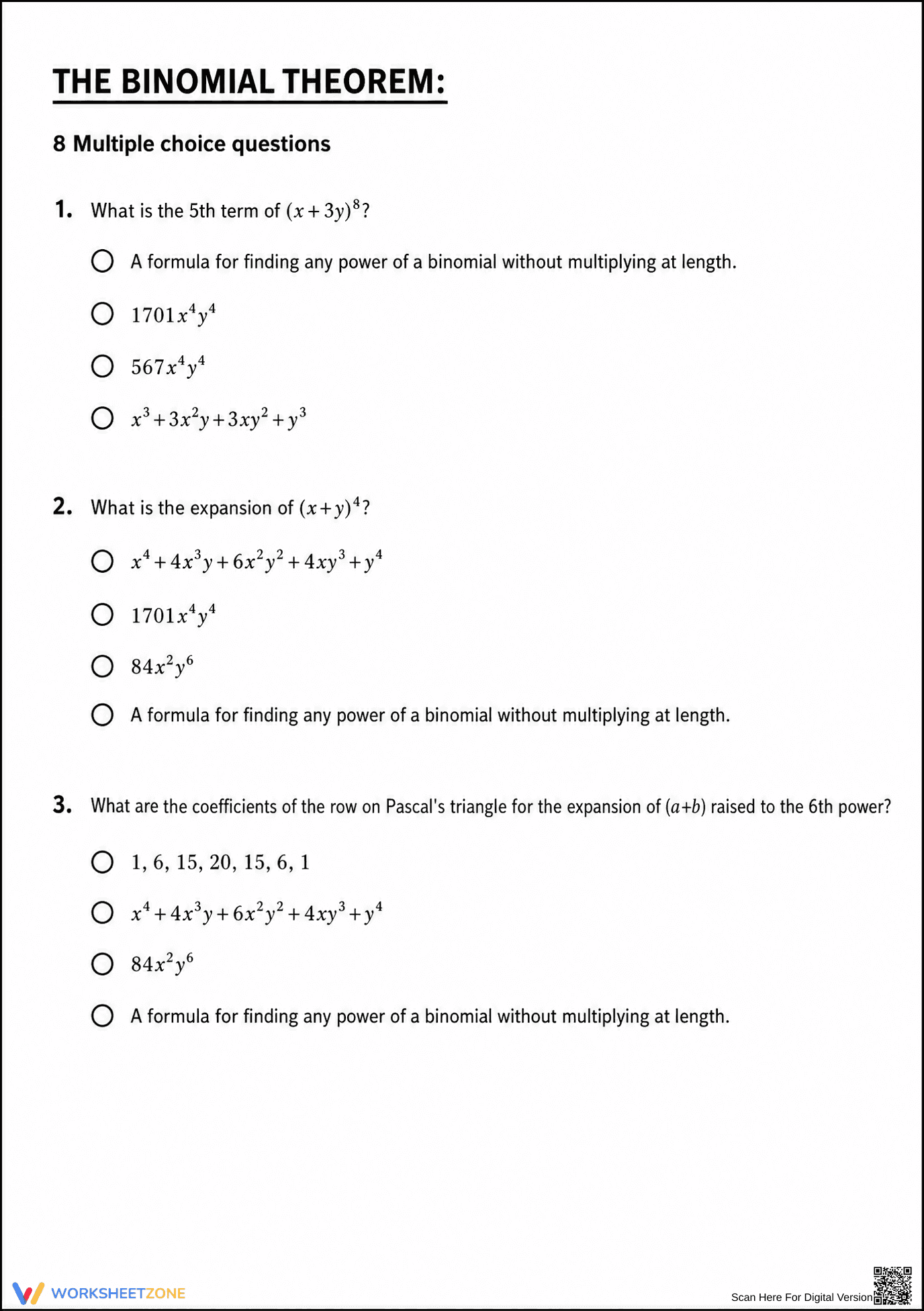
This focused math worksheet provides high school students with targeted practice on the Binomial Theorem and Pascal's Triangle. By working through these specific problems, learners will develop the algebraic fluency needed to expand complex binomials and identify specific terms without having to multiply expressions out fully.
At a Glance
- Grade: 11 · Subject: Algebra
- Standard:
HSA.APR.C.5— Apply the Binomial Theorem to expand binomials- Skill Focus: Binomial Theorem and Pascal's Triangle
- Format: 3 pages · 8 problems · Answer key included · PDF
- Best For: Independent practice or quiz
- Time: 20–30 minutes
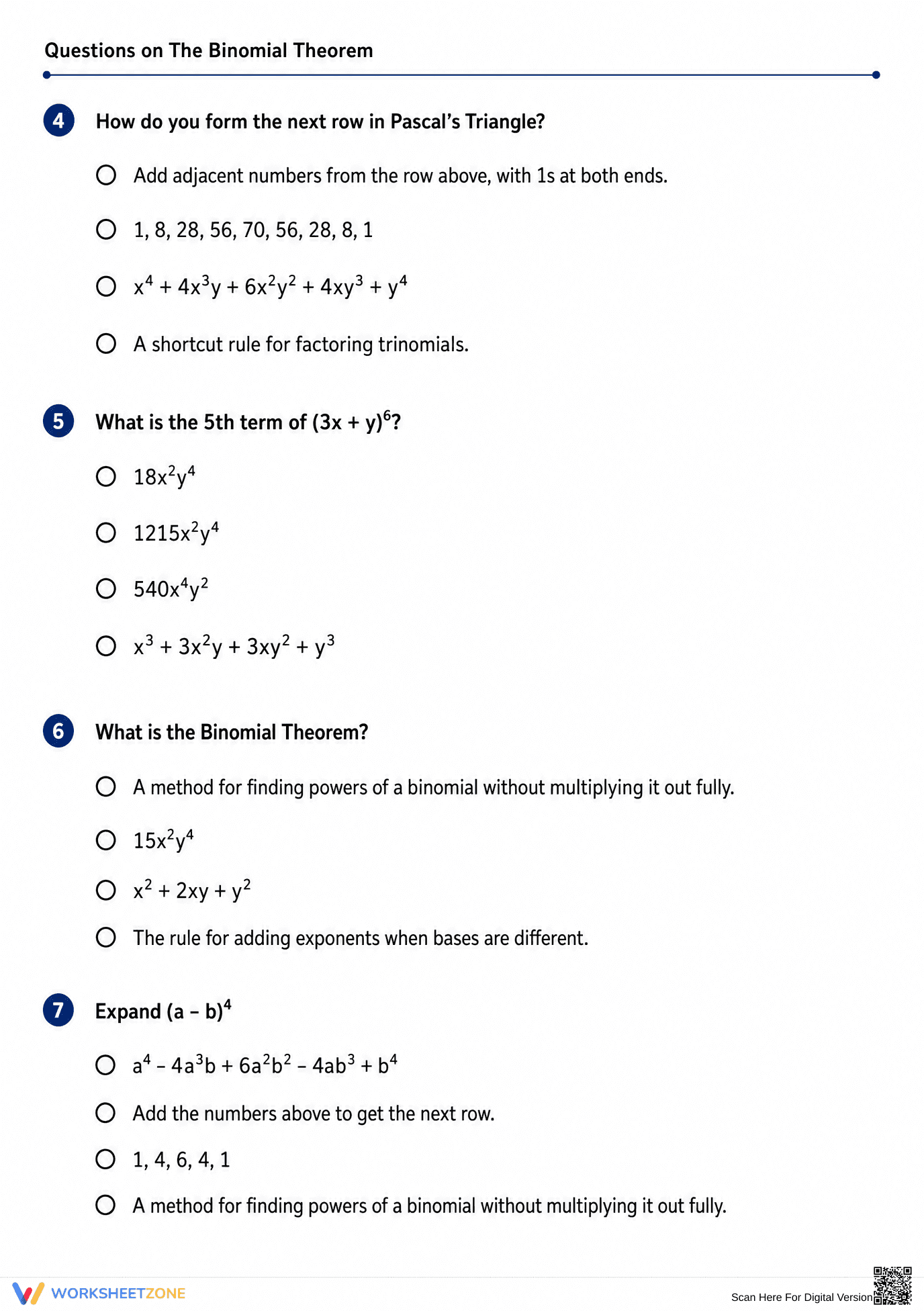
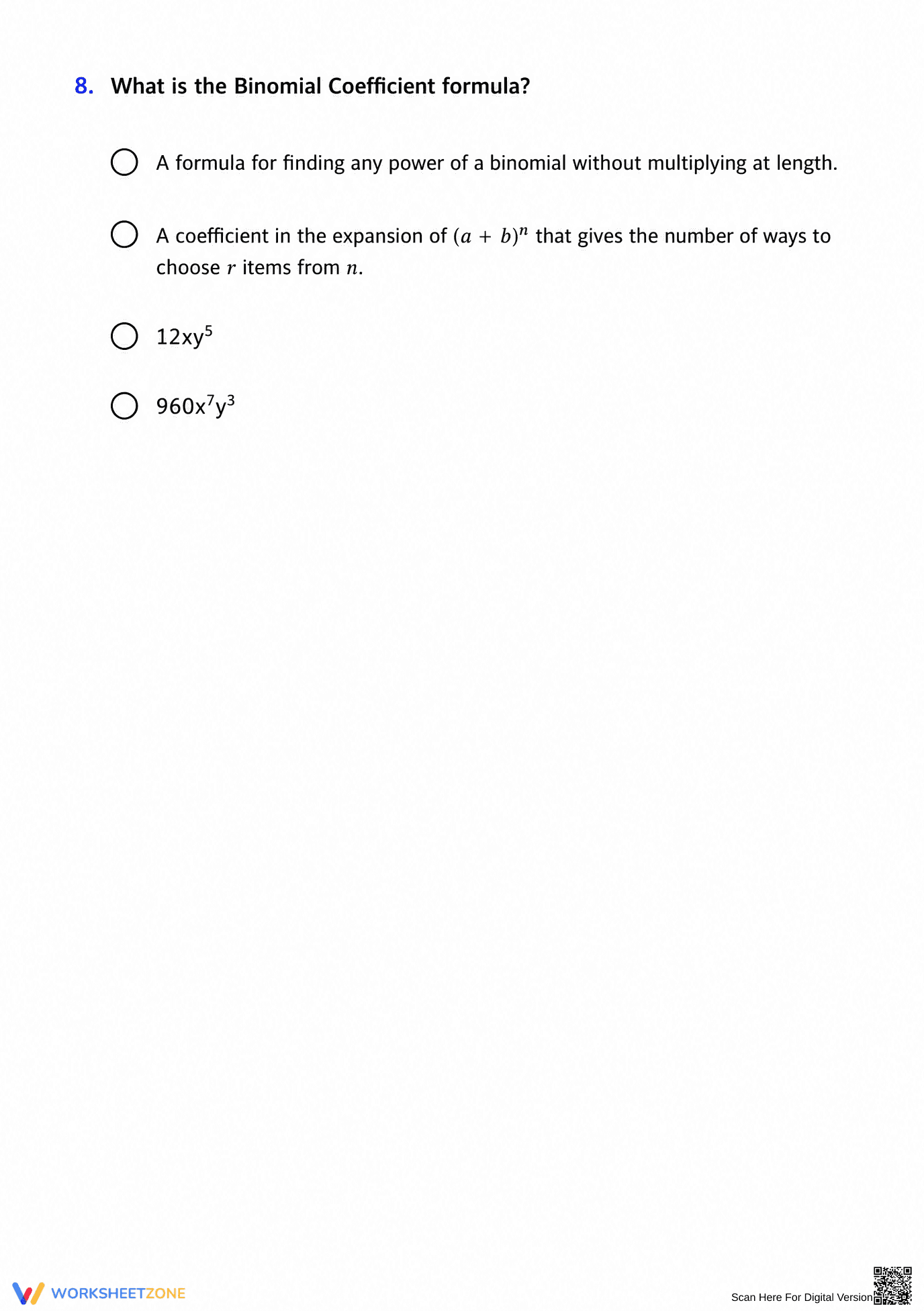
Inside this resource, educators will find a streamlined three-page assessment featuring eight multiple-choice questions. The tasks require students to calculate specific terms within a binomial expansion, determine full expansions of given expressions, and identify correct rows within Pascal's Triangle. A complete answer key is included to ensure fast and accurate grading for teachers.
Skill Progression
- Guided practice: The initial questions focus on foundational vocabulary and the basic structure of Pascal's Triangle, allowing students to warm up their conceptual understanding.
- Supported practice: Mid-level problems ask students to find specific terms (like the 4th or 5th term) of a binomial expansion, requiring targeted application of the formula.
- Independent practice: The final tasks challenge students to fully expand expressions such as (a - b)^4, demonstrating complete mastery of the theorem.
This gradual-release approach ensures students build confidence as they move from basic definitions to complex algebraic calculations.
Standards Alignment
This worksheet is directly aligned to CCSS.MATH.CONTENT.HSA.APR.C.5: Know and apply the Binomial Theorem for the expansion of (x + y)^n in powers of x and y for a positive integer n. It also reinforces foundational polynomial operations. Both standard codes can be copied directly into lesson plans, IEP goals, or district curriculum mapping tools.
How to Use It
Teachers can deploy this worksheet as a formative assessment immediately following direct instruction on the Binomial Theorem. It serves perfectly as a 20-minute independent practice activity or a Friday quiz. While students work, teachers should observe whether they are correctly applying the combination formula or relying on Pascal's Triangle, intervening if signs are dropped during expansions with negative terms.
Who It's For
This resource is designed for Grade 11 and Grade 12 students enrolled in Algebra 2, Pre-Calculus, or College Prep Math. To support learners who might struggle with the abstract formula, provide a printed copy of Pascal's Triangle as a differentiation tool. It pairs excellently with introductory lessons on polynomial identities and combinatorics.
Mastering the Binomial Theorem is a critical stepping stone for advanced mathematics, particularly in calculus and probability. According to EdReports 2024, instructional materials that provide focused, standard-aligned practice on complex algebraic concepts significantly improve student retention and procedural fluency. This worksheet directly targets HSA.APR.C.5, ensuring students can confidently apply the Binomial Theorem to expand binomials. By isolating this specific skill through targeted multiple-choice questions, educators can quickly identify misconceptions related to coefficients, exponents, or the application of Pascal's Triangle. Regular practice with these algebraic structures reduces cognitive load during higher-level problem-solving tasks, allowing students to focus on broader mathematical applications. Integrating this targeted practice into the daily curriculum ensures that high school learners build the rigorous mathematical foundation required for college readiness, standardized testing success, and future advanced STEM coursework.


