


























Views
Downloads

Lowercase Letter z Worksheet | Essential Grade K ELA
Paste this activity's link or code into your existing LMS (Google Classroom, Canvas, Teams, Schoology, Moodle, etc.).
Students can open and work on the activity right away, with no student login required.
You'll still be able to track student progress and results from your teacher account.
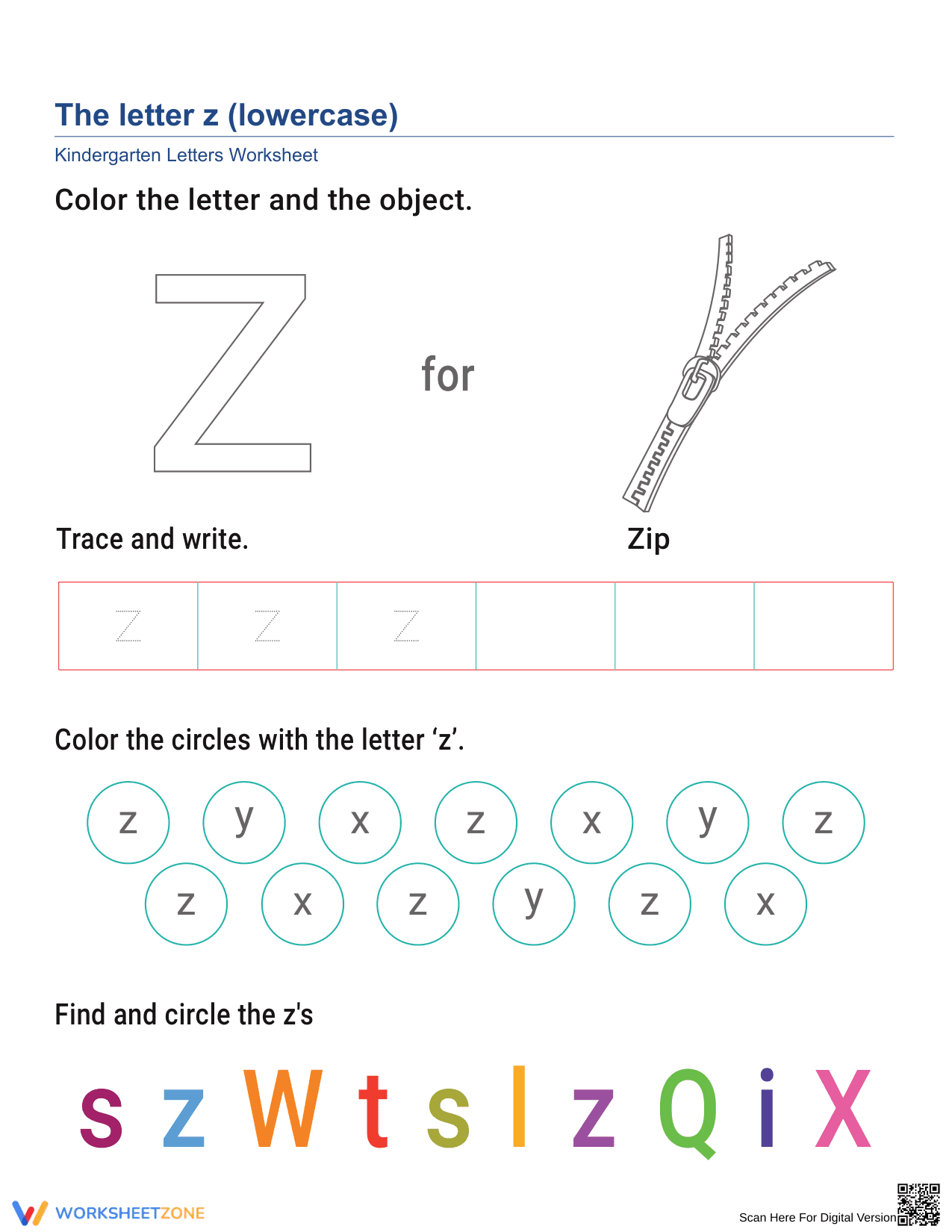
This Kindergarten lowercase letter z worksheet helps early learners master letter recognition and fine motor control. Students engage with the letter through multi-sensory activities including coloring, tracing, and visual discrimination. By completing these tasks, children build the foundational phonics skills necessary for reading fluency and confident handwriting.
At a Glance
- Grade: Kindergarten · Subject: ELA
- Standard:
CCSS.ELA-LITERACY.RF.K.1.D— Recognize and name all upper- and lowercase letters of the alphabet- Skill Focus: Lowercase letter z recognition
- Format: 1 page · 4 tasks · Answer key included · PDF
- Best For: Initial letter introduction and handwriting practice
- Time: 10–15 minutes
What's Inside
This single-page PDF features four distinct sections designed to reinforce the letter z. It includes a large coloring graphic for the letter and a "zip" illustration, a dedicated tracing and writing row with 5 practice boxes, a circle-identification grid, and a mixed-font letter string for advanced visual discrimination. A clear answer key is provided for quick grading.
Skill Progression
- Guided practice: Students begin by coloring a large lowercase z and a "zip" illustration to build phonemic association and hand strength.
- Supported practice: Three tracing prompts provide a scaffold for letter formation before transitioning to two independent writing boxes for production.
- Independent practice: Two discrimination tasks require students to identify the letter z among 12 circles and a mixed-letter string containing distractors.
This sequence follows a gradual-release model to ensure students move from simple recognition to independent production and identification.
Standards Alignment
This resource aligns with CCSS.ELA-LITERACY.RF.K.1.D: "Recognize and name all upper- and lowercase letters of the alphabet." It specifically targets the lowercase form, which is essential for reading fluency. This standard code can be copied directly into lesson plans, IEP goals, or district curriculum mapping tools.
How to Use It
Use this worksheet during the "You Do" phase of a phonics lesson after introducing the letter sound. It works well as a morning work assignment or a literacy center rotation. For formative assessment, observe if students can distinguish the lowercase z from the letter x in the final identification task. Completion typically takes 10 to 15 minutes.
Who It's For
This worksheet is designed for Preschool and Kindergarten students beginning their alphabet journey. It is also suitable for Grade 1 students requiring RTI support or fine motor intervention. Pair this resource with a letter z anchor chart or a tactile sand-tracing activity for a comprehensive instructional approach.
Early literacy research emphasizes that lowercase letter recognition is a stronger predictor of future reading success than uppercase mastery, as lowercase letters comprise the majority of printed text. This worksheet targets CCSS.ELA-LITERACY.RF.K.1.D by requiring students to isolate the lowercase "z" from similar visual distractors like "x" and "y." According to Fisher & Frey (2014), the gradual release of responsibility—moving from guided coloring and tracing to independent identification—is essential for cementing orthographic mapping in young brains. By providing four distinct modalities of interaction, this resource ensures that students develop both the fine motor skills for writing and the visual processing speed required for fluent decoding. The inclusion of a concrete keyword like "zip" further strengthens the letter-sound connection, providing a holistic approach to alphabet instruction that fits easily into any phonics-based curriculum or intervention block.


