


























Views
Downloads

Printable Letter Z Tracing Worksheet | Grade K ELA
Paste this activity's link or code into your existing LMS (Google Classroom, Canvas, Teams, Schoology, Moodle, etc.).
Students can open and work on the activity right away, with no student login required.
You'll still be able to track student progress and results from your teacher account.
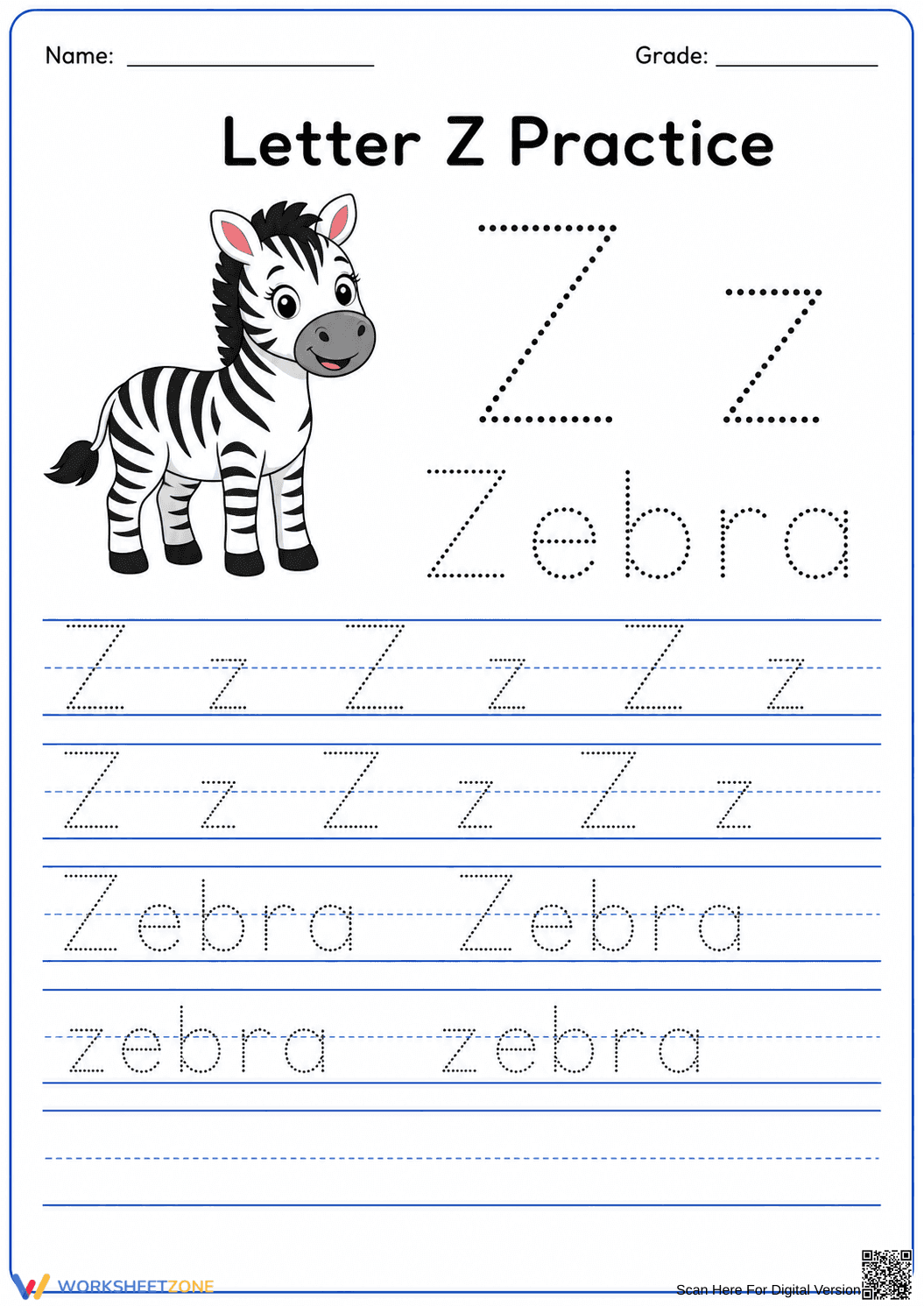
This printable letter Z tracing worksheet helps early learners develop essential fine motor skills and letter recognition. By practicing uppercase and lowercase Z, students build the foundational handwriting abilities required for fluent writing. The engaging zebra theme keeps young learners focused as they trace individual letters and complete words.
At a Glance
- Grade: K · Subject: ELA
- Standard:
CCSS.ELA-LITERACY.L.K.1.A— Print many upper- and lowercase letters- Skill Focus: Letter Z Tracing
- Format: 1 page · 20 problems · No answer key · PDF
- Best For: Morning work or centers
- Time: 10–15 minutes
Inside this single-page resource, educators will find a structured progression of handwriting tasks. The page begins with large, guided uppercase and lowercase Z models alongside a helpful zebra illustration. Students then move to standard primary-lined sections, completing approximately 20 tracing elements that include individual letters and the full word "Zebra." A final blank primary line offers space for independent, unguided practice.
This resource is designed for a highly efficient, zero-prep workflow:
- Print (1 minute): Simply download the PDF and print the required number of copies. The black-and-white design is ink-friendly and requires no special formatting.
- Distribute (1 minute): Hand out the sheets during morning arrival or transition times. The clear visual instructions mean students can begin immediately.
- Review (1 minute): Quickly scan completed pages to check for proper stroke order and line adherence. Total teacher prep time is under two minutes, making it an ideal addition to any emergency sub plan.
This handwriting practice is directly aligned to CCSS.ELA-LITERACY.L.K.1.A, which requires students to print many upper- and lowercase letters. The structured tracing lines support the spatial awareness necessary to meet this standard. Both standard codes can be copied directly into lesson plans, IEP goals, or district curriculum mapping tools.
Deploy this worksheet during morning work to establish a calm, focused routine right after the bell rings. Alternatively, use it as an independent literacy center activity while the teacher conducts small group guided reading. As students work, observe their pencil grip and stroke direction, offering immediate corrective feedback if they start the letter Z from the bottom instead of the top. Expect students to complete this activity in 10 to 15 minutes.
This resource is primarily designed for Kindergarten and early first-grade students mastering the alphabet. It also serves as an excellent intervention tool for older students requiring occupational therapy support or fine motor remediation. Pair this worksheet with a read-aloud book featuring zoo animals or an anchor chart demonstrating proper letter formation to reinforce the visual concepts.
Developing automaticity in handwriting is a critical component of early literacy that directly impacts future writing fluency and reading comprehension. According to Fisher & Frey (2014), explicit instruction and repeated practice in letter formation reduce the cognitive load required for transcription, allowing young writers to focus on idea generation and sentence structure. This targeted practice aligns with CCSS.ELA-LITERACY.L.K.1.A, ensuring students can accurately print many upper- and lowercase letters. By providing structured tracing opportunities for the letter Z, educators facilitate the muscle memory necessary for efficient writing. Consistent, brief practice sessions are shown to be highly effective in establishing these foundational motor patterns. Integrating this targeted handwriting exercise into daily routines ensures that early learners build the physical stamina and precision required for long-term academic success across all subject areas.


