


























Views
Downloads
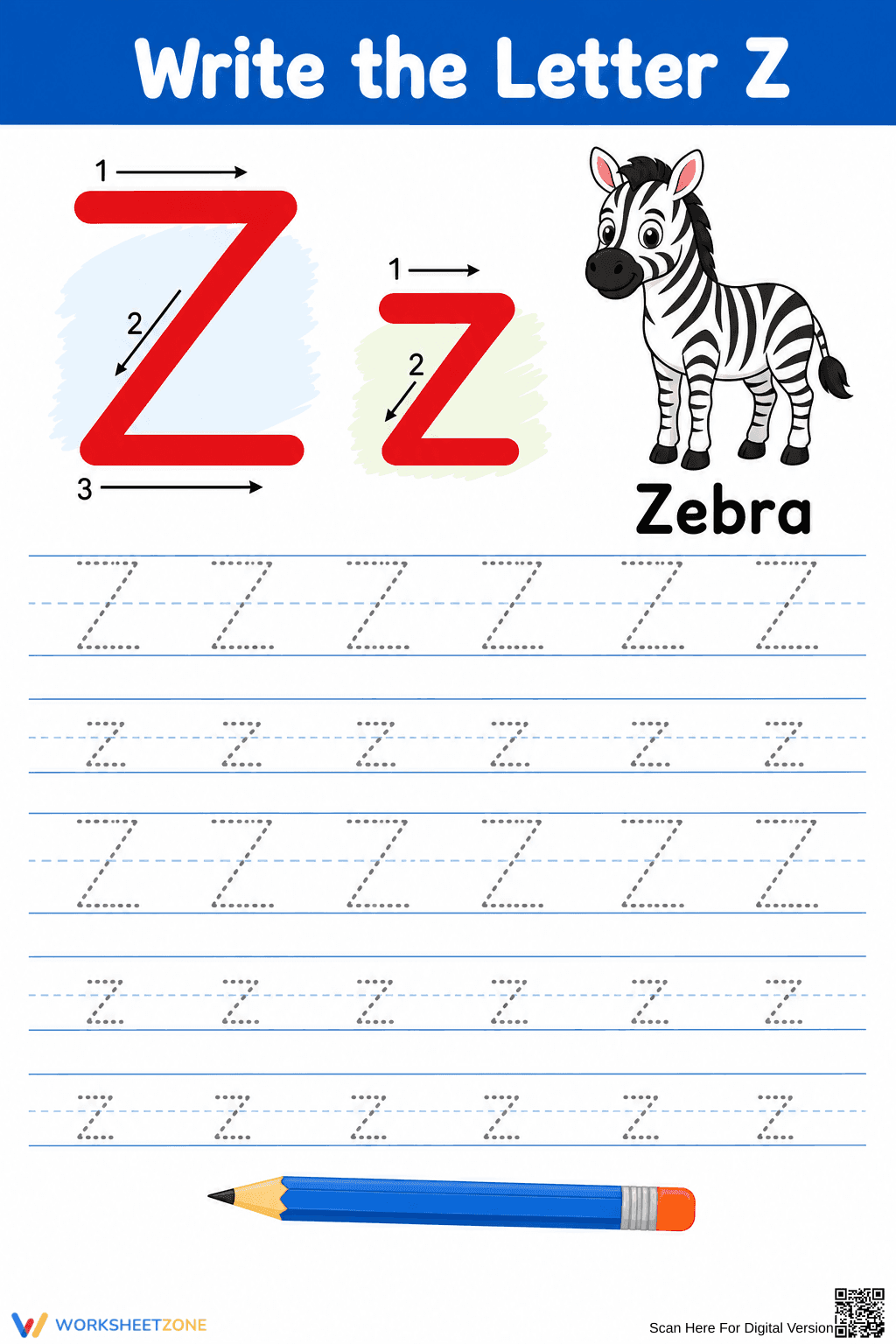

Printable Letter Z Tracing Worksheet | Grade K ELA
Paste this activity's link or code into your existing LMS (Google Classroom, Canvas, Teams, Schoology, Moodle, etc.).
Students can open and work on the activity right away, with no student login required.
You'll still be able to track student progress and results from your teacher account.
This foundational handwriting worksheet helps early learners master the letter Z through guided tracing and beginning sound recognition. Students practice proper stroke order for both uppercase and lowercase forms while associating the letter with a familiar animal, building essential fine motor and phonics skills simultaneously.
At a Glance
- Grade: K · Subject: ELA
- Standard:
CCSS.ELA-LITERACY.L.K.1.A— Print many upper- and lowercase letters- Skill Focus: Letter Z tracing and beginning sounds
- Format: 1 page · 30 problems · No answer key needed · PDF
- Best For: Independent morning work
- Time: 10–15 minutes
Inside this single-page resource, educators will find a comprehensive letter formation guide featuring numbered directional arrows for both the uppercase and lowercase letter Z. A visual anchor of a zebra reinforces the beginning sound connection. The core activity provides five distinct rows of dashed letters for tracing practice, totaling thirty individual tracing opportunities to build muscle memory and handwriting fluency.
Zero-Prep Workflow
- Print (1 minute): Simply send the PDF to your printer. The high-contrast dashed lines ensure clean, readable copies for every student.
- Distribute (1 minute): Hand out the sheets alongside standard pencils or primary grip writing tools. No extra materials are required.
- Review (1 minute): Briefly model the numbered stroke order on the board before letting students work independently.
With a total teacher prep time of under three minutes, this activity is an ideal addition to emergency sub plans or quick morning routines.
Standards Alignment
This resource directly supports CCSS.ELA-LITERACY.L.K.1.A: Print many upper- and lowercase letters. By providing structured, repetitive practice with directional cues, students develop the fine motor control necessary for legible handwriting. It also touches upon early phonics skills by linking the visual letter to its corresponding sound. Both standard codes can be copied directly into lesson plans, IEP goals, or district curriculum mapping tools.
How to Use It
Deploy this worksheet during morning work or literacy centers to establish a calm, focused start to the day. It works exceptionally well immediately following direct instruction on the letter Z. As a formative assessment tip, observe students while they trace to ensure they are following the numbered arrows rather than drawing the letter from bottom to top. Most early learners will complete this task within a 10 to 15-minute timeframe.
Who It's For
This printable is designed primarily for Kindergarten students developing basic handwriting and letter recognition skills. It also serves as an excellent remediation tool for first-grade students who struggle with letter formation or fine motor control. For a complete lesson, pair this tracing sheet with a read-aloud book featuring prominent Z words or a classroom anchor chart displaying zoo animals.
Effective handwriting instruction requires explicit modeling and ample opportunities for guided repetition. According to Fisher & Frey (2014), structured practice with clear visual cues significantly improves early literacy outcomes by reducing the cognitive load associated with letter formation. This allows young learners to focus more on letter-sound correspondence and less on the mechanics of writing. By targeting CCSS.ELA-LITERACY.L.K.1.A, which requires students to print many upper- and lowercase letters, this worksheet provides the exact type of targeted repetition necessary for mastery. The inclusion of directional arrows ensures that students practice the correct motor pathways from the very beginning, preventing the development of poor writing habits that can be difficult to correct later. Consistent use of such targeted tracing activities builds the foundational fluency required for subsequent writing and reading tasks across the primary curriculum.


