


























Views
Downloads

Printable Lowercase Letter W Worksheet | Grade K
Paste this activity's link or code into your existing LMS (Google Classroom, Canvas, Teams, Schoology, Moodle, etc.).
Students can open and work on the activity right away, with no student login required.
You'll still be able to track student progress and results from your teacher account.
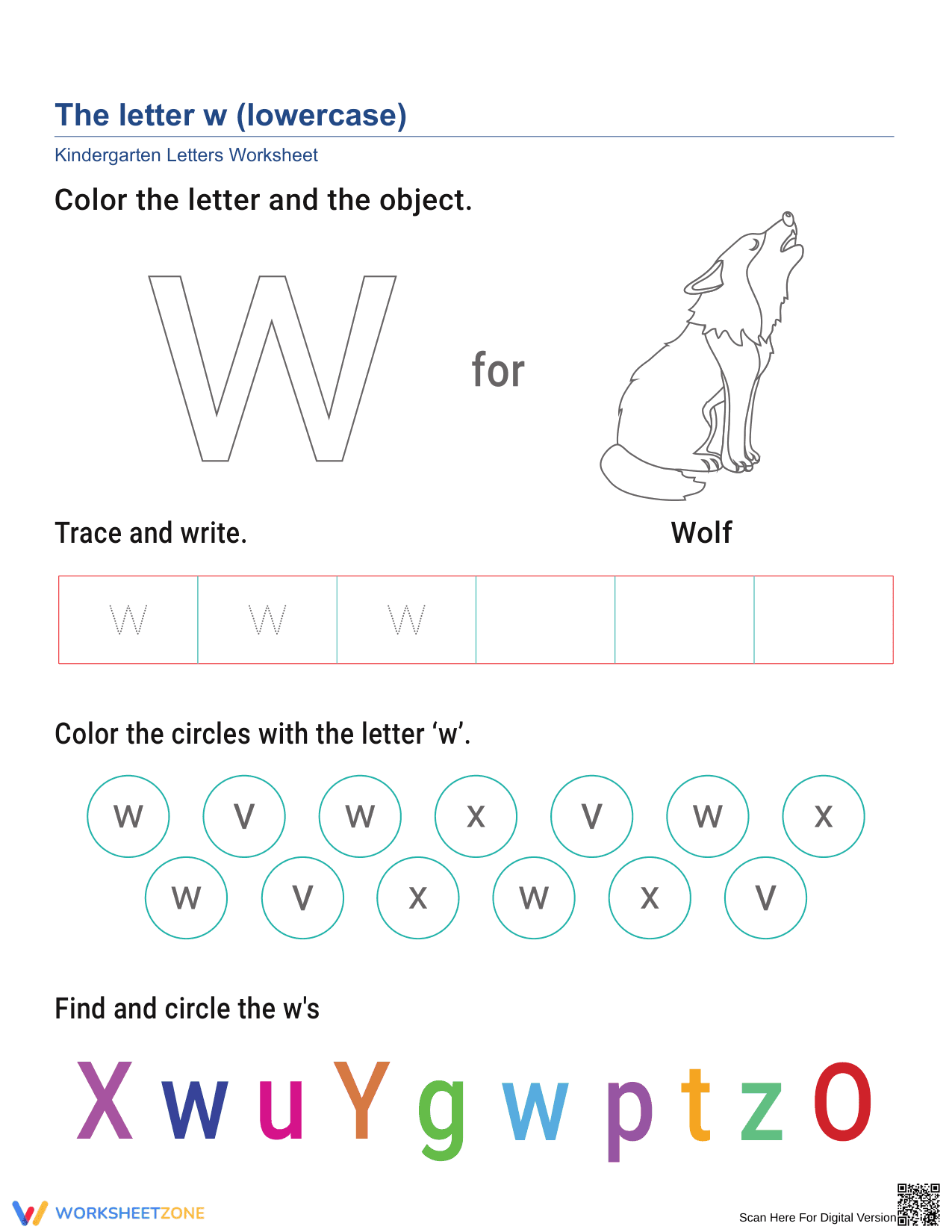
This foundational Kindergarten ELA worksheet helps early readers master the lowercase letter w. By combining visual recognition, fine motor tracing, and letter discrimination tasks, students build the essential alphabet fluency required for reading readiness. The clear layout ensures young learners can focus entirely on letter formation and identification.
At a Glance
- Grade: Kindergarten · Subject: ELA
- Standard:
CCSS.ELA-LITERACY.RF.K.1.D— Recognize and name all lowercase letters- Skill Focus: Lowercase letter w recognition and formation
- Format: 1 page · 4 tasks · No answer key needed · PDF
- Best For: Independent practice and literacy centers
- Time: 10–15 minutes
This single-page resource features four distinct activity zones. Students begin by coloring a large letter w alongside a wolf to build phonetic association. Next, a tracing block provides guided handwriting practice. The bottom half includes two visual discrimination exercises: coloring circles containing the target letter among distractors like v and x, and finding the letter w hidden within a string of mixed typography.
Zero-Prep Workflow
This resource is designed for immediate classroom implementation with minimal teacher friction:
- Print (1 minute): The black-and-white design is optimized for standard school printers, requiring no special ink or paper.
- Distribute (1 minute): The intuitive layout means students can begin working immediately with standard crayons and pencils.
- Review (1 minute): The visual nature of the tasks allows for rapid, at-a-glance checking by the teacher or paraprofessional.
With prep time under two minutes, this worksheet is ideal for sub plans.
Standards Alignment
This worksheet is directly aligned to CCSS.ELA-LITERACY.RF.K.1.D, requiring students to recognize and name all upper- and lowercase letters of the alphabet. It also supports early writing standards by having students print lowercase letters. Both standard codes can be copied directly into lesson plans, IEP goals, or district curriculum mapping tools.
How to Use It
Deploy this worksheet during morning work to establish a calm, productive start to the day, or use it as an independent station during literacy centers. Before direct instruction, it serves as a gentle introduction to the letter of the week. As a formative assessment tip, observe students during the visual discrimination tasks; confusing 'w' with 'v' or 'x' may indicate a need for targeted visual tracking support. Expected completion time is 10 to 15 minutes.
Who It's For
This resource is primarily designed for Kindergarten students mastering their alphabet, but it is equally effective for Preschoolers ready for structured practice or First Graders needing targeted intervention. For students requiring extra fine motor support, provide tactile tracing materials before moving to the pencil-and-paper task. Pair this worksheet with a read-aloud book featuring heavy 'w' alliteration or a classroom alphabet anchor chart.
Mastering the alphabet is a critical precursor to reading comprehension and fluent decoding. This worksheet targets CCSS.ELA-LITERACY.RF.K.1.D, ensuring students can accurately recognize and name all lowercase letters. According to Fisher & Frey (2014), providing students with multiple modalities of practice—such as the coloring, tracing, and visual discrimination tasks included here—significantly improves retention and automaticity in early literacy skills. When young learners engage with the lowercase letter w through varied, repeated exposures, they build the neural pathways necessary for rapid letter identification. This automaticity reduces cognitive load during later phonics instruction, allowing students to focus entirely on blending and segmenting sounds rather than struggling to recall letter shapes. By integrating these foundational exercises into daily routines, educators establish a robust literacy framework that supports long-term academic success.


