


























Views
Downloads
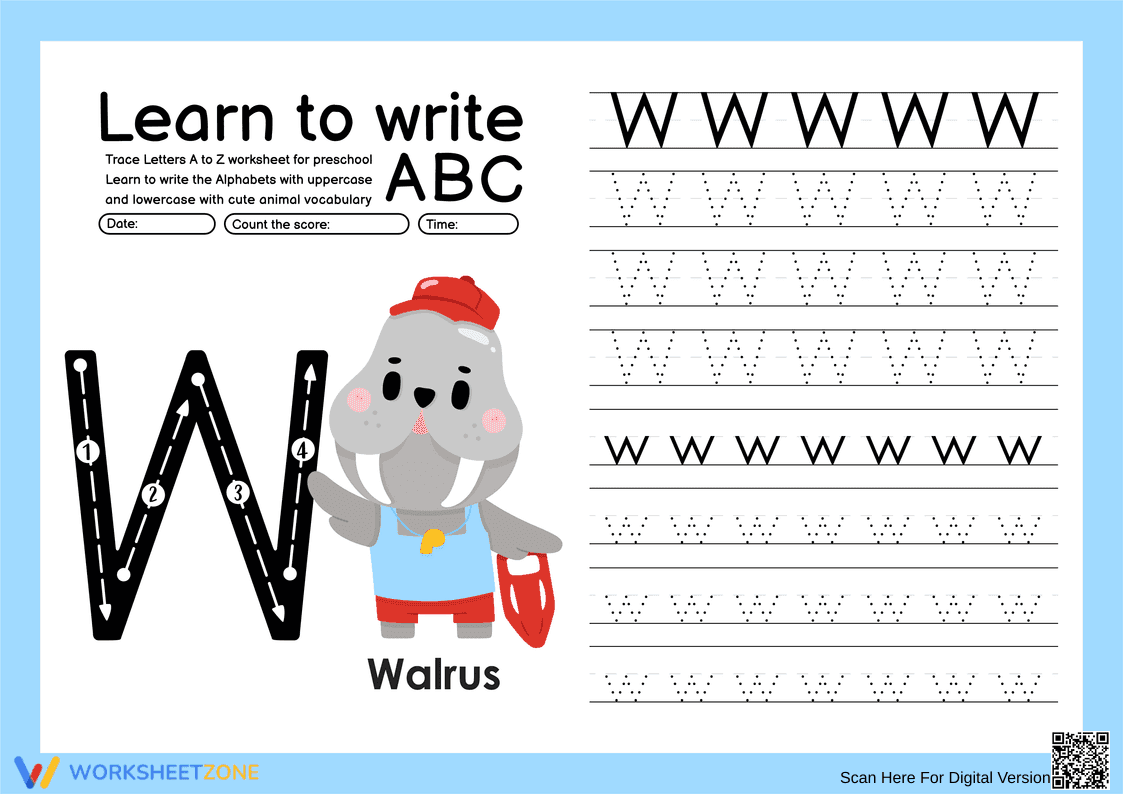

Grade K Letter W Tracing — Printable No-Prep Worksheet
Paste this activity's link or code into your existing LMS (Google Classroom, Canvas, Teams, Schoology, Moodle, etc.).
Students can open and work on the activity right away, with no student login required.
You'll still be able to track student progress and results from your teacher account.
This foundational handwriting worksheet helps early learners master the formation of the letter W. By providing guided tracing paths and ample repetition, students develop the fine motor control required to print uppercase and lowercase forms accurately. The clear visual cues ensure independent success from the first stroke.
At a Glance
- Grade: K · Subject: ELA
- Standard:
CCSS.ELA-LITERACY.L.K.1.A— Print many upper- and lowercase letters- Skill Focus: Letter W formation and tracing
- Format: 1 page · 40 problems · No answer key · PDF
- Best For: Independent morning work
- Time: 10–15 minutes
This single-page resource features a large, instructional model of the uppercase letter W complete with numbered directional arrows to guide proper stroke sequence. Alongside a helpful "Walrus" visual, the page includes eight rows of tracing practice. Students transition from tracing solid letters to following dotted guidelines for both uppercase and lowercase forms, providing approximately 40 individual tracing opportunities to build muscle memory.
This resource is designed for immediate classroom implementation with a zero-prep workflow:
- Print (1 minute): Simply download the PDF and print the required number of copies. The black-and-white friendly design saves ink.
- Distribute (1 minute): Hand out the sheets during morning routines or literacy centers. The visual instructions make it self-explanatory for young learners.
- Review (1 minute): Quickly scan student work to ensure they are following the directional arrows rather than drawing from the bottom up.
With under two minutes of total teacher prep time, this is an ideal, reliable activity for emergency sub plans or quick transitions.
This activity is directly aligned to CCSS.ELA-LITERACY.L.K.1.A: Print many upper- and lowercase letters. It also supports early phonics skills by associating the letter W with the word "Walrus." Both standard codes can be copied directly into lesson plans, IEP goals, or district curriculum mapping tools.
Educators can deploy this worksheet during morning work to establish a calm, focused start to the day before direct instruction begins. Alternatively, it serves as an excellent independent station during literacy centers. As a formative assessment tip, observe students while they trace the initial large model; ensure they start at the top line and follow the numbered sequence (1 through 4) rather than lifting their pencil unnecessarily. Expected completion time ranges from 10 to 15 minutes depending on the child's fine motor development.
This resource is primarily designed for Kindergarten students, though it serves as excellent remediation for first graders needing handwriting support or advanced preschool children demonstrating early writing readiness. For differentiation, teachers can provide textured surfaces underneath the paper for tactile feedback. It pairs perfectly with a direct instruction lesson on the /w/ sound or a read-aloud featuring winter animals like the walrus.
Developing automaticity in handwriting is a critical precursor to expressive written composition in early childhood education. This targeted resource addresses CCSS.ELA-LITERACY.L.K.1.A, requiring students to print many upper- and lowercase letters accurately. According to a recent EdReports 2024 analysis of foundational literacy practices, explicit instruction in letter formation combined with distributed tracing practice significantly reduces the cognitive load required for early spelling and writing tasks. When young learners do not have to consciously think about how to form the letter W, they can allocate more working memory to phonemic awareness, vocabulary acquisition, and sentence generation. By providing numbered stroke sequences and repetitive dotted guidelines, this worksheet aligns with evidence-based motor learning principles, ensuring students build accurate, efficient handwriting habits that support broader, long-term literacy development across all academic subjects.


