




























Views
Downloads
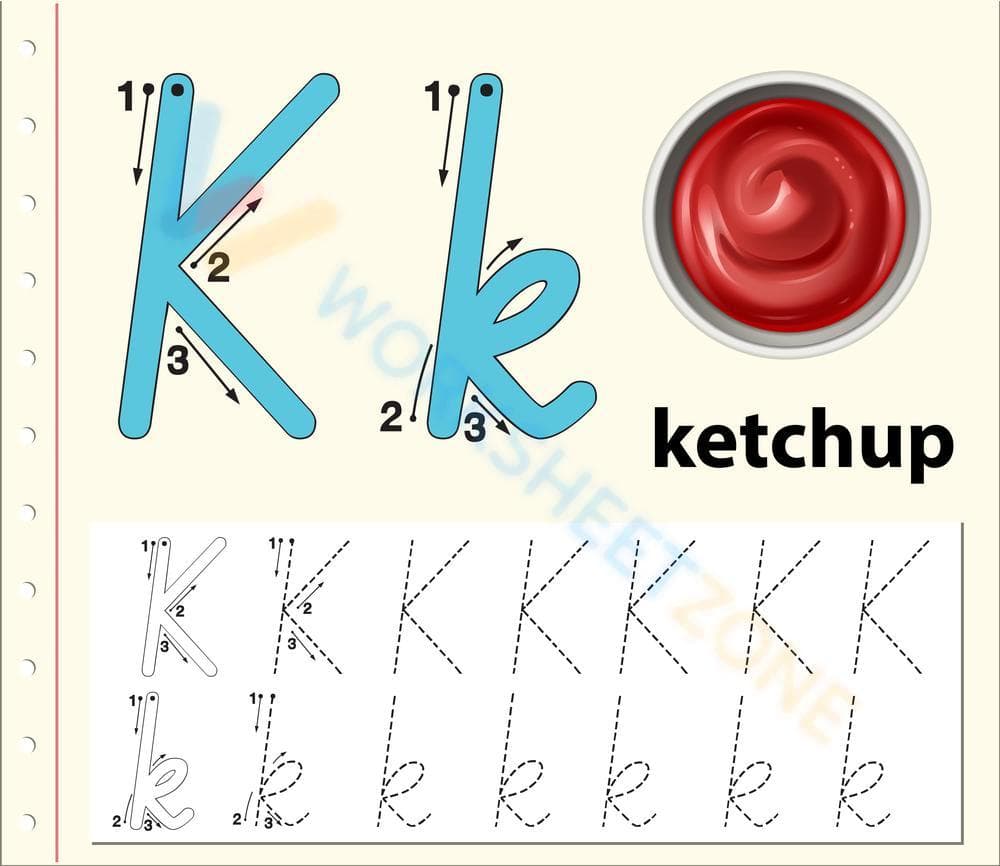

Printable Letter K Tracing Worksheet for Kindergarten

Paste this activity's link or code into your existing LMS (Google Classroom, Canvas, Teams, Schoology, Moodle, etc.).
Students can open and work on the activity right away, with no student login required.
You'll still be able to track student progress and results from your teacher account.
This printable Letter K tracing worksheet helps kindergarteners master uppercase and lowercase letter formation. Students trace the letters using numbered directional arrows, connecting the letter shape to the beginning sound of ketchup. This resource builds fine motor control and letter recognition, ensuring early writing success.
At a Glance
- Grade: Kindergarten · Subject: ELA Phonics
- Standard:
CCSS.ELA-LITERACY.RF.K.1.D— Recognize and name uppercase and lowercase letters- Skill Focus: Letter K formation and identification
- Format: 1 page · 14 tracing tasks · No answer key needed · PDF
- Best For: Morning work or independent writing practice
- Time: 10–15 minutes
This single-page PDF features large, numbered stroke diagrams for both uppercase K and lowercase k, providing a clear visual guide for young writers. Below the instructional models, students practice their skills on two rows of dashed letters, containing 7 uppercase and 7 lowercase tracing opportunities. A colorful ketchup illustration reinforces the letter-sound association.
This zero-prep worksheet fits into any busy classroom routine. First, print the single-page PDF (takes 10 seconds). Next, distribute the sheets to students with pencils or crayons (takes 1 minute). Finally, review student stroke order during independent practice (takes 1 minute). Total teacher preparation time is under 2 minutes, making this an ideal resource for emergency sub plans or quick morning work.
This worksheet aligns directly with CCSS.ELA-LITERACY.RF.K.1.D, which requires students to recognize and name all upper- and lowercase letters of the alphabet. By tracing the specific stroke paths, students internalize the physical movements required for letter production. Both standard codes can be copied directly into lesson plans, IEP goals, or district curriculum mapping tools.
Use this worksheet during direct instruction as a guided practice activity immediately after introducing the letter K sound. Alternatively, assign it as an independent center activity to reinforce handwriting skills later in the week. While students work, observe their stroke directionality to ensure they follow the numbered arrows rather than drawing from bottom to top. Expect completion within 10 to 15 minutes.
This resource targets kindergarten students learning basic letter formation, but also supports preschool students needing enrichment or first graders requiring handwriting intervention. Pair this worksheet with a shared reading of a letter K alphabet book or a physical letter-sorting activity to create a comprehensive phonics lesson.
According to research by Fisher & Frey (2014) on the gradual release of responsibility, structured visual scaffolds like numbered stroke guides are critical for early motor skill acquisition. This worksheet applies this principle to CCSS.ELA-LITERACY.RF.K.1.D by providing clear directional cues for uppercase and lowercase Letter K formation. By scaffolding the writing process from large guided models to smaller independent tracing tasks, the resource helps young learners build muscle memory and letter recognition. Early childhood educators can confidently integrate this tool into their phonics curriculum, knowing that explicit handwriting instruction directly correlates with improved reading readiness and spelling outcomes in later grades. The structured layout ensures that students focus on correct letter formation, preventing the development of poor writing habits.


