




























Views
Downloads
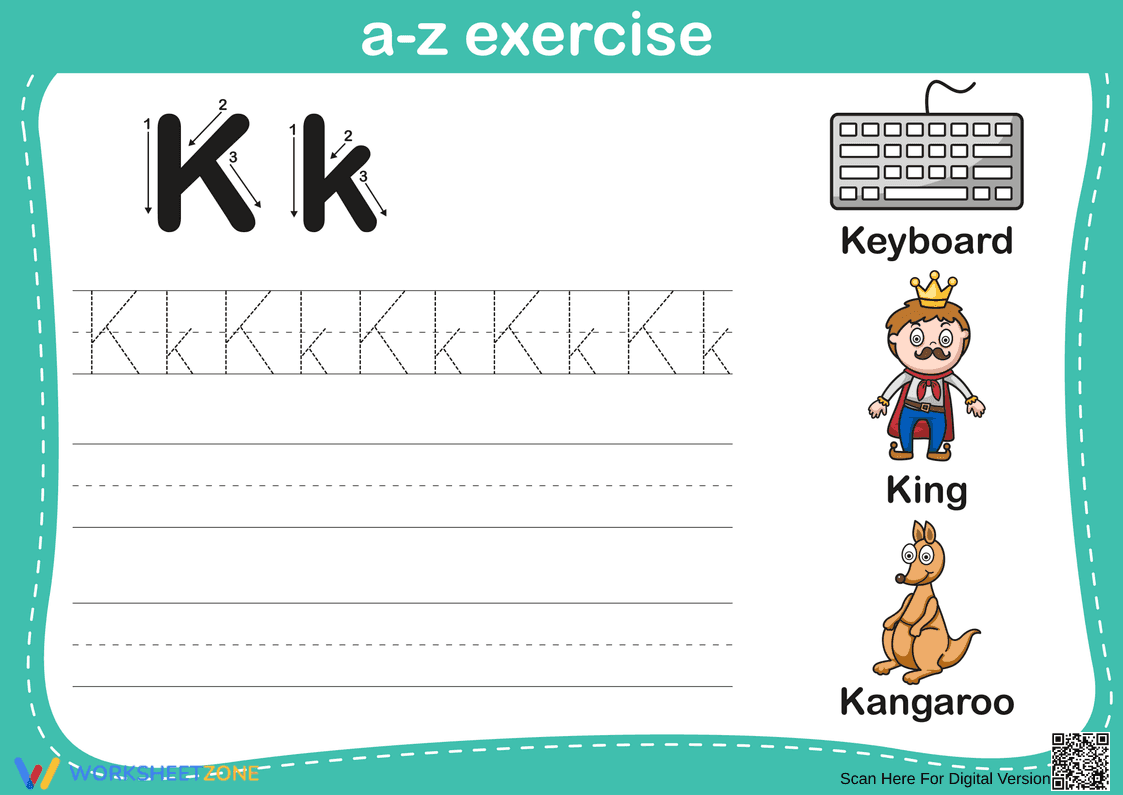

Letter K Tracing Worksheet | Printable Kindergarten ELA

Paste this activity's link or code into your existing LMS (Google Classroom, Canvas, Teams, Schoology, Moodle, etc.).
Students can open and work on the activity right away, with no student login required.
You'll still be able to track student progress and results from your teacher account.
This single-page handwriting worksheet helps early learners master the formation of the uppercase and lowercase letter K. Students practice proper stroke order and build fine motor control while connecting the letter to familiar vocabulary words like keyboard, king, and kangaroo.
At a Glance
- Grade: Kindergarten · Subject: ELA
- Standard:
CCSS.ELA-LITERACY.L.K.1.A— Print upper- and lowercase letters- Skill Focus: Letter K formation
- Format: 1 page · 10 tracing tasks · No answer key needed · PDF
- Best For: Morning work or literacy centers
- Time: 10–15 minutes
This resource features a clear, structured layout designed specifically for early writers. The top section provides large, numbered directional arrows demonstrating the exact stroke sequence for both the capital and lowercase K. Below this, students find one line of dotted letters for guided tracing, followed by three blank primary-lined spaces for independent writing practice. The right side of the page includes three colorful illustrations with matching vocabulary words to reinforce initial letter sounds.
Zero-Prep Workflow
- Print (1 minute): Simply download the PDF and print the single-page layout. No special formatting or color ink is strictly required, though the illustrations pop nicely in color.
- Distribute (1 minute): Hand out the sheets during morning arrival or transition times. The visual instructions make it immediately clear what students need to do.
- Review (1 minute): Quickly scan student work to ensure they are starting their strokes from the top line rather than the bottom.
Total teacher prep time is under two minutes, perfect for sub plans.
This worksheet aligns directly with CCSS.ELA-LITERACY.L.K.1.A, which requires students to print many upper- and lowercase letters. By combining guided tracing with independent practice lines, the activity ensures students move from supported letter formation to independent recall. Both standard codes can be copied directly into lesson plans, IEP goals, or district curriculum mapping tools.
Use this resource during morning work to settle students with a structured task. It also functions perfectly as an independent station during guided reading rotations. While students work, teachers should observe their pencil grip and stroke direction, offering immediate corrective feedback if a child attempts to draw the letter K from the bottom up. Expect most kindergarteners to complete the tracing and writing portions within 10 to 15 minutes.
This material is designed primarily for preschool and kindergarten students who are actively developing their fine motor skills and alphabet knowledge. It serves as an excellent intervention tool for first graders who still struggle with letter reversals or incorrect stroke order. Pair this worksheet with a tactile activity, such as tracing the letter K in sand or shaving cream, to solidify the motor pathway before moving to pencil and paper.
Mastering handwriting is a critical foundational skill that directly impacts later reading and writing fluency in early childhood education. According to Fisher & Frey (2014), explicit instruction in letter formation reduces the cognitive load required for transcription, allowing young writers to eventually focus on content generation rather than the mechanics of writing. This resource supports that instructional goal by targeting CCSS.ELA-LITERACY.L.K.1.A, helping students print upper- and lowercase letters accurately and confidently. By providing numbered directional arrows alongside guided tracing lines, the worksheet ensures students practice the correct motor patterns from the very beginning. Consistent, focused practice on individual letters like the letter K builds the automaticity necessary for successful early literacy development. Educators can rely on this structured approach to foster both fine motor control and letter-sound correspondence in their classrooms.


