




























Views
Downloads

Letter K Tracing Worksheet | Essential Kindergarten ELA

Paste this activity's link or code into your existing LMS (Google Classroom, Canvas, Teams, Schoology, Moodle, etc.).
Students can open and work on the activity right away, with no student login required.
You'll still be able to track student progress and results from your teacher account.
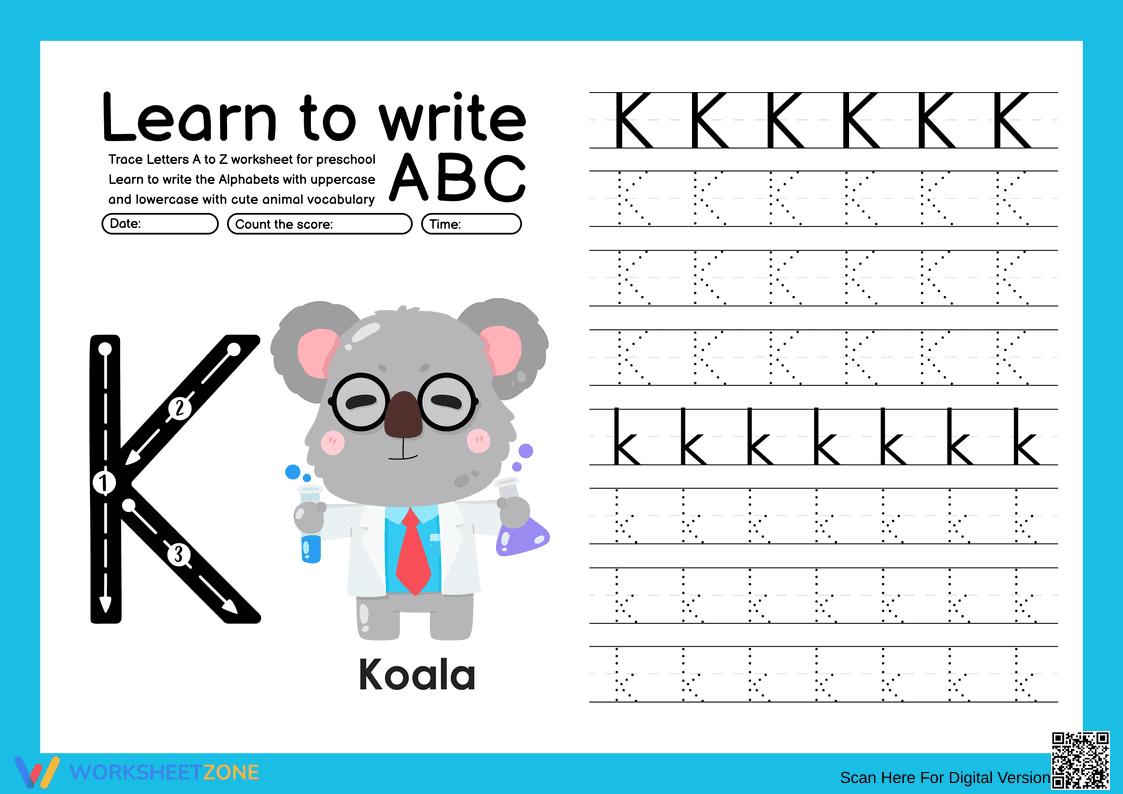
This essential handwriting worksheet provides focused practice for mastering the letter K. Students develop fine motor control and letter recognition by tracing both uppercase and lowercase forms. By following the numbered stroke guides, learners build the muscle memory necessary for independent writing and early literacy success in a structured, engaging format.
At a Glance
- Grade: Kindergarten · Subject: ELA
- Standard:
CCSS.ELA-LITERACY.RF.K.1.D— Recognize and name all upper- and lowercase letters of the alphabet- Skill Focus: Letter K formation
- Format: 1 page · 49 tasks · Answer key included · PDF
- Best For: Morning work or literacy centers
- Time: 10–15 minutes
What's Inside: This single-page PDF features a large, numbered instructional graphic for the letter K to guide initial formation. It includes four rows dedicated to uppercase 'K' and four rows for lowercase 'k', totaling 48 individual tracing opportunities. The page is accented with a friendly koala illustration to reinforce the phonetic sound and includes fields for date, score, and completion time.
Zero-Prep Workflow
- Print (30 seconds): Select the single-page PDF and print enough copies for your small group or entire class.
- Distribute (30 seconds): Hand out the sheets during your phonics block or as students arrive for morning work.
- Review (1 minute): Quickly scan the completed tracing lines to identify students needing additional support with diagonal strokes.
This resource is designed for immediate use, making it an ideal choice for substitute folders or last-minute literacy reinforcement.
Standards Alignment
This worksheet aligns with `CCSS.ELA-LITERACY.RF.K.1.D`: "Recognize and name all upper- and lowercase letters of the alphabet." It also supports `CCSS.ELA-LITERACY.L.K.1.A`, which focuses on printing many upper- and lowercase letters. Both standard codes can be copied directly into lesson plans, IEP goals, or district curriculum mapping tools.
How to Use It
Use this worksheet during the "You Do" phase of a gradual release lesson on the letter K. It serves as an excellent formative assessment tool; observe students as they trace to ensure they follow the correct top-to-bottom and left-to-right stroke order. Expected completion time ranges from 10 to 15 minutes depending on the student's fine motor development.
Who It's For
This resource is tailored for Preschool, Kindergarten, and Grade 1 students who are beginning their handwriting journey. It is particularly effective for English Language Learners (ELLs) who benefit from the visual animal cue. Pair this worksheet with a letter K anchor chart or a short reading passage featuring "K" vocabulary for a complete instructional experience.
Handwriting instruction remains a foundational pillar of early literacy, as research from Fisher & Frey (2014) emphasizes that the physical act of forming letters reinforces phonological awareness and letter-sound correspondence. This worksheet targets CCSS.ELA-LITERACY.RF.K.1.D by providing 49 specific tracing tasks that bridge the gap between recognition and production. By utilizing a clear stroke-order guide and repetitive practice, students move from guided tracing to the threshold of independent writing. The inclusion of both uppercase and lowercase forms ensures that learners understand the dual nature of the alphabet, a critical step for reading fluency. This resource provides a high-utility, evidence-based approach to alphabet mastery that fits easily into any existing curriculum, ensuring that students meet grade-level expectations for letter formation and identification through consistent, scaffolded practice.


