


























Views
Downloads

Letter G Tracing Worksheet | Kindergarten Printable
Paste this activity's link or code into your existing LMS (Google Classroom, Canvas, Teams, Schoology, Moodle, etc.).
Students can open and work on the activity right away, with no student login required.
You'll still be able to track student progress and results from your teacher account.
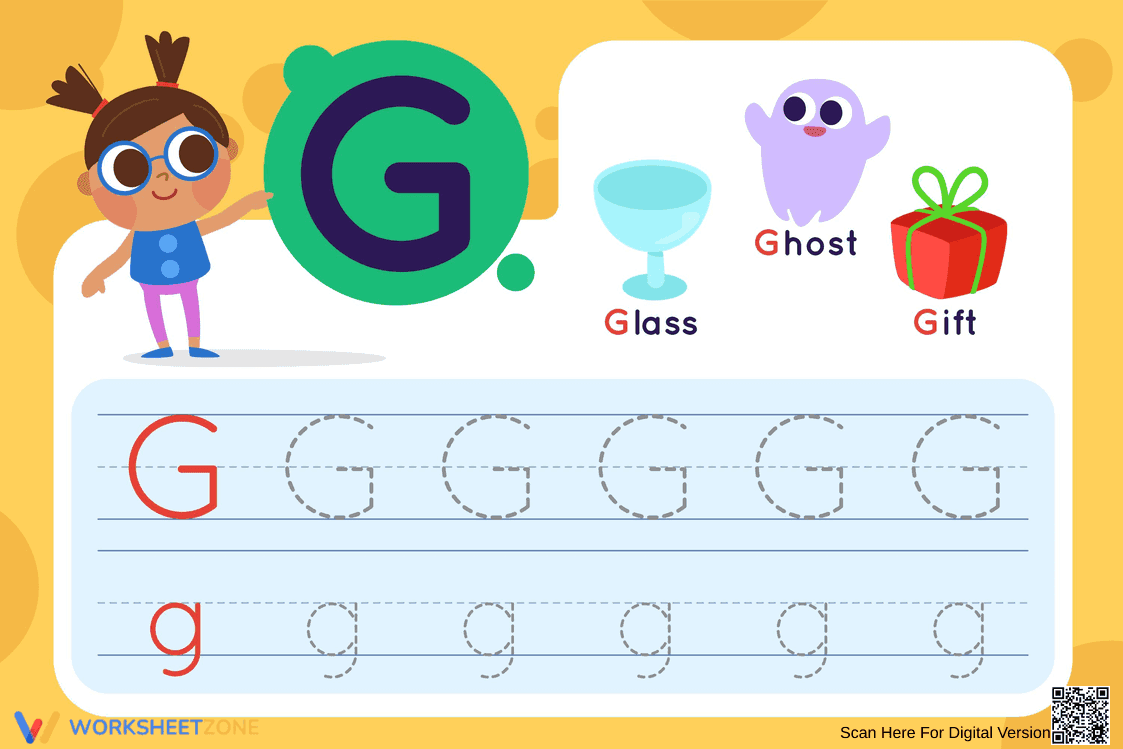
This Kindergarten Letter G tracing worksheet helps students master uppercase and lowercase letter formation through guided repetition. By connecting the visual shape of the letter to beginning sound illustrations like a ghost and a gift, learners build essential phonemic awareness. This resource ensures students develop the fine motor skills required for neat handwriting.
At a Glance
- Grade: Kindergarten · Subject: Handwriting
- Standard:
CCSS.ELA-LITERACY.L.K.1.A— Print many upper- and lowercase letters accurately- Skill Focus: Letter G formation and beginning sounds
- Format: 1 page · 15 tasks · PDF
- Best For: Daily morning work or literacy centers
- Time: 10–15 minutes
The worksheet features a clean layout designed for young learners. It includes one full page featuring 6 uppercase tracing opportunities and 6 lowercase tracing opportunities. At the top, three vibrant illustrations—a glass, a ghost, and a gift—provide context for the 'g' sound. The use of primary dashed lines helps students understand proper letter height.
Zero-Prep Workflow
This resource is designed for immediate classroom implementation with a total teacher prep time of under 2 minutes. Follow these three simple steps:
- Print: Select the single-page PDF and print enough copies for your small group or entire class.
- Distribute: Hand out the sheets along with pencils or crayons for tracing.
- Review: Briefly point to the images at the top to reinforce the beginning sound before students begin.
Standards Alignment
The primary focus of this activity is CCSS.ELA-LITERACY.L.K.1.A, which requires students to print many upper- and lowercase letters. Additionally, it supports phonological awareness by linking letters to their corresponding sounds. Both standard codes can be copied directly into lesson plans, IEP goals, or district curriculum mapping tools.
How to Use It
Incorporate this worksheet during your literacy block after direct instruction on the letter G. It works well as a quiet-time activity or a station in a literacy center. For a formative assessment, observe the student's stroke order as they trace. Most students will complete the 15 tasks within 10 to 15 minutes.
Who It's For
This resource is tailored for preschool and kindergarten students beginning their handwriting journey. It provides scaffolding for learners who need visual guides to maintain letter proportions. Pair this worksheet with a letter G anchor chart or a read-aloud book featuring 'G' words to create a comprehensive learning experience.
According to Fisher & Frey (2014), the gradual release of responsibility begins with clear visual modeling and supported practice, which this Letter G tracing worksheet provides through its structured layout. By focusing on CCSS.ELA-LITERACY.L.K.1.A, the resource ensures that students develop the fine motor control necessary for printing many upper- and lowercase letters accurately. The inclusion of phonemic anchors—Glass, Ghost, and Gift—strengthens the connection between grapheme recognition and initial sound production, a critical milestone in early literacy development. Research indicates that repetitive, guided tracing helps solidify muscle memory, reducing the cognitive load on young learners as they transition to independent writing. This worksheet serves as a foundational tool for preschool and kindergarten students, offering a direct path to letter mastery. Educators can utilize this resource to provide consistent, high-quality practice that aligns with national standards for early childhood language arts and handwriting proficiency.


