


























Views
Downloads
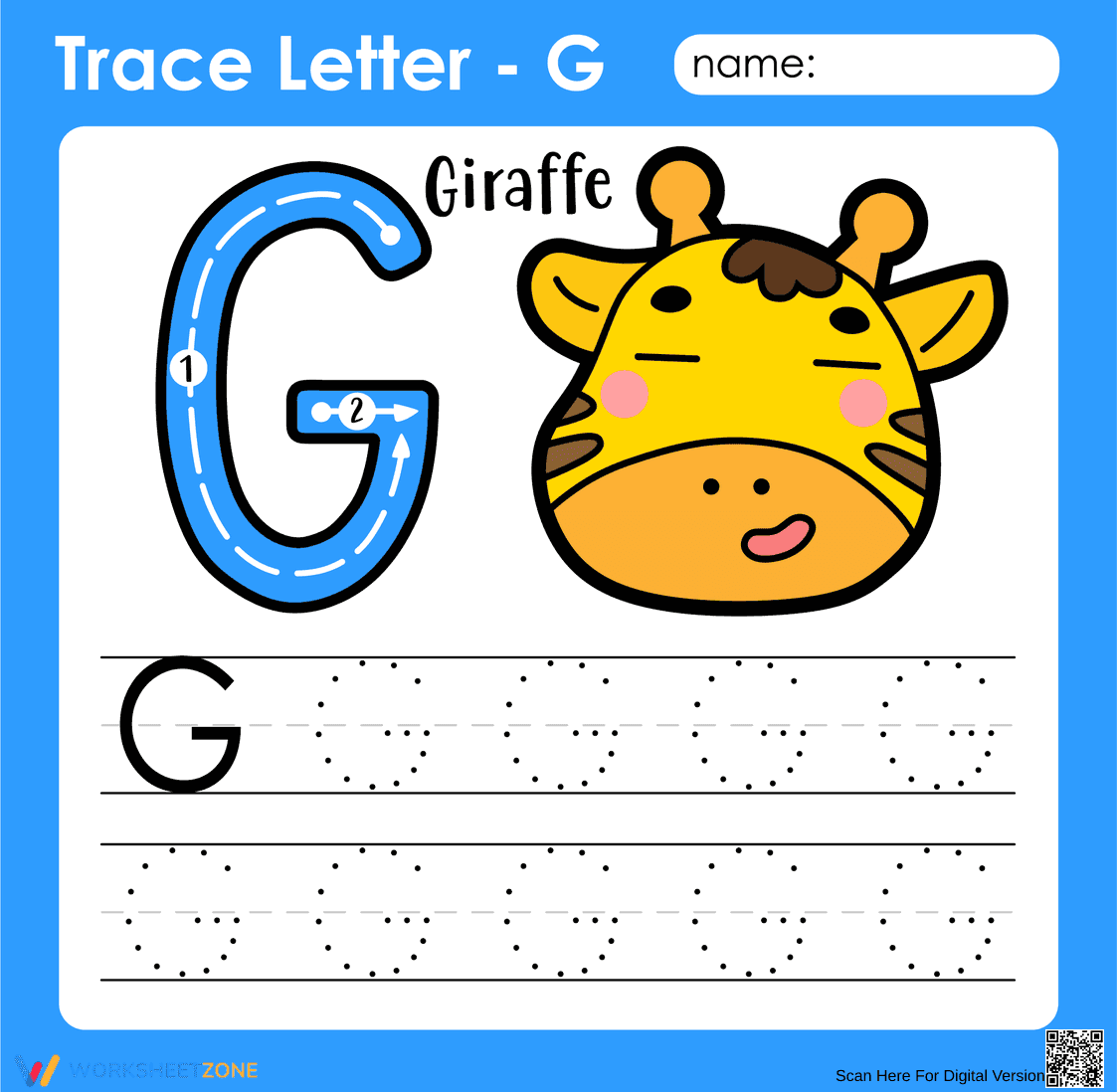

Trace Letter G Worksheet | Essential Kindergarten Practice
Paste this activity's link or code into your existing LMS (Google Classroom, Canvas, Teams, Schoology, Moodle, etc.).
Students can open and work on the activity right away, with no student login required.
You'll still be able to track student progress and results from your teacher account.
This printable letter G tracing worksheet provides foundational handwriting practice for early learners. By focusing on the specific stroke order of the uppercase G, students develop the muscle memory required for legible writing. This resource ensures that preschoolers and kindergarteners master letter formation through guided repetition and engaging visual cues.
At a Glance
- Grade: Kindergarten · Subject: Handwriting
- Standard:
CCSS.ELA-LITERACY.L.K.1.A— Print many upper- and lowercase letters- Skill Focus: Uppercase Letter G Formation
- Format: 1 page · 10 problems · Answer key included · PDF
- Best For: Morning work or literacy centers
- Time: 5–10 minutes
This single-page PDF features a large, high-contrast letter G at the top, complete with numbered directional arrows to guide the initial stroke. Below the primary example, students find 9 individual tracing tasks arranged in two neat rows. The inclusion of a friendly giraffe graphic reinforces the phonetic connection between the letter and its sound, while the clear dotted lines provide the necessary scaffolding for tiny hands.
The zero-prep design allows for an immediate classroom workflow. Teachers can print the worksheet in under 30 seconds, distribute it to a small group in another 30 seconds, and spend approximately 1 minute reviewing the correct starting point for the letter. This efficiency makes it an ideal choice for emergency sub plans or transition periods between core subjects.
This resource aligns with `CCSS.ELA-LITERACY.L.K.1.A`, which requires students to print many upper- and lowercase letters. By isolating the letter G, the worksheet allows for targeted intervention. Both standard codes can be copied directly into lesson plans, IEP goals, or district curriculum mapping tools.
Use this worksheet during the independent practice phase of a gradual release lesson. After demonstrating the letter on a whiteboard, have students trace the large G with their fingers before using a pencil. For formative assessment, observe whether students start at the top (position 1) or attempt to draw the letter from the bottom up, which can indicate a need for further modeling.
This activity is designed for Pre-K and Kindergarten students who are beginning their literacy journey. It is also highly effective for occupational therapy sessions focusing on fine motor control or for English Language Learners (ELL) who need to familiarize themselves with the Latin alphabet. Pair this with a letter G anchor chart for maximum impact.
According to the Fisher & Frey (2014) framework for gradual release of responsibility, structured practice like this tracing worksheet is vital for moving students toward independent mastery. Research indicates that handwriting is not merely a motor skill but a "language-by-hand" process that activates neural pathways associated with reading and spelling. The 10 tasks provided here offer the optimal amount of repetition to solidify the motor plan for the letter G without causing cognitive fatigue in young learners. By utilizing the numbered directional arrows, the worksheet addresses common reversal issues and ensures that the initial "G" shape is formed correctly from the outset. This alignment with evidence-based instructional practices supports long-term literacy outcomes and provides a reliable tool for early childhood educators seeking to build a strong alphabetic foundation in their classrooms.


