




























Views
Downloads

Printable Letter G Worksheet | Kindergarten ELA

Paste this activity's link or code into your existing LMS (Google Classroom, Canvas, Teams, Schoology, Moodle, etc.).
Students can open and work on the activity right away, with no student login required.
You'll still be able to track student progress and results from your teacher account.
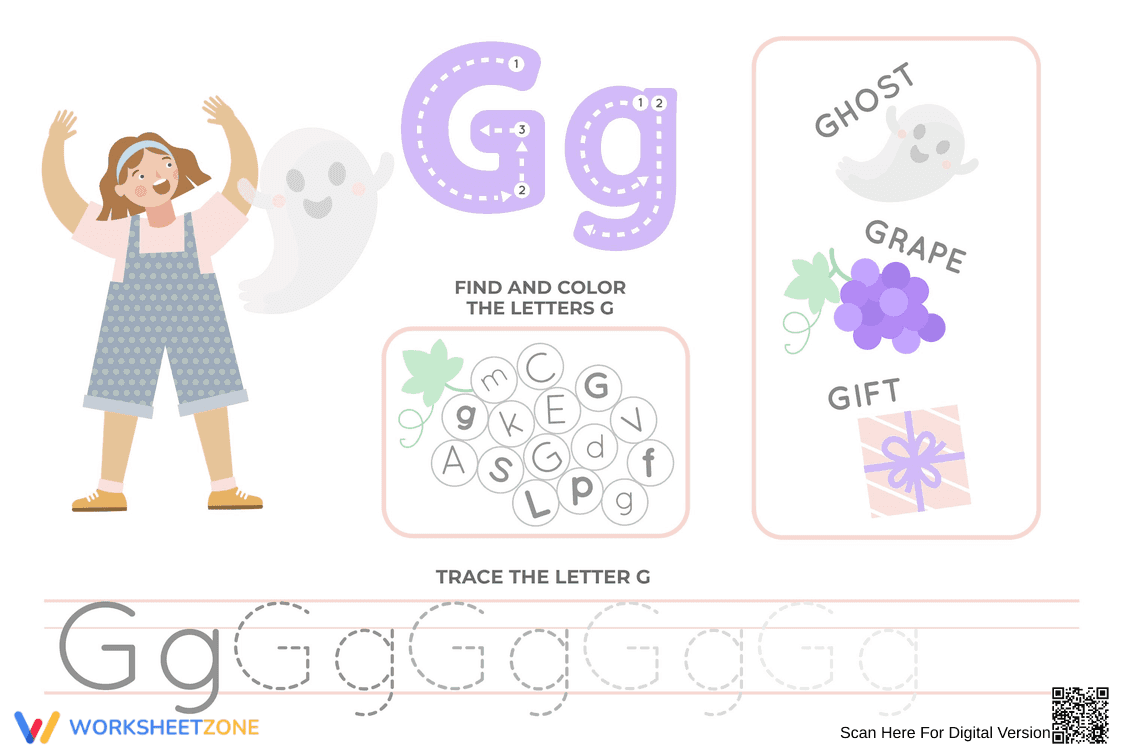
This printable Kindergarten ELA worksheet helps early learners master the letter G through targeted tracing and identification activities. Students build essential alphabet recognition and fine motor skills by interacting with uppercase and lowercase forms. The engaging format keeps young readers focused while reinforcing foundational phonics concepts.
At a Glance
- Grade: K · Subject: ELA
- Standard:
CCSS.ELA-LITERACY.RF.K.1.D— Recognize and name all upper- and lowercase letters.- Skill Focus: Letter G recognition and tracing
- Format: 1 page · 3 tasks · No answer key · PDF
- Best For: Independent practice or morning work
- Time: 10–15 minutes
This single-page resource features three distinct task types designed to reinforce letter familiarity. First, students follow directional arrows to trace a large uppercase and lowercase G. Next, they complete a "find and color" bubble activity to distinguish the target letter from distractors. Finally, students practice standard handwriting by tracing multiple Gs on primary lined paper. Visual cues like a ghost, grape, and gift provide helpful phonetic context.
Zero-Prep Workflow
This worksheet is designed for immediate classroom implementation with absolutely no teacher setup required.
- Print (1 minute): Simply download the PDF and print a class set.
- Distribute (1 minute): Hand out the sheets during morning work, literacy centers, or as a quick transition activity.
- Review (3 minutes): Quickly scan student work to ensure proper stroke order and accurate letter identification.
With a total prep time of under two minutes, this resource is an excellent addition to any emergency sub plan or busy morning routine.
Standards Alignment
This resource is directly aligned to CCSS.ELA-LITERACY.RF.K.1.D, requiring students to recognize and name all upper- and lowercase letters of the alphabet. It also supports early handwriting development by guiding proper stroke formation. Both standard codes can be copied directly into lesson plans, IEP goals, or district curriculum mapping tools.
How to Use It
Deploy this worksheet during literacy centers after introducing the letter G through direct instruction. It serves as an excellent independent practice activity while the teacher works with small reading groups. Alternatively, use it as a formative assessment tool; observe students as they complete the "find and color" section to quickly gauge their ability to visually discriminate the letter G from other letters like C or E. Most kindergarteners will complete this activity within 10 to 15 minutes.
Who It's For
This worksheet is primarily designed for kindergarten students developing foundational literacy skills. It is also highly effective for preschool students who are ready for early alphabet exposure, or first-grade students needing targeted intervention on letter reversals. For a complete lesson, pair this printable with an interactive anchor chart featuring G-words or a read-aloud focused on the hard G sound.
Mastering alphabet recognition is a critical stepping stone for early literacy development. According to a 2024 report by EdReports, explicit instruction in letter identification, combined with guided handwriting practice, significantly improves phonemic awareness and subsequent reading fluency. This worksheet targets CCSS.ELA-LITERACY.RF.K.1.D by requiring students to recognize and name all upper- and lowercase letters. Integrating visual discrimination tasks with tactile tracing exercises supports multiple learning modalities. The inclusion of directional arrows ensures students build correct muscle memory. Early intervention in letter formation prevents ingrained handwriting difficulties later on. Providing structured practice with individual letters like G allows young learners to build confidence and automaticity, essential components for decoding words and achieving long-term reading success.


