


























Views
Downloads

Give Compliments Worksheet | Grade 3 Essential
Paste this activity's link or code into your existing LMS (Google Classroom, Canvas, Teams, Schoology, Moodle, etc.).
Students can open and work on the activity right away, with no student login required.
You'll still be able to track student progress and results from your teacher account.
Teaching students how to navigate social interactions requires explicit practice in reciprocity. This worksheet focuses on the "Give one back" strategy, helping children move beyond a simple "thank you" to actively engaging with others. By practicing these responses in a low-stakes writing format, students build the confidence needed for real-world social success and positive peer relationships.
At a Glance
- Grade: 3 · Subject: Social Skills
- Standard:
CCSS.ELA-LITERACY.SL.3.1— Engage effectively in a range of collaborative discussions with diverse partners- Skill Focus: Social Reciprocity & Gratitude
- Format: 1 page · 3 problems · No-prep · PDF
- Best For: Morning meetings and SEL small groups
- Time: 10–15 minutes
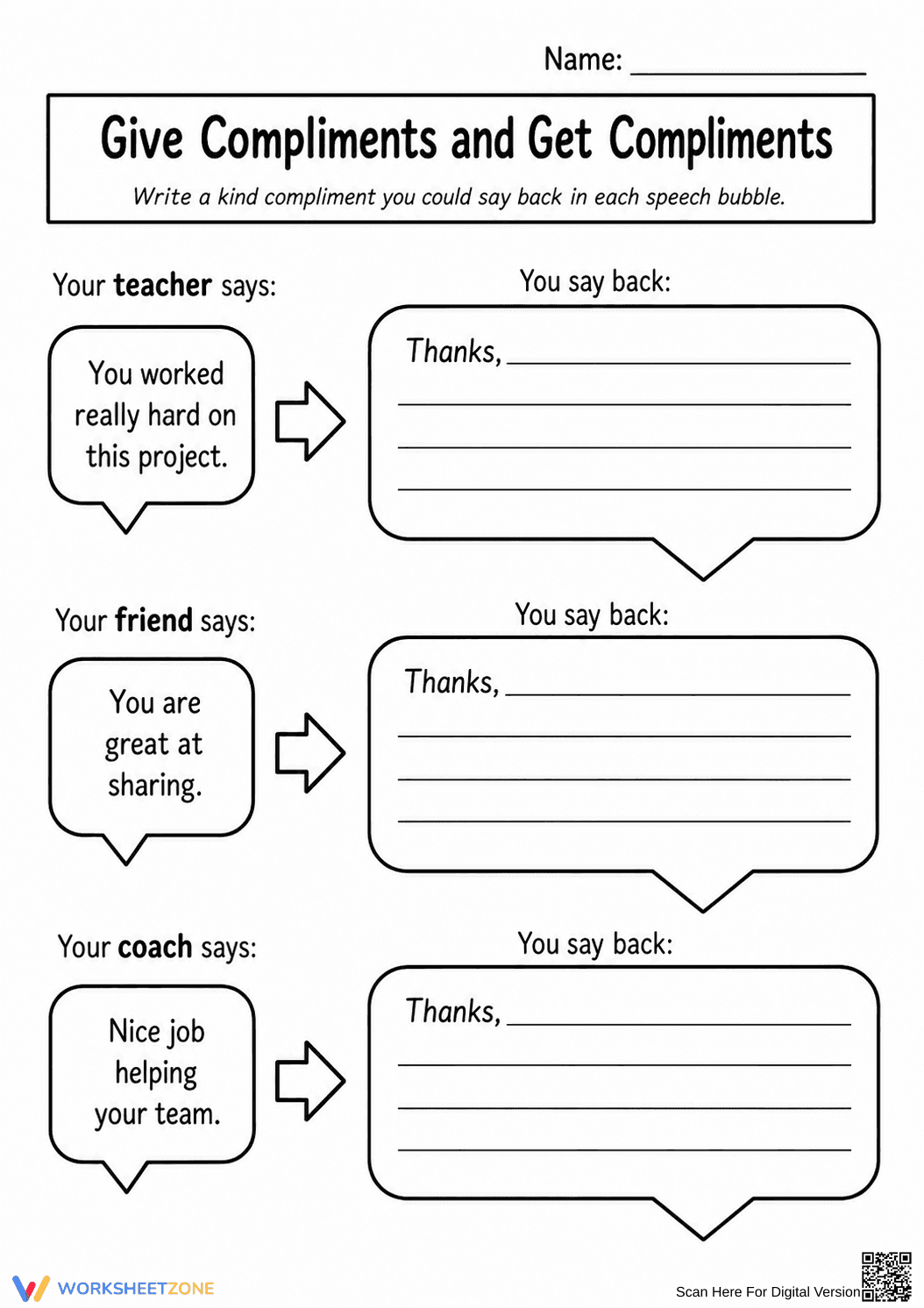
This one-page PDF features three distinct social scenarios involving a teacher, a friend, and a coach. Each section includes a speech bubble containing a specific compliment and a corresponding empty bubble for the student's response. To support learners, each response bubble is pre-filled with the word "Thanks," providing a helpful sentence starter that encourages polite and reciprocal communication.
The zero-prep workflow for this resource is designed for maximum efficiency in the classroom. First, print the document in seconds for your entire group. Second, distribute the sheets during a dedicated social skills block or morning meeting. Finally, review the responses by having students share their return compliments aloud to practice verbal delivery. Total teacher preparation time is under 2 minutes, making this an ideal resource for busy educators or last-minute substitute plans.
This resource aligns with CCSS.ELA-LITERACY.SL.3.1, which requires students to engage effectively in collaborative discussions. By practicing the specific social script of receiving and returning a compliment, students meet the standard's requirement to build on others' talk in conversations. This standard code can be copied directly into lesson plans, IEP goals, or district curriculum mapping tools.
Use this worksheet as a formative assessment during a social-emotional learning (SEL) unit on friendship or manners. After students complete the written portion, pair them up to role-play the scenarios, focusing on eye contact and body language. This transition from writing to speaking helps solidify the social habit. Expect the written portion to take approximately 10 to 15 minutes for most elementary learners.
This worksheet is designed for elementary students in grades 2 through 5, particularly those who struggle with social cues or conversational flow. It is an excellent resource for speech-language pathologists, school counselors, and special education teachers working with students on the autism spectrum. Pair this with a "compliment circle" activity for a comprehensive social skills lesson that bridges the gap between paper and practice.
Research from Fisher & Frey (2014) emphasizes the importance of structured social interaction practice for developing communicative competence. This worksheet targets CCSS.ELA-LITERACY.SL.3.1 by providing a scaffolded framework for reciprocal conversation. By practicing the "Give one back" strategy, students move beyond passive reception of praise toward active social engagement. Studies in social-emotional learning (SEL) indicate that explicit instruction in gratitude and compliment-giving improves peer relationships and classroom climate. This resource provides 3 specific scenarios that allow for immediate application of these skills. According to Fisher & Frey (2014), providing students with sentence frames—such as the "Thanks," prompt used here—reduces cognitive load and allows learners to focus on the social nuance of the interaction. This approach is particularly effective for students requiring social skills intervention or those on the autism spectrum who benefit from clear, predictable social scripts.


