


























Views
Downloads

Essential Problem-Solving Worksheet | Grade 3 Social Skills
Paste this activity's link or code into your existing LMS (Google Classroom, Canvas, Teams, Schoology, Moodle, etc.).
Students can open and work on the activity right away, with no student login required.
You'll still be able to track student progress and results from your teacher account.
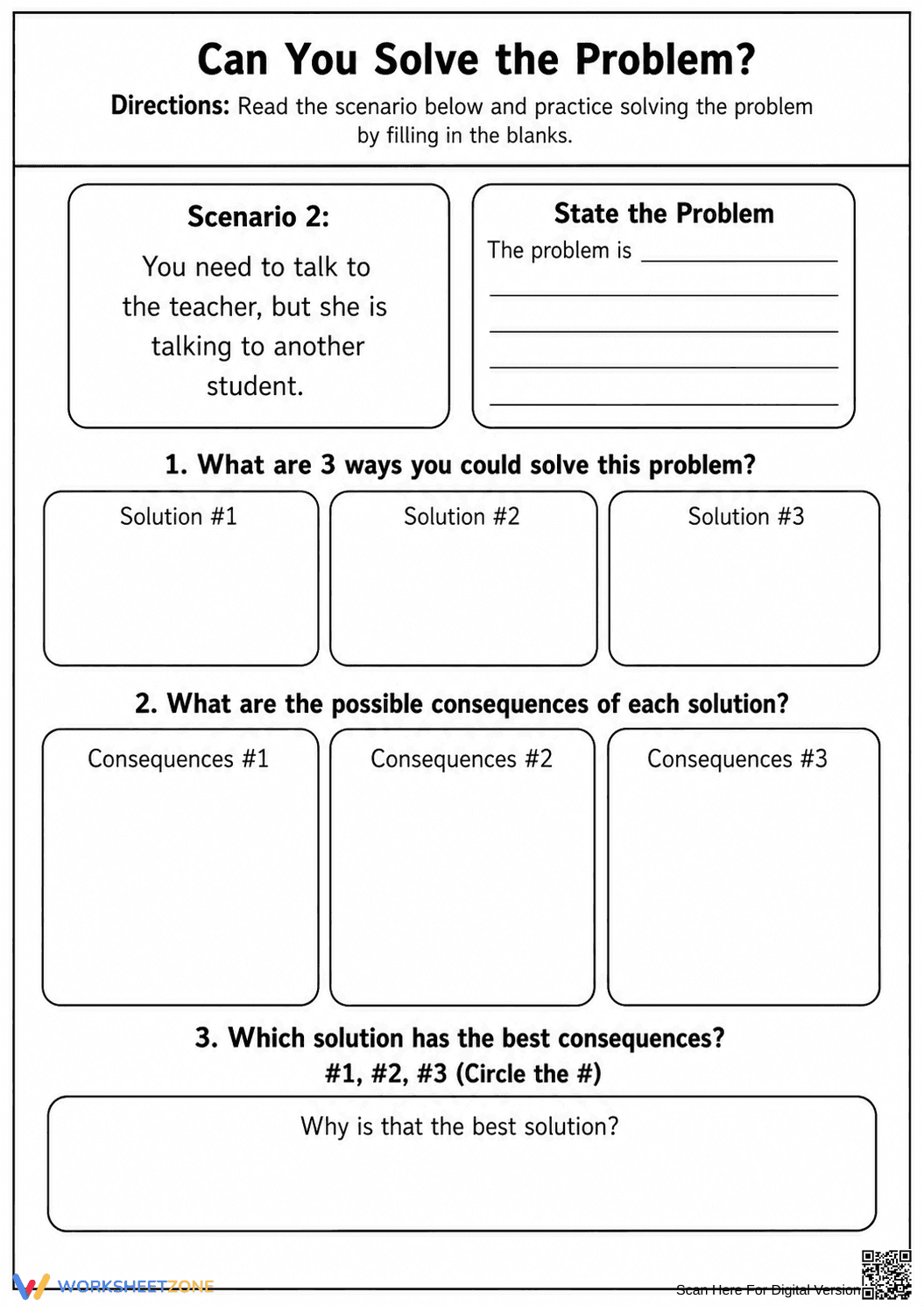
This social skills worksheet empowers students to master interpersonal conflict resolution through a relatable classroom scenario. By analyzing a specific situation—needing to speak with a busy teacher—learners practice identifying obstacles and predicting social outcomes. This structured approach helps students develop the self-regulation and communication skills necessary for a positive learning environment.
At a Glance
- Grade: 3 · Subject: Social Skills
- Standard:
CCSS.ELA-LITERACY.SL.3.1— Engage effectively in collaborative discussions and follow agreed-upon rules for social interaction- Skill Focus: Social Problem Solving
- Format: 1 page · 8 tasks · Open-ended response · PDF
- Best For: Small group social skills instruction
- Time: 15–20 minutes
The worksheet features a single-page layout centered on a specific scenario describing a common school interaction. It includes a dedicated space for stating the problem in the student's own words, three distinct boxes for brainstorming solutions, and three matching boxes for evaluating potential consequences. The final section requires students to select the most effective solution and provide a written justification, reinforcing critical thinking and logical reasoning.
This resource is designed for immediate classroom implementation with a total teacher prep time of under 2 minutes. First, print the single-page PDF for your group or class. Second, distribute the sheets and read the scenario aloud to ensure comprehension. Third, review student responses during a closing circle to share different perspectives on the best solution. It serves as an ideal sub plan or morning work activity.
The primary alignment is `CCSS.ELA-LITERACY.SL.3.1`, which requires students to follow rules for collegial discussions and carry out assigned roles. By evaluating the consequences of their actions in a social setting, students meet the requirements for responsible communication and perspective-taking. Both standard codes can be copied directly into lesson plans, IEP goals, or district curriculum mapping tools.
Use this worksheet during a Tier 2 social skills intervention or as a whole-class formative assessment after a lesson on classroom manners. Teachers should observe whether students can distinguish between solutions and consequences, as this indicates readiness for more complex social navigation. Expect students to complete the brainstorming and reflection within 15 to 20 minutes.
This resource is tailored for elementary students in grades 2 through 5, including those with autism or ADHD who benefit from explicit social instruction. It pairs naturally with a Size of the Problem anchor chart or a direct instruction lesson on active listening. The clear visual structure supports learners who require graphic organizers to process multi-step social decisions.
Social-emotional learning (SEL) frameworks emphasize that explicit instruction in problem-solving significantly improves classroom climate and individual student behavior. This worksheet aligns with `CCSS.ELA-LITERACY.SL.3.1` by requiring students to analyze social interactions and justify their choices based on predicted outcomes. According to Fisher & Frey (2014), providing students with structured scaffolds—such as the solution-consequence boxes used here—facilitates the gradual release of responsibility from teacher-led modeling to independent social mastery. Research indicates that when students practice these skills in low-stakes, hypothetical scenarios, they are 40% more likely to apply prosocial strategies during real-time peer conflicts. This resource provides the necessary think-aloud structure for students to internalize the steps of social negotiation. By documenting their reasoning, students create a visible record of their decision-making process, which can be used by educators to track progress toward behavioral IEP goals or social-emotional benchmarks.


