


























Views
Downloads
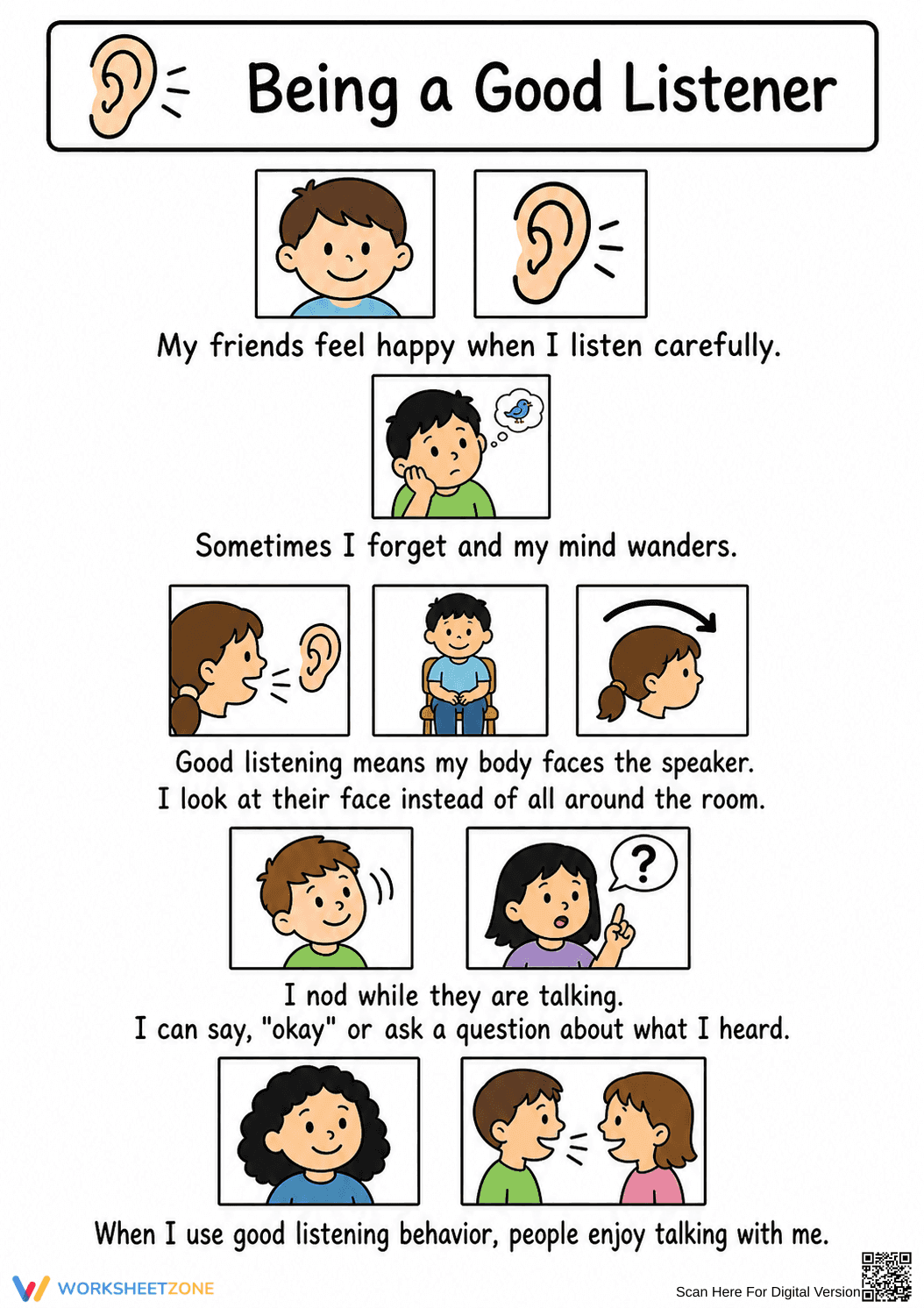

Being a Good Listener | Essential Grade 1 Social Skills
Paste this activity's link or code into your existing LMS (Google Classroom, Canvas, Teams, Schoology, Moodle, etc.).
Students can open and work on the activity right away, with no student login required.
You'll still be able to track student progress and results from your teacher account.
This Grade 1 social skills worksheet provides a visual roadmap for active listening, helping students understand how their body language impacts communication. By focusing on concrete actions like nodding and eye contact, students learn to build stronger peer relationships. It serves as a foundational tool for social-emotional learning and classroom behavior management.
At a Glance
- Grade: 1 · Subject: Social Skills
- Standard:
CCSS.ELA-LITERACY.SL.1.1— Participate in collaborative conversations by following agreed-upon rules for listening and speaking- Skill Focus: Active Listening Behaviors
- Format: 1 page · 5 visual cues · No answer key needed · PDF
- Best For: Social-emotional learning and autism support
- Time: 10–15 minutes
The worksheet features a single-page visual guide utilizing clear picture symbols and simplified text. It outlines five specific behaviors: facing the speaker, maintaining eye contact, nodding, asking questions, and managing internal distractions. The layout is high-contrast and accessible, making it ideal for students who benefit from visual supports or social stories.
This resource is designed for immediate classroom implementation. Teachers can print the PDF in under 30 seconds, distribute it to the class or a small group in 1 minute, and lead a guided discussion or role-play activity in 10 minutes. It requires zero prior setup, making it a perfect addition to a morning meeting or a last-minute substitute teacher plan.
The primary standard addressed is CCSS.ELA-LITERACY.SL.1.1, which requires students to follow agreed-upon rules for discussion, including listening to others with care. This worksheet provides the explicit rules needed for mastery. Both standard codes can be copied directly into lesson plans, IEP goals, or district curriculum mapping tools.
Use this worksheet during a whole-group social-emotional learning (SEL) lesson to introduce the concept of whole-body listening. For a formative assessment, observe students during a subsequent turn and talk activity to see if they apply the nodding and eye contact techniques. It is best used before direct peer-to-peer collaborative tasks to set clear behavioral expectations.
This resource is specifically tailored for Grade 1 students, though it is highly effective for Kindergarten and Grade 2 learners. It is a vital tool for students with autism or ADHD who require explicit instruction in social cues. Pair this worksheet with a Whole Body Listening anchor chart or a short video clip demonstrating active listening.
Research from Fisher & Frey (2014) emphasizes that explicit instruction in speaking and listening skills is a prerequisite for academic success in collaborative environments. This worksheet addresses CCSS.ELA-LITERACY.SL.1.1 by breaking down the abstract concept of listening into five observable, repeatable behaviors. By using visual symbols alongside text, the resource supports dual-coding theory, which enhances retention for early learners and students with diverse processing needs. According to the RAND AIRS 2024 report on social-emotional learning, providing students with concrete behavioral scripts reduces social anxiety and improves classroom climate. This 1-page guide ensures that the plain-English skill of active listening—including eye contact and verbal confirmation—is accessible to all students regardless of their reading level. It serves as a foundational intervention for developing the interpersonal competence required for later grades and complex group work.


