


























Views
Downloads
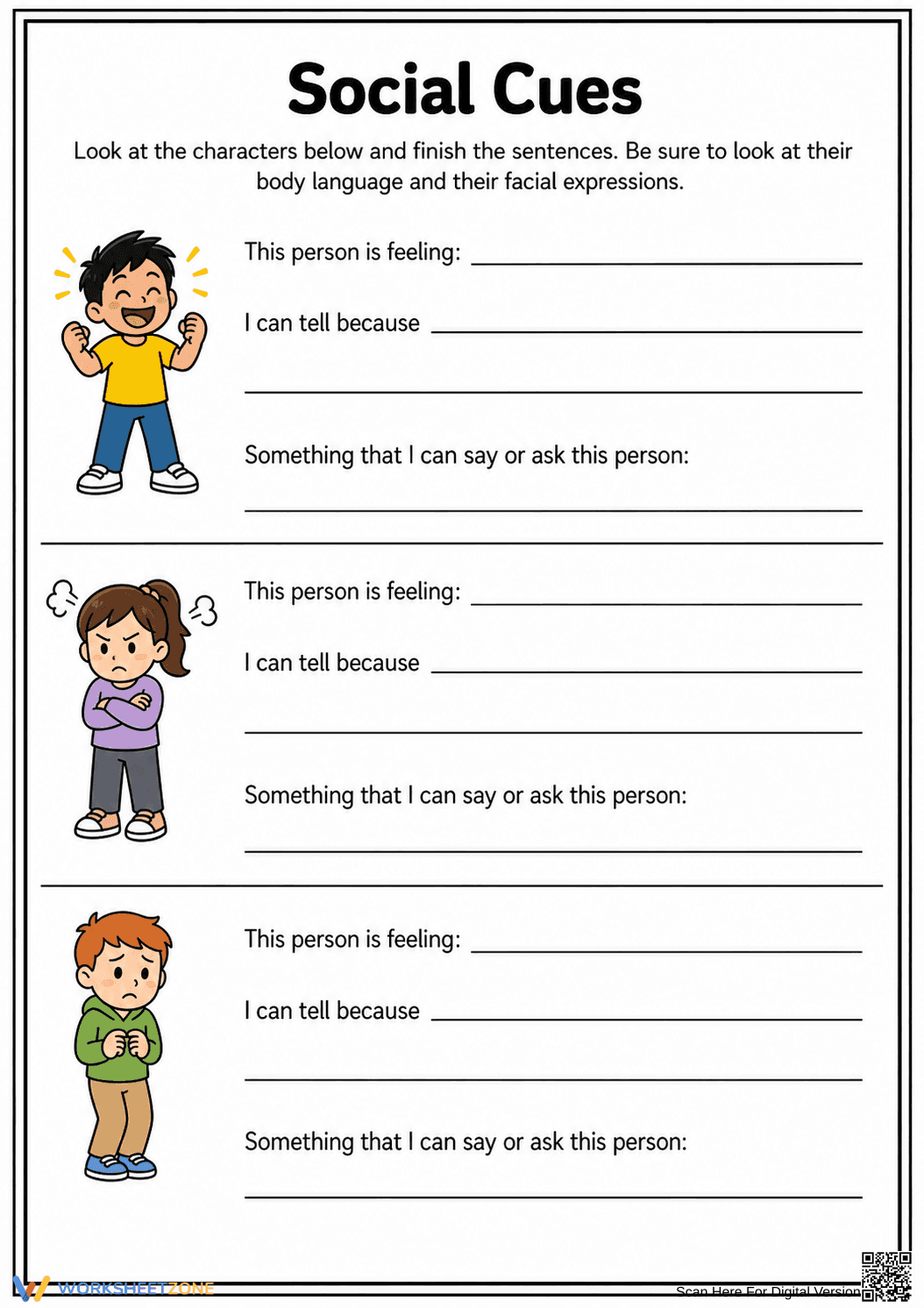

Printable Social Cues Worksheet | Grade 3 SEL
Paste this activity's link or code into your existing LMS (Google Classroom, Canvas, Teams, Schoology, Moodle, etc.).
Students can open and work on the activity right away, with no student login required.
You'll still be able to track student progress and results from your teacher account.
This printable social-emotional learning worksheet helps students practice recognizing social cues by observing facial expressions and body language. By analyzing three distinct character scenarios, learners identify emotions, explain their visual evidence, and formulate appropriate verbal responses to build empathy and foundational communication skills.
At a Glance
- Grade: 3 · Subject: Social Emotional Learning
- Standard:
CCSS.ELA-LITERACY.RL.3.3— Describe character feelings and explain their actions- Skill Focus: Reading Social Cues
- Format: 1 page · 3 scenarios · PDF
- Best For: Morning meetings and counseling sessions
- Time: 15–20 minutes
This single-page resource features three illustrated character scenarios depicting distinct emotional states: excitement, anger, and anxiety. For each character, students complete three guided prompts to identify the emotion, cite visual evidence, and draft a supportive statement for a real-life interaction.
Zero-Prep Workflow
This worksheet is designed for immediate classroom implementation with no prior setup required. The straightforward progression ensures a smooth experience for both teachers and substitute educators:
- Print (1 minute): Generate copies of the single-page PDF for your entire class or small group.
- Distribute (1 minute): Hand out the worksheets during morning meeting, advisory, or a dedicated SEL block.
- Review (3 minutes): Briefly model the first scenario by pointing out the character's clenched fists and furrowed brow before letting students work independently.
Total teacher preparation time is under two minutes, making it an ideal sub plan.
Standards Alignment
This resource aligns with CCSS.ELA-LITERACY.RL.3.3: Describe characters in a story and explain how their actions contribute to events. By applying this literacy skill to visual scenarios, students practice inferring emotions from physical evidence. Both standard codes can be copied directly into lesson plans, IEP goals, or district curriculum mapping tools.
How to Use It
Integrate this worksheet into your weekly routine during morning meetings or dedicated social skills instruction. Before direct instruction on conflict resolution, use the angry character scenario to spark a discussion about recognizing frustration in peers. During small group counseling sessions, have students role-play the supportive responses they wrote down. As a formative assessment tip, observe whether students rely solely on facial expressions or if they successfully incorporate body language cues like posture and hand placement into their written evidence. Expected completion time is 15 to 20 minutes.
Who It's For
This activity is primarily designed for second through fourth-grade students developing foundational social awareness. It serves as an excellent intervention tool for neurodivergent learners, including students with autism, who benefit from explicit instruction in reading nonverbal communication. Pair this worksheet with an anchor chart displaying common facial expressions or a read-aloud focused on empathy to reinforce the connection between visual cues and emotional responses.
Explicit instruction in nonverbal communication significantly impacts a student's ability to navigate peer relationships and collaborative academic tasks. When students practice reading social cues, they develop the capacity to describe character feelings and explain their actions, a core competency outlined in CCSS.ELA-LITERACY.RL.3.3. According to a comprehensive EdReports 2024 analysis of social-emotional learning frameworks, structured visual analysis of body language and facial expressions improves emotional vocabulary and perspective-taking accuracy by providing concrete anchors for abstract feelings. This worksheet operationalizes that research by requiring learners to explicitly link visual evidence to emotional states and formulate prosocial responses. By repeatedly practicing this sequence in a low-stakes format, students build the cognitive pathways necessary for real-time empathy and conflict de-escalation in the busy classroom environment, ultimately fostering a more inclusive school culture.


