


























Views
Downloads

Grade 8 Giving Compliments — Printable No-Prep Worksheet
Paste this activity's link or code into your existing LMS (Google Classroom, Canvas, Teams, Schoology, Moodle, etc.).
Students can open and work on the activity right away, with no student login required.
You'll still be able to track student progress and results from your teacher account.
This social skills worksheet helps students practice the art of giving genuine compliments to peers and adults. By providing structured prompts for different types of praise, the activity empowers learners to build positive relationships, demonstrate empathy, and improve their interpersonal communication skills in everyday social settings.
At a Glance
- Grade: 8 · Subject: Social Skills
- Standard:
CCSS.ELA-LITERACY.SL.8.1— Engage effectively in collaborative discussions with diverse partners- Skill Focus: Giving compliments
- Format: 1 page · 6 problems · No answer key · PDF
- Best For: Social-emotional learning
- Time: 15–20 minutes
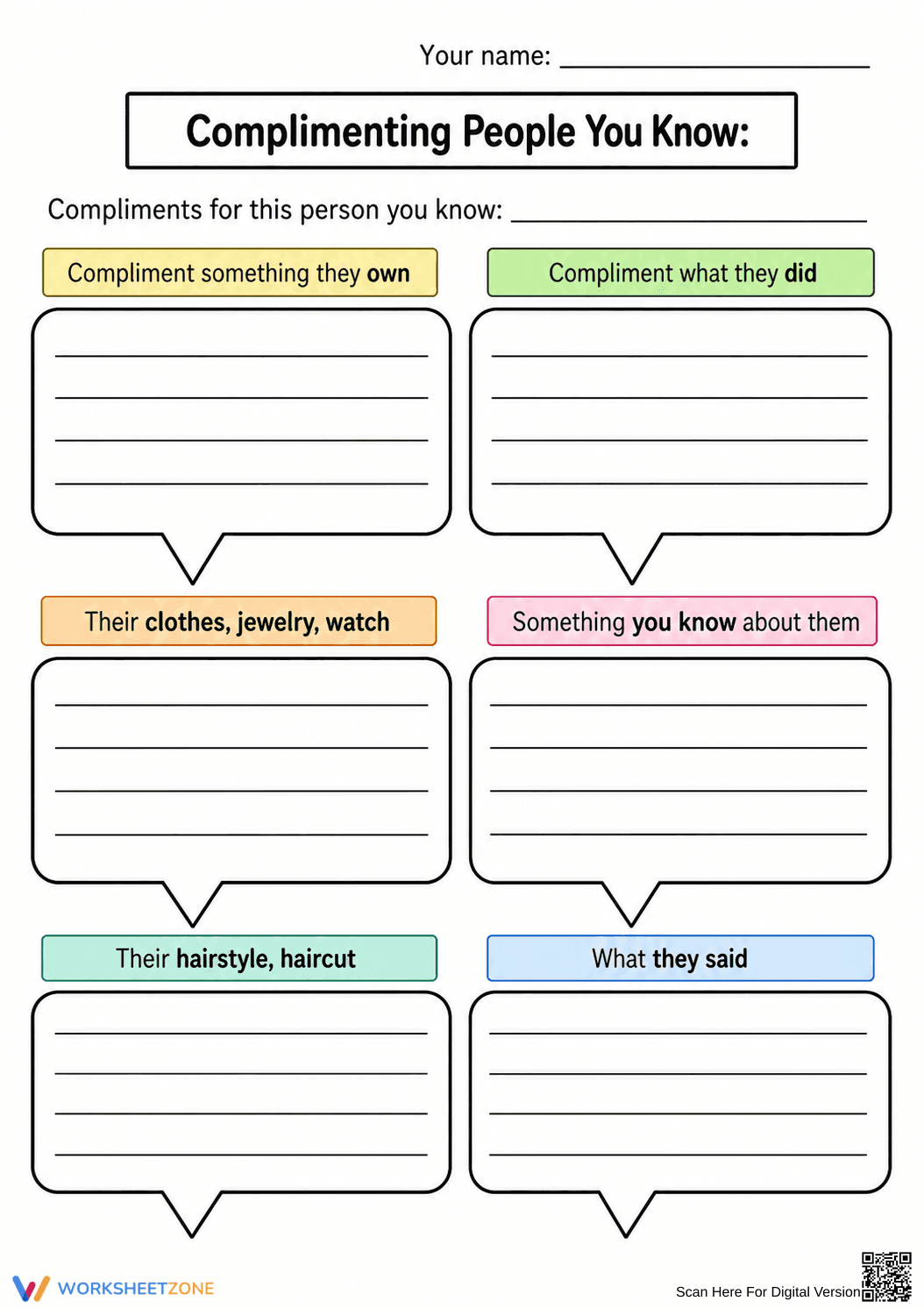
Inside this single-page resource, educators will find six distinct speech-bubble prompts designed to guide students through the process of formulating specific, meaningful compliments. The task boxes prompt learners to praise something a person owns, an action they took, their clothing, a personal fact, their hairstyle, and something they said. Because this is an open-ended exercise, there is no answer key, allowing students to draw from authentic experiences.
This resource is designed for immediate classroom implementation with a zero-prep workflow:
- Print (1 min): Download the PDF and print a class set.
- Distribute (1 min): Hand out during advisory or a social skills block.
- Review (2 mins): Explain the difference between generic and specific compliments.
Total teacher prep time is under two minutes, making this an excellent, self-explanatory activity for substitute teacher plans or unexpected schedule changes.
This activity aligns with CCSS.ELA-LITERACY.SL.8.1, which requires students to engage effectively in a range of collaborative discussions with diverse partners, building on others' ideas and expressing their own clearly. A supporting standard, CCSS.ELA-LITERACY.W.8.4, is also addressed as students produce clear and coherent writing within the speech bubbles. Both standard codes can be copied directly into lesson plans, IEP goals, or district curriculum mapping tools.
Teachers can utilize this worksheet as a warm-up activity before a group project to establish a supportive classroom culture. Alternatively, it serves as an excellent exercise during a social skills group. As a formative assessment tip, observe students as they share their written compliments aloud; note whether they maintain appropriate eye contact. Expected completion time ranges from 15 to 20 minutes.
This worksheet is primarily designed for middle school students, particularly those in Grade 8, who benefit from explicit instruction in social-emotional learning. It is highly effective for neurodivergent learners, including students with autism, who may need concrete frameworks for navigating social interactions. For differentiation, teachers can provide sentence starters or a vocabulary bank of positive adjectives. Pair this activity with a direct instruction lesson on empathy or active listening to reinforce the concepts.
Developing strong interpersonal communication skills is a critical component of adolescent development and academic success. This worksheet targets CCSS.ELA-LITERACY.SL.8.1 by helping students engage effectively in collaborative discussions with diverse partners through the practice of giving specific, genuine compliments. According to a 2024 report by EdReports, integrating structured social-emotional learning activities directly into the daily curriculum significantly improves classroom climate and peer relationships. When students are explicitly taught how to recognize and affirm the positive qualities of their peers, they are more likely to participate actively in collaborative academic tasks and exhibit prosocial behaviors. By breaking down the abstract concept of praise into six concrete categories, this resource provides the scaffolding necessary for students to build empathy and self-awareness. Educators can use this tool to foster a supportive environment where all learners feel valued.


