


























Views
Downloads
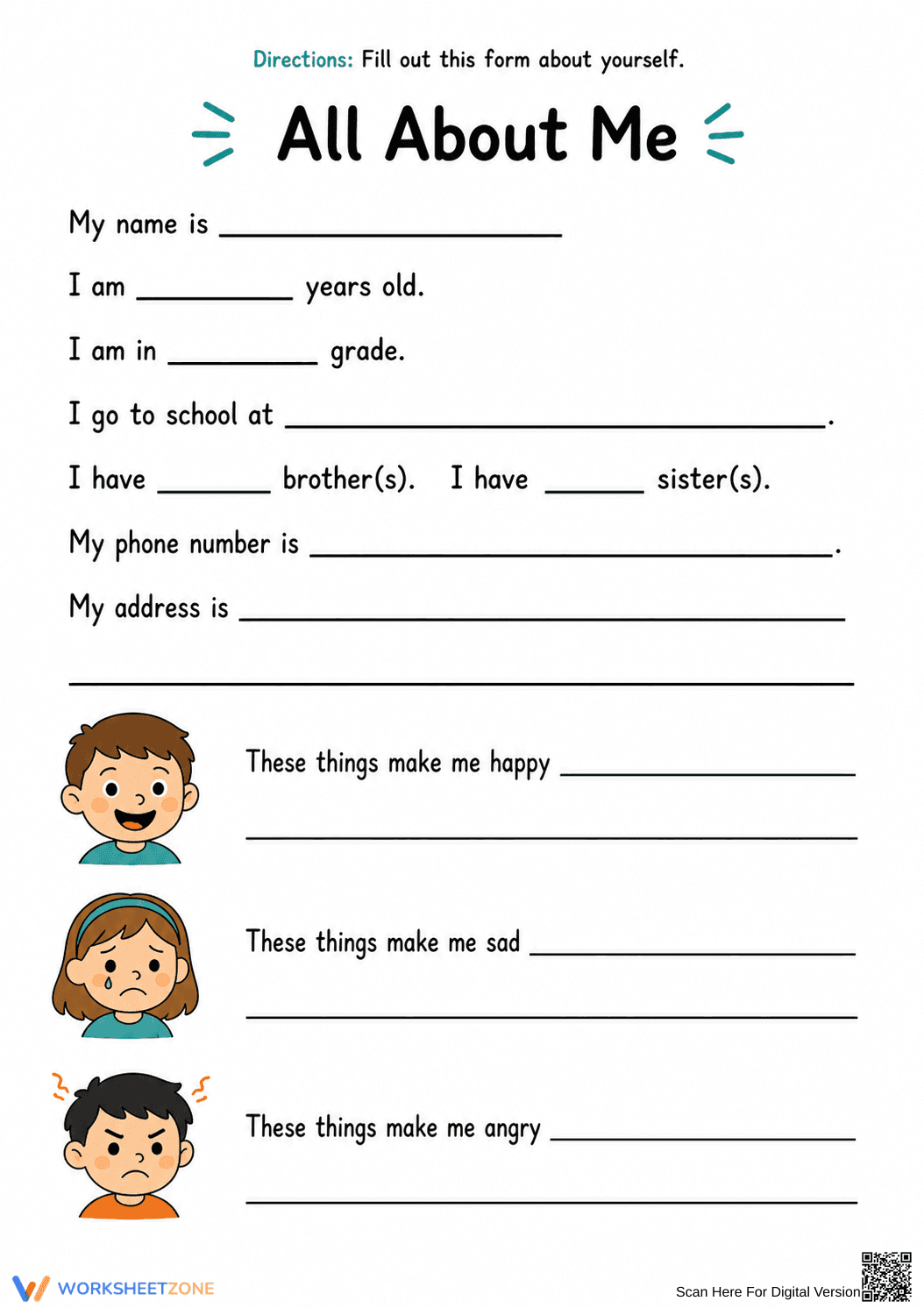

All About Me Worksheet | Grade 2 Essential
Paste this activity's link or code into your existing LMS (Google Classroom, Canvas, Teams, Schoology, Moodle, etc.).
Students can open and work on the activity right away, with no student login required.
You'll still be able to track student progress and results from your teacher account.
This All About Me worksheet provides a structured framework for students to document their personal identity and emotional triggers. By combining functional data entry with social-emotional reflection, it helps learners communicate essential information while identifying what makes them happy, sad, or angry. It is an ideal tool for the first week of school or social skills groups.
At a Glance
- Grade: 2 · Subject: Social Skills
- Standard:
CCSS.ELA-LITERACY.W.2.2— Write informative texts to examine a topic and convey ideas clearly- Skill Focus: Personal identification
- Format: 1 page · 10 prompts · Subjective responses · PDF
- Best For: First week of school icebreaker
- Time: 15–20 minutes
The worksheet features 10 distinct fill-in-the-blank prompts across a single page. The top half focuses on factual data like school name, phone number, and address, while the bottom half uses visual emoji-style cues to guide emotional expression. The layout is clean with wide lines, making it accessible for students developing fine motor skills and those who require clear visual boundaries for writing.
Zero-Prep Workflow
- Print: Generate the single-page PDF and print enough copies for your group in under 30 seconds.
- Distribute: Hand out the sheets as a morning warm-up or a "get to know you" activity that requires no prior instruction.
- Review: Collect the sheets to identify student needs or safety information like home addresses in approximately 5 minutes.
Total teacher preparation time is under 2 minutes, making this an excellent resource for emergency sub plans or busy transition periods.
Standards Alignment
This resource aligns with `CCSS.ELA-LITERACY.W.2.2`, which requires students to write informative texts that convey ideas and information clearly. By documenting their own lives, students practice the foundational skill of organizing factual details into a cohesive format. Both standard codes can be copied directly into lesson plans, IEP goals, or district curriculum mapping tools.
How to Use It
Use this as an intake tool during the first week of school to quickly gather student contact details and sibling information. Alternatively, assign it during a Social-Emotional Learning (SEL) block to facilitate a discussion on emotional regulation. Observe how students describe their "angry" triggers to inform future classroom management strategies. Completion typically takes 15–20 minutes depending on writing speed.
Who It's For
This is specifically designed for elementary students in Grades 1–3, including those in autism education programs who benefit from clear, visual prompts. It pairs naturally with an "All About Me" poster project or a direct instruction lesson on community safety and personal privacy. The simple language ensures accessibility for English Language Learners as well.
According to Fisher & Frey (2014), structured self-reflection tools in early elementary settings significantly improve a student's ability to self-advocate and communicate personal boundaries. This worksheet addresses the CCSS.ELA-LITERACY.W.2.2 standard by requiring students to examine the topic of themselves and convey personal information clearly. Research from RAND AIRS 2024 suggests that combining visual cues with writing prompts supports cognitive load management for neurodivergent learners. By providing 10 specific prompts, the resource ensures that students with communication challenges have a clear roadmap for sharing their identity. This standalone summary confirms the worksheet's utility as a research-backed tool for both academic writing and social-emotional development in inclusive classrooms. Teachers can use the data collected to build rapport and customize future instruction based on individual student preferences and emotional needs.


