


























Views
Downloads

Essential Social Skills: Interested in Others Worksheet
Paste this activity's link or code into your existing LMS (Google Classroom, Canvas, Teams, Schoology, Moodle, etc.).
Students can open and work on the activity right away, with no student login required.
You'll still be able to track student progress and results from your teacher account.
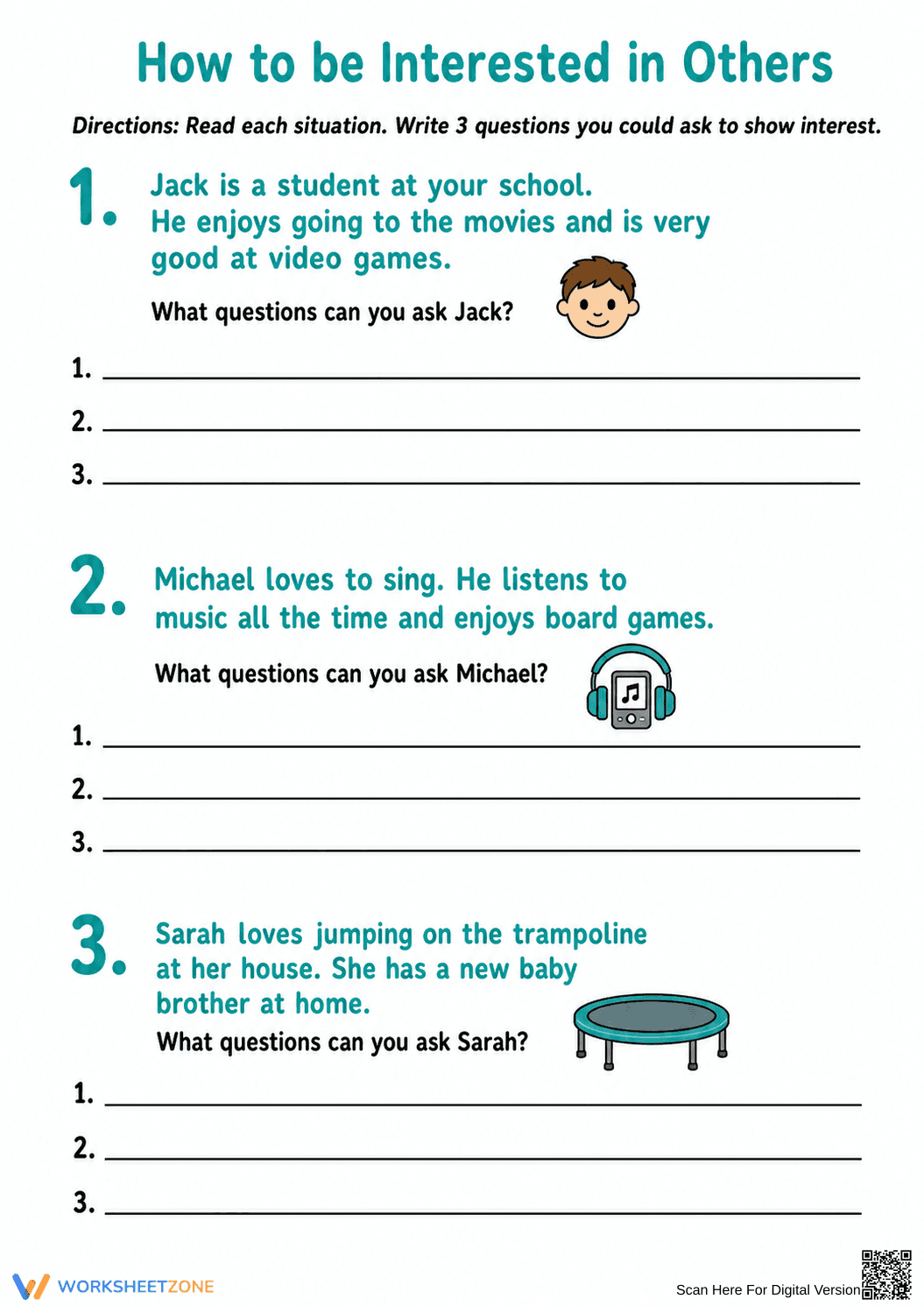
This social skills worksheet helps students master the art of conversational reciprocity by practicing how to show genuine interest in peers. By formulating specific questions based on a peer's hobbies and life events, learners move beyond basic greetings to build meaningful connections. It provides a structured framework for developing social perspective-taking and active listening skills.
At a Glance
- Grade: 4 · Subject: Social Skills
- Standard:
CCSS.ELA-LITERACY.SL.4.1— Pose and respond to specific questions to clarify or follow up on information- Skill Focus: Conversational Reciprocity
- Format: 1 page · 9 problems · Open-ended · PDF
- Best For: Social-emotional learning and autism support
- Time: 15–20 minutes
Inside this one-page PDF, you will find three distinct social scenarios featuring relatable characters: Jack, Michael, and Sarah. Each scenario includes a brief profile of the person’s interests—ranging from video games and music to family updates—paired with visual icons to support reading comprehension. Students are provided with nine dedicated response lines to draft three unique questions for each individual.
This resource is designed for a zero-prep workflow that fits into any busy school day. First, print the single-page worksheet (30 seconds). Next, distribute the sheet during a social skills block or small group session (1 minute). Finally, review the student's questions to provide immediate feedback on social relevance and tone (5 minutes). This makes it an ideal choice for unexpected sub plans or transition periods.
This activity aligns with CCSS.ELA-LITERACY.SL.4.1.C: "Pose and respond to specific questions to clarify or follow up on information, and make comments that contribute to the discussion and link to the remarks of others." By focusing on the "pose" aspect of this standard, students learn the mechanics of initiating social engagement.
Use this worksheet during a Tier 2 social skills intervention or as a warm-up for a speech therapy session. A great formative assessment tip is to observe if the student’s questions are "open-ended" (starting with Who, What, or How) versus "closed-ended" (Yes/No). This helps identify if the student can sustain a conversation beyond a single exchange.
This resource is specifically designed for students with autism spectrum disorder, social communication challenges, or ADHD who benefit from explicit instruction in social cues. It pairs naturally with a "Social Detective" style lesson or an anchor chart about conversation drivers. It is also effective for general education students needing a refresher on empathy and friendship-building.
Research by Fisher & Frey (2014) emphasizes that social-emotional learning is most effective when students are given structured opportunities to practice perspective-taking in simulated environments before applying them in real-world peer interactions. This worksheet applies those principles by providing low-stakes scenarios that require students to infer what a peer might value. By generating three distinct questions per scenario, students are pushed to think deeply about a single topic rather than relying on repetitive social scripts. According to the RAND AIRS 2024 report, explicit social skill instruction significantly improves classroom climate and reduces social anxiety among neurodivergent learners. This 9-task practice set ensures that students have the repetition necessary to internalize the habit of asking follow-up questions, which is a foundational component of social competence and long-term relationship maintenance in educational settings.


