


























Views
Downloads

Printable Social Problem Solving Worksheet | Grade 3
Paste this activity's link or code into your existing LMS (Google Classroom, Canvas, Teams, Schoology, Moodle, etc.).
Students can open and work on the activity right away, with no student login required.
You'll still be able to track student progress and results from your teacher account.
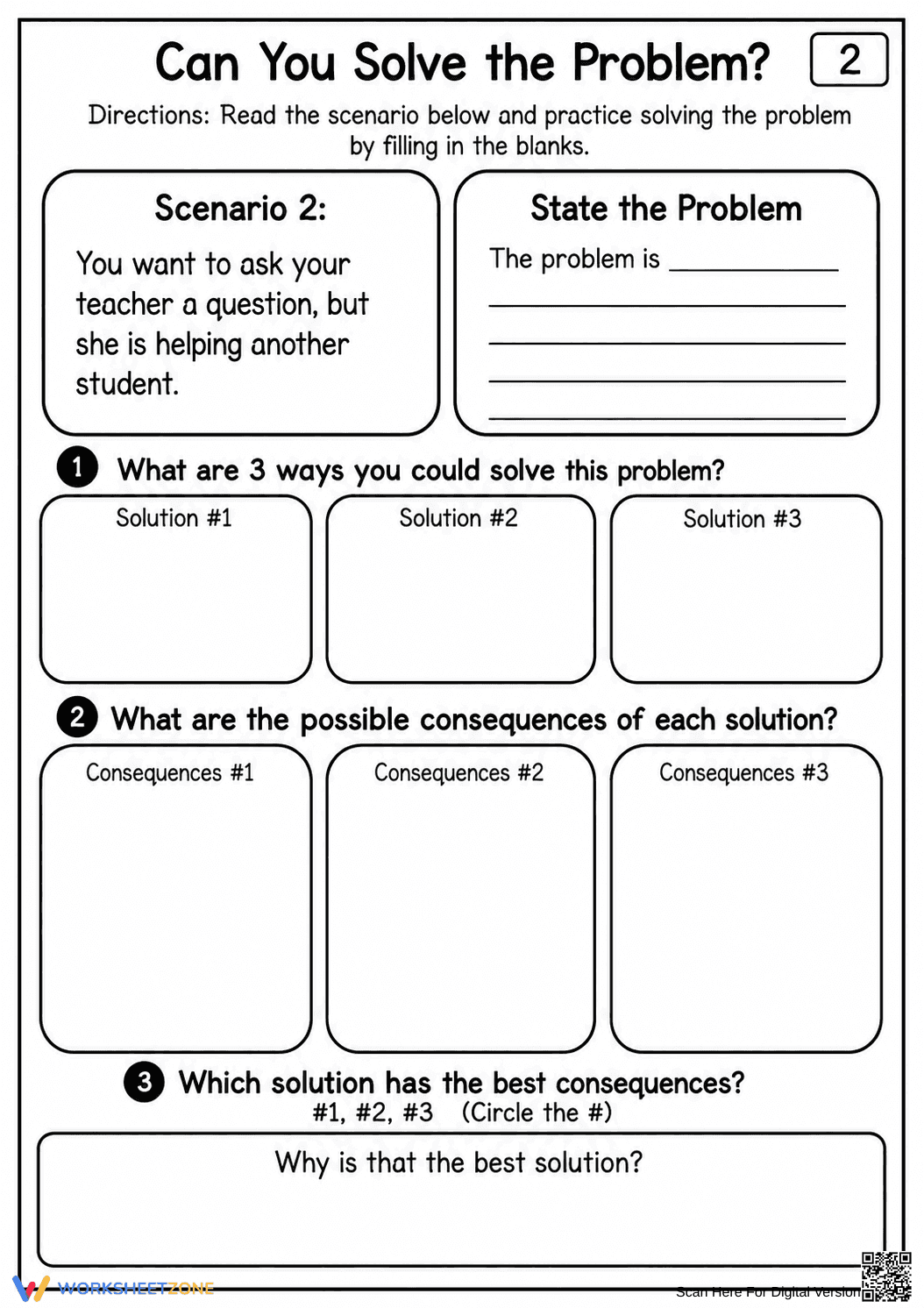
This Grade 3 social skills worksheet helps students manage common classroom challenges by practicing structured problem-solving. By analyzing a relatable scenario, learners identify the core issue, brainstorm multiple solutions, and evaluate potential consequences before making a reasoned decision.
At a Glance
- Grade: 3 · Subject: Social Skills
- Standard:
CCSS.ELA-LITERACY.W.3.1— Support a point of view with reasons- Skill Focus: Problem Solving & Consequences
- Format: 1 page · 4 problems · No answer key · PDF
- Best For: Independent practice or SEL blocks
- Time: 15–20 minutes
This single-page resource features a highly relatable classroom scenario where a student needs help but the teacher is busy. It includes four distinct task sections: stating the problem, brainstorming three unique solutions, mapping out the specific consequences for each proposed action, and finally selecting the best approach. The worksheet provides clearly defined, fill-in-the-blank boxes that visually guide students through the decision-making process without overwhelming them.
- Print (1 minute): Simply print the single-page PDF. No special materials or prior setup are required.
- Distribute (1 minute): Hand out the worksheet during morning meeting, an SEL block, or as a fast-finisher activity.
- Review (3 minutes): Briefly read the scenario aloud and let students work independently. Total teacher prep time is under two minutes, making this an ideal emergency sub plan.
Aligned to primary standard CCSS.ELA-LITERACY.W.3.1: Write opinion pieces on topics or texts, supporting a point of view with reasons. By requiring students to choose the best solution and justify their choice based on the evaluated consequences, this activity reinforces foundational argumentative writing skills within a social-emotional context. Both standard codes can be copied directly into lesson plans, IEP goals, or district curriculum mapping tools.
Use this worksheet during a dedicated social-emotional learning (SEL) block to introduce the concept of cause and effect in personal behavior. It works exceptionally well as an independent reflection activity after direct instruction on classroom expectations. Alternatively, assign it to small groups and have students debate which solution yields the best outcome. As a formative assessment tip, observe whether students can accurately predict realistic consequences for negative or impulsive solutions. Expected completion time is 15 to 20 minutes.
This resource is designed for elementary school students, particularly those in second through fifth grade, who are developing their self-management and social awareness skills. It is highly beneficial for neurodivergent learners or students with IEP goals focused on peer interactions and impulse control. Pair this worksheet with a classroom anchor chart detailing the "Stop, Think, Act" framework to provide additional scaffolding for students who struggle with abstract social concepts.
Integrating structured decision-making exercises into daily routines significantly improves student behavior and peer relationships. This worksheet targets CCSS.ELA-LITERACY.W.3.1, requiring learners to support a point of view with reasons as they evaluate social scenarios. According to a 2024 report by EdReports, embedding critical thinking and consequence evaluation into relatable classroom contexts increases student engagement and retention of social-emotional concepts. When children practice identifying problems and brainstorming multiple solutions in a low-stakes environment, they build the cognitive flexibility needed to handle real-world conflicts. By explicitly mapping out the outcomes of different choices, educators can foster a more empathetic and self-regulated classroom community. This targeted practice ensures that students are not just memorizing rules, but actively developing the analytical skills necessary for long-term social and academic success.


