


























Views
Downloads

Printable Body Language Worksheet | Grade 6-8
Paste this activity's link or code into your existing LMS (Google Classroom, Canvas, Teams, Schoology, Moodle, etc.).
Students can open and work on the activity right away, with no student login required.
You'll still be able to track student progress and results from your teacher account.
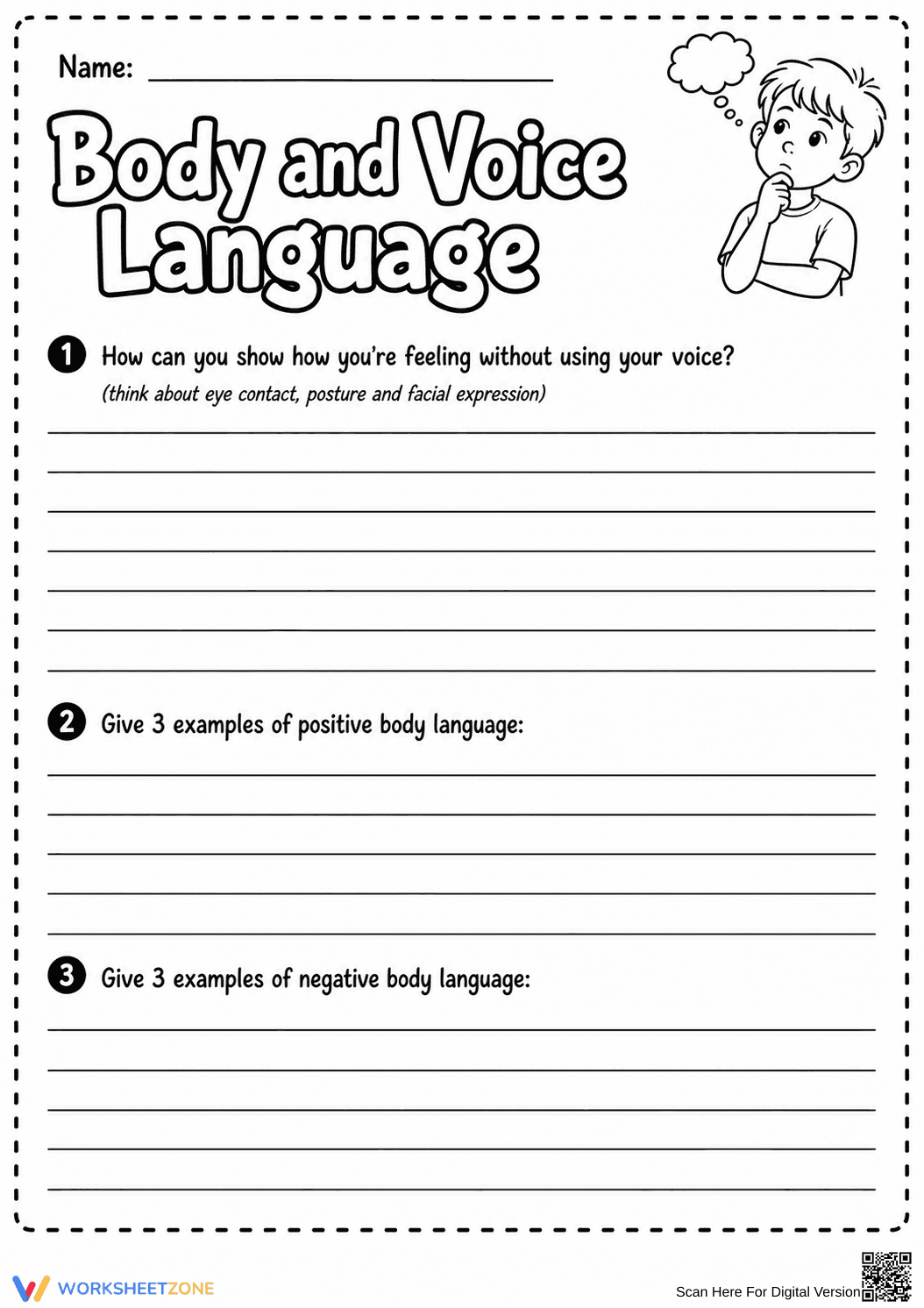
This middle school social skills worksheet helps students identify and interpret nonverbal communication cues. By reflecting on how posture, eye contact, and facial expressions convey emotions, students build essential emotional intelligence. The activity requires learners to articulate specific examples of both positive and negative body language in everyday interactions.
At a Glance
- Grade: 6-8 · Subject: Social Skills
- Standard:
CCSS.ELA-LITERACY.SL.6.1— Engage effectively in collaborative discussions and express ideas clearly- Skill Focus: Nonverbal Communication
- Format: 1 page · 3 problems · No answer key · PDF
- Best For: Independent practice or group discussion
- Time: 15–20 minutes
This single-page resource features three open-ended prompts about nonverbal behaviors. The first question guides students to consider how feelings are expressed without a voice, focusing on eye contact, posture, and facial expressions. The next two questions require students to generate three examples of positive body language and three of negative body language. Ample lined space is provided for written responses.
Designed for immediate classroom implementation, this zero-prep worksheet follows a simple three-step workflow:
- Print (1 minute): The clean design ensures quick printing for the entire class.
- Distribute (1 minute): Hand out as a standalone activity or SEL supplement.
- Review (5 minutes): Use responses to facilitate a class discussion about nonverbal cues.
With under two minutes of teacher prep time, this resource is perfect for emergency sub plans or advisory periods.
This activity aligns with CCSS.ELA-LITERACY.SL.6.1, which requires students to engage effectively in a range of collaborative discussions, building on others' ideas and expressing their own clearly. Understanding nonverbal communication is a foundational component of this standard, as it enables students to interpret peer reactions and adjust their own communication styles accordingly. Both standard codes can be copied directly into lesson plans, IEP goals, or district curriculum mapping tools.
Teachers can utilize this worksheet as an introductory activity before a unit on effective communication. It works well during advisory periods to spark conversations about peer dynamics. As a formative assessment tip, observe students sharing their examples; note whether they accurately connect physical gestures to emotional states. Expected completion time ranges from 15 to 20 minutes.
This resource is primarily designed for middle school students in grades 6 through 8, particularly those participating in social skills groups, advisory classes, or special education programs focusing on autism support. The straightforward prompts offer natural differentiation; students who need more support can list basic emotions, while advanced learners can describe complex social scenarios. It pairs perfectly with role-playing activities or anchor charts detailing active listening strategies.
Developing a strong grasp of nonverbal communication is critical for middle school students navigating complex social environments. This worksheet supports CCSS.ELA-LITERACY.SL.6.1 by helping learners engage effectively in collaborative discussions and express ideas clearly through an understanding of physical cues. According to a comprehensive EdReports 2024 analysis, integrating explicit social-emotional learning tasks into the daily curriculum significantly improves students' ability to interpret peer interactions and reduces classroom conflicts. By requiring students to categorize positive and negative body language, this activity bridges the gap between abstract emotional concepts and concrete behavioral observations. Educators can leverage these structured reflection exercises to build a more empathetic and communicative classroom culture, ensuring that all students have the foundational skills necessary for successful collaborative work and long-term interpersonal success.


