


























Views
Downloads

Printable Making Mistakes Worksheet | Grade K-1
Paste this activity's link or code into your existing LMS (Google Classroom, Canvas, Teams, Schoology, Moodle, etc.).
Students can open and work on the activity right away, with no student login required.
You'll still be able to track student progress and results from your teacher account.
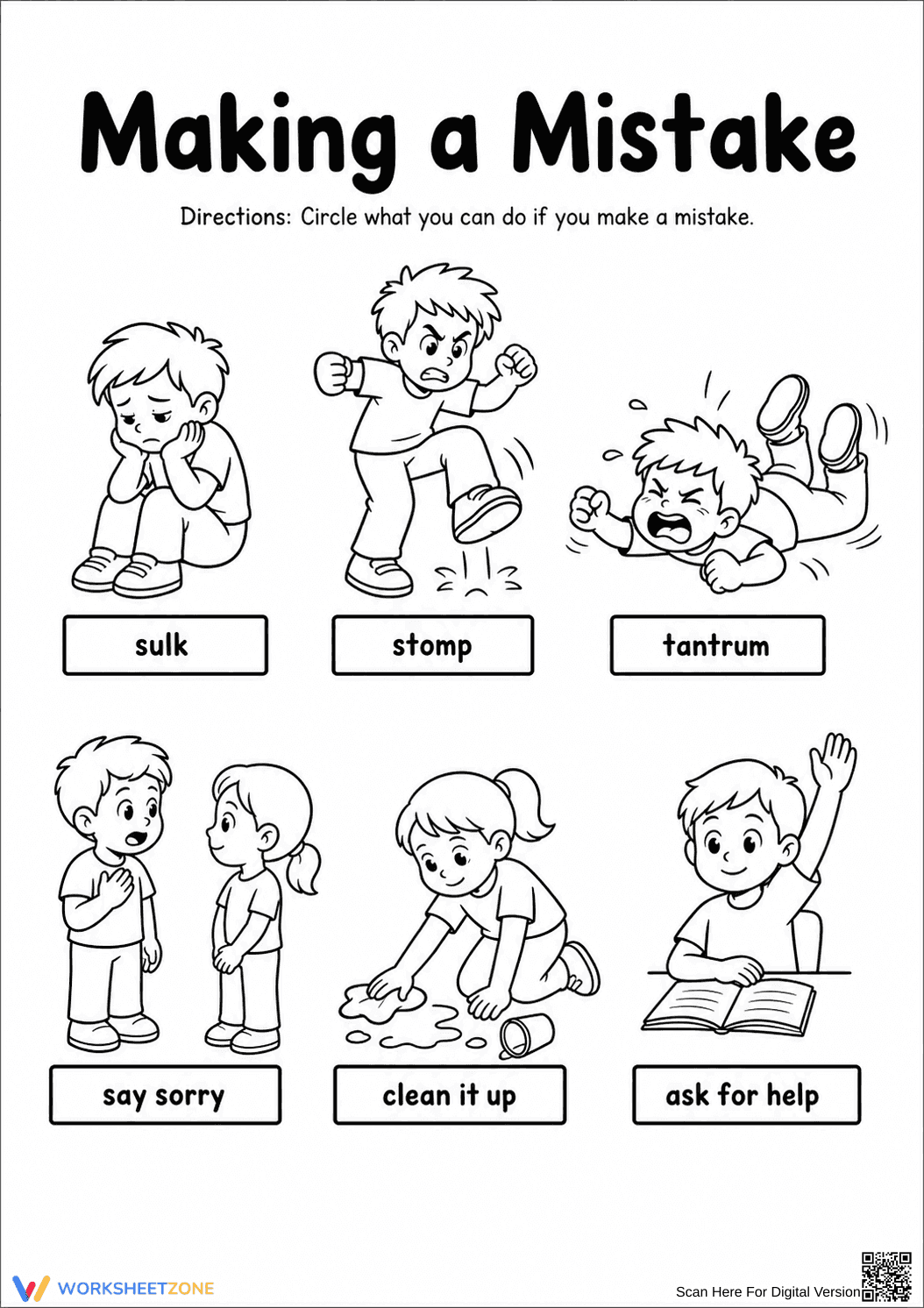
This foundational social-emotional learning worksheet helps early elementary students identify positive ways to respond when they make a mistake. By evaluating relatable scenarios, children learn to choose constructive actions over negative emotional reactions, building essential self-management and problem-solving skills for the classroom and beyond.
At a Glance
- Grade: K · Subject: Social Skills
- Standard:
CASEL.SM— Regulate emotions and behaviors in different situations- Skill Focus: Positive behavioral choices
- Format: 1 page · 6 problems · No answer key needed · PDF
- Best For: Morning work or SEL blocks
- Time: 10–15 minutes
This single-page resource features six distinct, illustrated scenarios showing common reactions to making a mistake. Students are presented with three negative reactions (sulking, stomping, throwing a tantrum) and three positive actions (saying sorry, cleaning it up, asking for help). The clear, bold illustrations and simple vocabulary make it highly accessible for early readers. Students simply review each picture and circle the choices that represent a helpful, constructive way to handle an error.
Designed for immediate classroom implementation, this activity requires virtually no teacher setup:
- Print (1 minute): The high-contrast black-and-white design prints perfectly without draining color ink.
- Distribute (1 minute): Hand out the single page during morning meeting or a dedicated social skills block.
- Review (3 minutes): The visual nature of the task allows for rapid whole-class review and discussion.
With a total prep time of under two minutes, this worksheet is an excellent addition to emergency sub plans or a quick reset activity after a challenging recess.
This resource aligns with core social-emotional learning frameworks, specifically CASEL.SM (Self-Management), which requires students to regulate their emotions, thoughts, and behaviors effectively in different situations. It also supports early communication standards by encouraging students to express their feelings constructively. Both standard codes can be copied directly into lesson plans, IEP goals, or district curriculum mapping tools.
Teachers can utilize this worksheet as a proactive tool during the first weeks of school to establish classroom expectations around making mistakes. It also serves as an effective restorative activity for students struggling with emotional regulation. While students work, observe whether they independently distinguish between positive and negative reactions, using this as a quick formative assessment. Expect the independent task to take 5 minutes, followed by 10 minutes of group discussion.
This worksheet is primarily designed for Kindergarten and first-grade students, as well as older students receiving specialized instruction in social skills or autism support programs. The heavy reliance on visual cues provides built-in differentiation for English Language Learners and pre-readers. It pairs perfectly with popular children's books about making mistakes or a classroom anchor chart detailing the steps of a genuine apology.
Integrating explicit instruction on emotional regulation, such as the skills practiced in this CASEL.SM aligned activity, is critical for early childhood development. When students learn to regulate emotions and behaviors in different situations, they experience fewer behavioral disruptions and higher academic engagement. According to a comprehensive EdReports 2024 analysis of foundational curricula, embedding visual scenario evaluations into daily routines significantly improves students' ability to internalize positive behavioral choices. By asking children to actively identify constructive responses—like asking for help or cleaning up—rather than simply telling them what not to do, educators foster a growth mindset. This targeted practice helps shift the focus from the mistake itself to the actionable steps required for resolution, building long-term resilience, enhancing peer relationships, and creating a much more supportive classroom environment for all learners.


