


























Views
Downloads
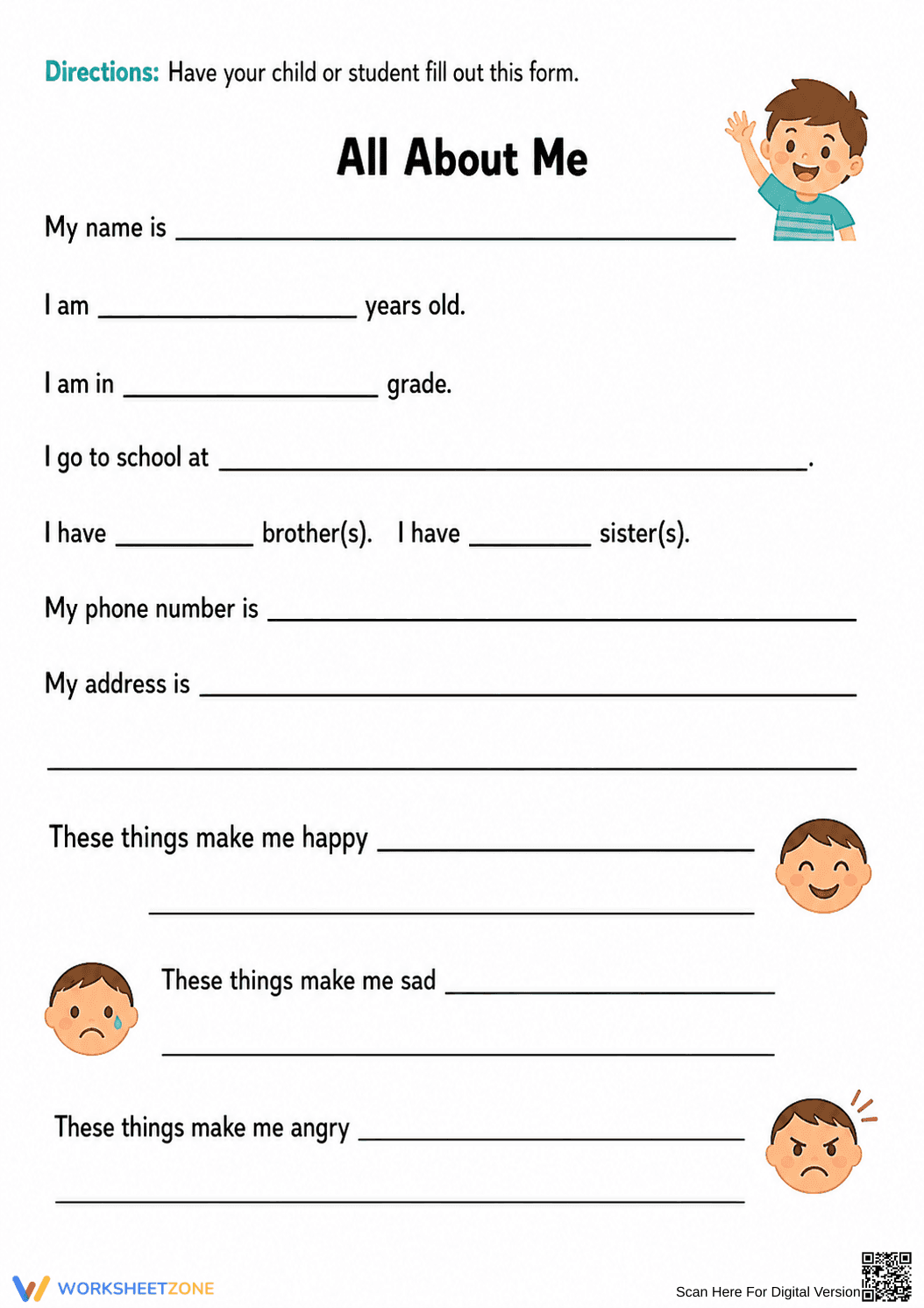

Grade 1 All About Me — Printable No-Prep Worksheet
Paste this activity's link or code into your existing LMS (Google Classroom, Canvas, Teams, Schoology, Moodle, etc.).
Students can open and work on the activity right away, with no student login required.
You'll still be able to track student progress and results from your teacher account.
This Grade 1 social skills worksheet provides a structured framework for students to practice self-identification and emotional expression. By completing specific personal prompts, early learners build the foundational communication skills necessary for social integration and safety, bridging the gap between personal experience and academic literacy.
At a Glance
- Grade: 1 · Subject: Social Skills
- Standard:
CCSS.ELA-LITERACY.W.1.2— Write informative texts to name a topic and supply facts- Skill Focus: Personal identification and emotional awareness
- Format: 1 page · 11 problems · No answer key needed · PDF
- Best For: First-week icebreakers and IEP goal tracking
- Time: 10–15 minutes
The worksheet features a clean, distraction-free layout specifically designed for students who benefit from visual clarity. It includes 11 fill-in-the-blank prompts covering vital personal data such as name, age, school, and contact information. Additionally, the bottom half of the page transitions into emotional literacy, asking students to identify triggers for happiness, sadness, and anger using simple sentence starters and visual emotion cues.
The zero-prep workflow for this resource is designed for maximum efficiency in busy classrooms. Teachers can print the single-page PDF in less than 30 seconds. Distribution takes approximately one minute, as the directions are self-explanatory for most early readers. Reviewing the completed forms allows for immediate formative assessment, totaling under two minutes of teacher preparation. This makes it an ideal choice for emergency sub plans or transition periods.
This resource aligns with CCSS.ELA-LITERACY.W.1.2, which requires students to write informative or explanatory texts in which they name a topic, supply some facts about the topic, and provide some sense of closure. By focusing on the self as the topic, students meet this standard through functional, real-world application. Both standard codes can be copied directly into lesson plans, IEP goals, or district curriculum mapping tools.
Use this worksheet during the first week of school as a low-stakes icebreaker to help you learn about your students' backgrounds and emotional baselines. It also functions effectively as a formative assessment tool for tracking progress on personal information IEP goals; teachers can observe whether students know their address and phone number from memory. Expect students to spend 10 to 15 minutes completing the form depending on their writing speed and fine motor abilities.
This resource is primarily intended for early elementary students and learners in special education settings, particularly those with autism or developmental delays. It pairs naturally with a Zones of Regulation anchor chart or a direct instruction lesson on community safety. The simplified text and clear lines provide necessary support for students with fine motor challenges, ensuring accessibility for diverse learning profiles.
Research from RAND AIRS 2024 emphasizes that functional writing tasks, such as self-identification forms, are critical for students with neurodiverse needs to develop autonomy. The All About Me worksheet addresses the CCSS.ELA-LITERACY.W.1.2 standard by requiring students to write informative texts to name a topic and supply facts about a familiar subject—themselves. By integrating emotional check-ins with biographical data, the resource supports the development of self-advocacy skills. Studies suggest that providing structured sentence frames helps scaffold the transition from oral storytelling to formal written expression. This worksheet acts as a primary scaffold, allowing students to focus on content generation rather than complex sentence construction. Educators can use the data gathered from these 11 prompts to tailor future social-emotional learning interventions, ensuring that classroom instruction remains responsive to individual student triggers and personal histories.


