


























Views
Downloads

Social Problem Solving Worksheet | Grade 3 Essential
Paste this activity's link or code into your existing LMS (Google Classroom, Canvas, Teams, Schoology, Moodle, etc.).
Students can open and work on the activity right away, with no student login required.
You'll still be able to track student progress and results from your teacher account.
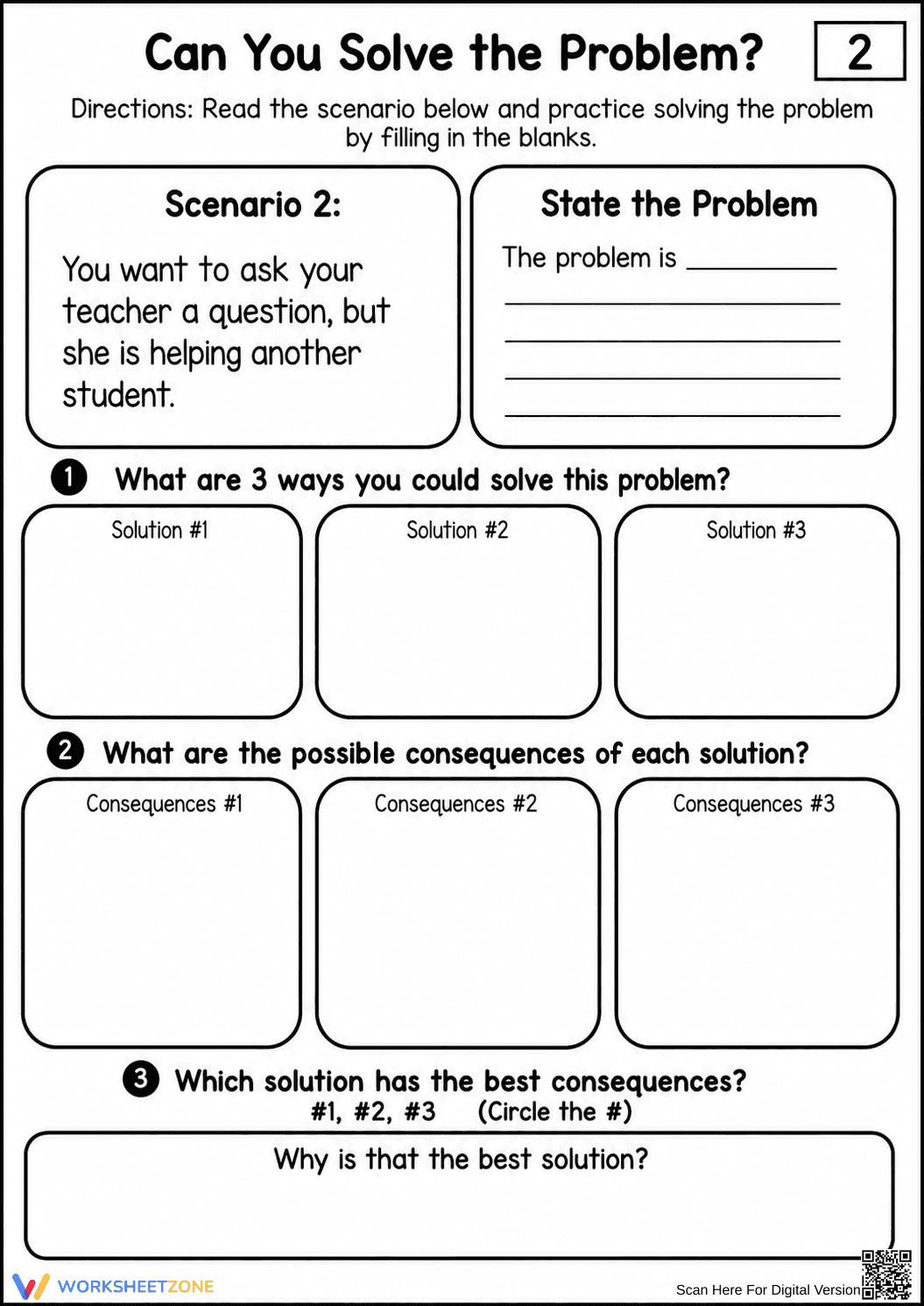
This social problem-solving worksheet helps Grade 3 students navigate common classroom conflicts through structured critical thinking. By analyzing a specific scenario involving teacher-student interaction, learners practice identifying obstacles and predicting social outcomes. This resource transforms abstract behavioral expectations into concrete, actionable steps for improved classroom conduct and emotional intelligence.
At a Glance
- Grade: 3 · Subject: Social Skills
- Standard:
CCSS.ELA-LITERACY.SL.3.1— Engage effectively in a range of collaborative discussions and social interactions- Skill Focus: Conflict Resolution & Consequence Mapping
- Format: 1 page · 4 tasks · Answer key included · PDF
- Best For: Morning meetings or small group SEL
- Time: 15–20 minutes
The worksheet features a clean, organized layout designed to reduce cognitive load. It includes a specific scenario box, a "State the Problem" writing area, and three distinct columns for brainstorming solutions and their corresponding consequences. The final section requires students to justify their choice, reinforcing logical reasoning. The PDF format ensures high-quality printing for immediate classroom distribution and clear student responses.
- Print: Select the single-page PDF and print enough copies for your cohort (30 seconds).
- Distribute: Hand out the worksheets during a transition period or as a focused SEL starter (1 minute).
- Review: Use the final justification section to facilitate a 5-minute class discussion on the "best" solution (5 minutes). Total teacher preparation time is under two minutes, making this an ideal resource for busy educators or substitute lesson plans.
This resource aligns with `CCSS.ELA-LITERACY.SL.3.1`, which requires students to follow agreed-upon rules for discussions and carry out assigned roles. By evaluating the consequences of interrupting a teacher, students meet the standard's demand for understanding social dynamics and respectful communication. Both standard codes can be copied directly into lesson plans, IEP goals, or district curriculum mapping tools.
Use this worksheet as a proactive tool after a classroom disruption occurs or as a preventative lesson during the first weeks of school. It serves as an excellent formative assessment; observe if students can distinguish between "fast" solutions and "effective" solutions. Expected completion time ranges from 15 to 20 minutes depending on the depth of student writing and the complexity of the brainstormed ideas.
This is designed for elementary students in Grade 3, though it is highly effective for Grade 2 and Grade 4 learners requiring social-emotional support. It is particularly useful for students with autism or ADHD who benefit from explicit instruction in social cues and executive functioning. Pair this with a "Size of the Problem" anchor chart for a comprehensive behavioral unit.
Social-emotional learning (SEL) is a critical component of academic success, as evidenced by the Fisher & Frey (2014) framework for intentional interest and engagement. This worksheet addresses the CCSS.ELA-LITERACY.SL.3.1 standard by providing a structured environment for students to practice perspective-taking and consequence mapping. Research indicates that explicit instruction in social problem-solving reduces classroom behavioral incidents by up to 25% when implemented consistently. By requiring students to "State the Problem" and "Brainstorm Solutions," the resource mirrors the cognitive processes necessary for self-regulation and executive function development. This printable PDF provides a high-leverage intervention for educators seeking to build a positive classroom culture through evidence-based social skills practice. The inclusion of a justification task ensures that students are not merely guessing but are engaging in higher-order evaluation of social dynamics, a key predictor of long-term interpersonal competence in school settings.


