


























Views
Downloads
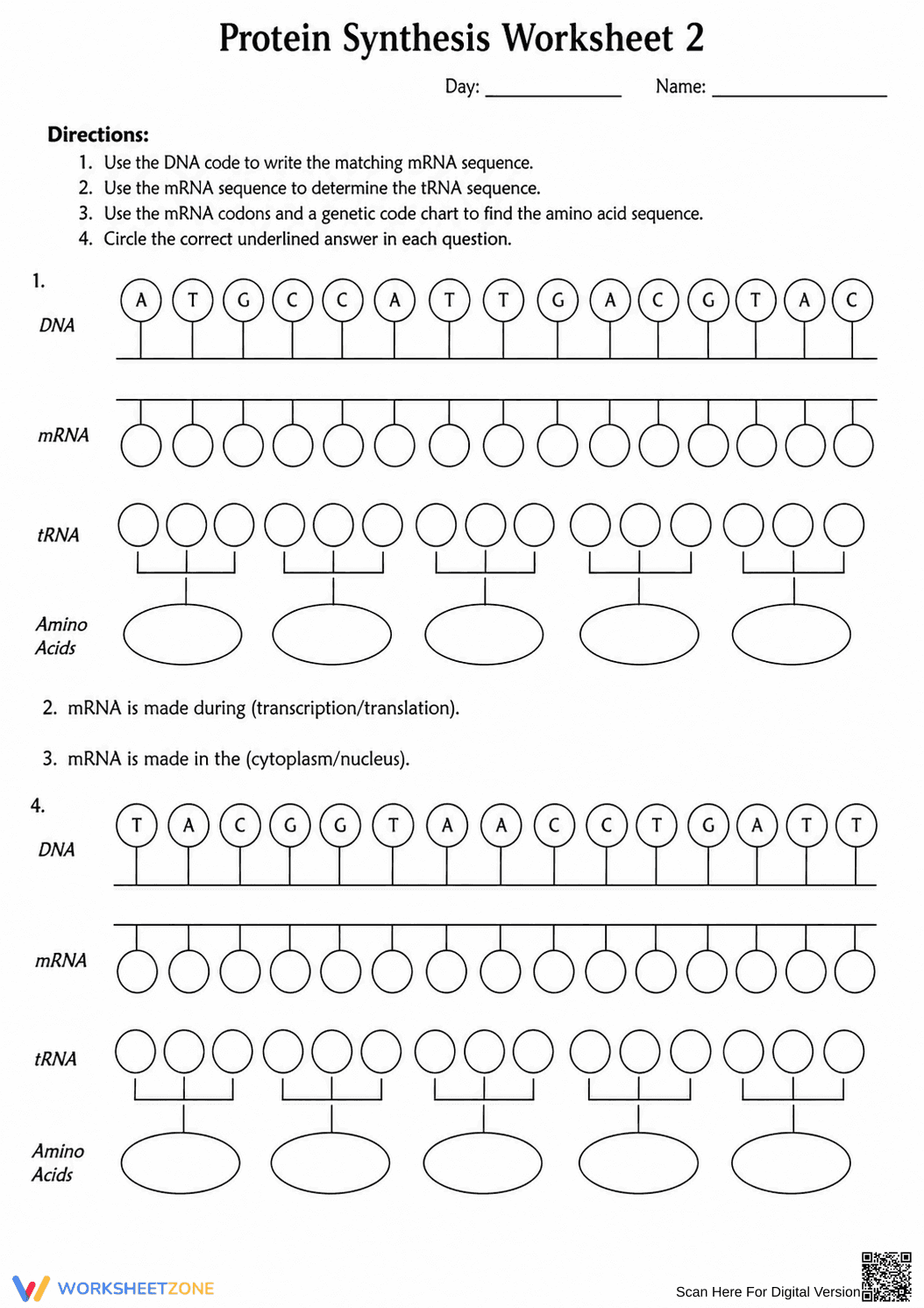

Grade 9 Protein Synthesis — Printable No-Prep Worksheet
Paste this activity's link or code into your existing LMS (Google Classroom, Canvas, Teams, Schoology, Moodle, etc.).
Students can open and work on the activity right away, with no student login required.
You'll still be able to track student progress and results from your teacher account.
This high school biology worksheet provides focused practice on the central dogma of molecular biology. Students will actively transcribe DNA into mRNA and translate mRNA into tRNA to determine amino acid sequences. This hands-on activity solidifies their understanding of how genetic information is expressed as functional proteins.
At a Glance
- Grade: 9 · Subject: Biology
- Standard:
HS-LS1-1— Explain how DNA structure determines protein structure- Skill Focus: Transcription and Translation
- Format: 1 page · 4 problems · Answer key included · PDF
- Best For: Independent practice or review
- Time: 15–20 minutes
Inside this single-page resource, educators will find two comprehensive sequence mapping problems and two targeted concept-check questions. Students are guided through the exact steps of protein synthesis, filling in blank circles to represent nucleotide bases for mRNA and tRNA, followed by identifying the resulting amino acids. The clear visual layout helps learners track the flow of genetic information. A complete answer key is included for quick grading.
This resource is designed for immediate classroom implementation with a zero-prep workflow.
- Print (1 minute): Download the PDF and print a class set. The black-and-white design is ink-friendly and copies clearly.
- Distribute (1 minute): Hand out the worksheet alongside a standard genetic code chart (codon wheel or table).
- Review (3 minutes): Use the included answer key to quickly check student sequences or project it on the board for self-correction.
Total teacher preparation takes under two minutes, making this an excellent option for emergency sub plans or spontaneous review sessions.
This activity is directly aligned to HS-LS1-1: Construct an explanation based on evidence for how the structure of DNA determines the structure of proteins which carry out the essential functions of life through systems of specialized cells. By mapping the exact base-pairing rules, students gather the foundational evidence needed to explain this complex biological system. Both standard codes can be copied directly into lesson plans, IEP goals, or district curriculum mapping tools.
Deploy this worksheet immediately after direct instruction on transcription and translation to reinforce the base-pairing rules (A-U, C-G). It also serves as an effective formative assessment tool; as students work, walk the room and observe whether they are correctly substituting Uracil for Thymine in their mRNA sequences. Expected completion time is 15 to 20 minutes, depending on the student's familiarity with reading a codon chart.
This resource is ideal for high school biology students encountering molecular genetics for the first time. The structured, visual format provides built-in scaffolding for learners who struggle with abstract biological processes, keeping their work organized step-by-step. Pair this worksheet with a visual anchor chart of a cell showing the nucleus and ribosomes to help students connect the sequence mapping to physical cellular locations.
Mastering the mechanics of transcription and translation is critical for high school biology students. Aligned with HS-LS1-1, this resource helps learners explain how DNA structure determines protein structure through active sequence mapping. According to a ScienceDirect TpT Analysis, providing students with structured, visual models for abstract molecular processes significantly reduces cognitive overload and improves retention of complex genetic concepts. By breaking down the central dogma into discrete, manageable steps—from DNA to mRNA, tRNA, and finally amino acids—students can systematically build their understanding of gene expression. This targeted practice ensures that foundational base-pairing rules are internalized before moving on to more advanced topics like genetic mutations or biotechnology.


