


























Views
Downloads
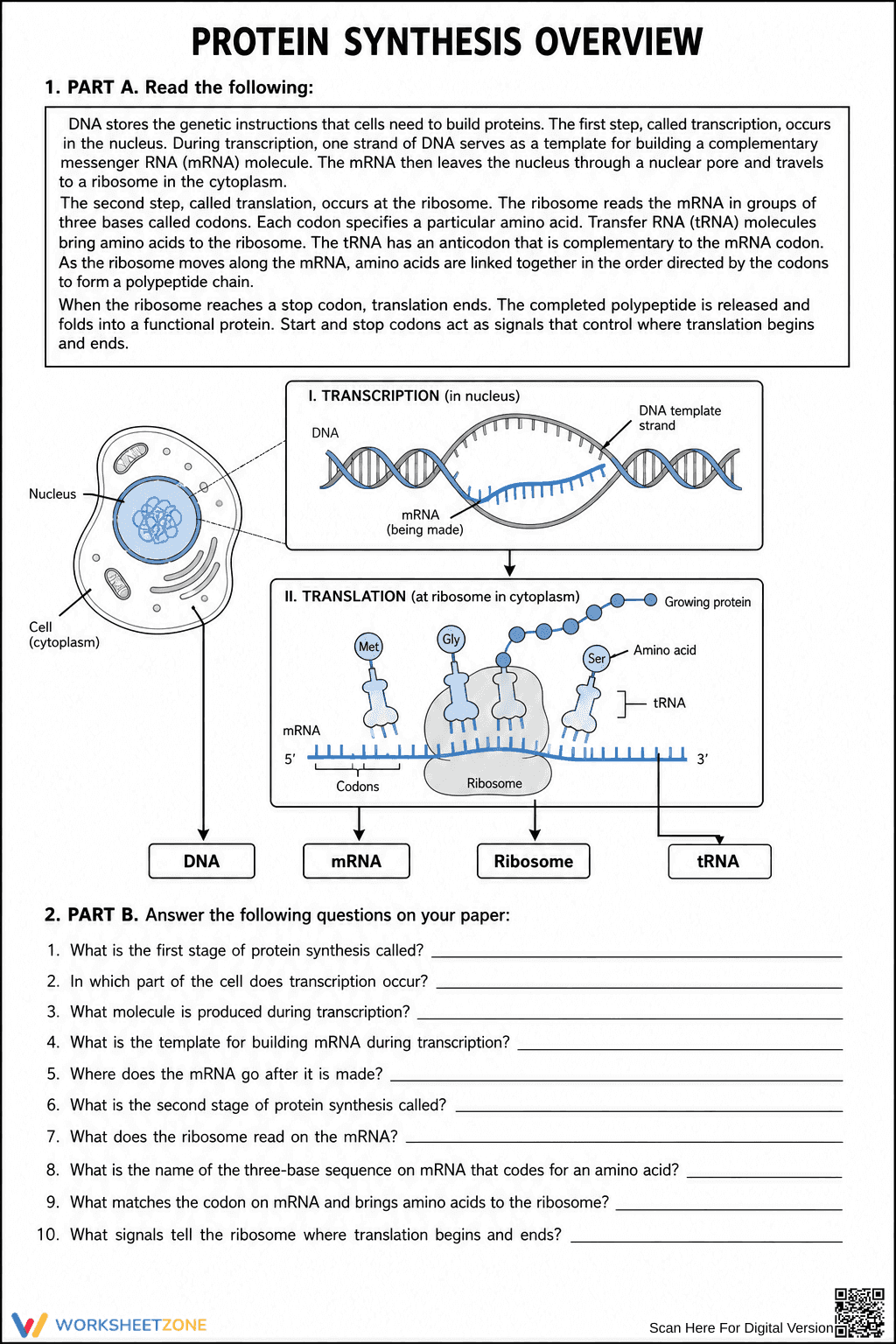

Printable Protein Synthesis Worksheet | HS Biology
Paste this activity's link or code into your existing LMS (Google Classroom, Canvas, Teams, Schoology, Moodle, etc.).
Students can open and work on the activity right away, with no student login required.
You'll still be able to track student progress and results from your teacher account.
This high school biology worksheet provides a clear, structured overview of protein synthesis, helping students master the complex processes of transcription and translation. By combining a focused reading passage with detailed diagrams, learners will confidently trace how genetic information moves from DNA to functional proteins.
At a Glance
- Grade: HS · Subject: Biology
- Standard:
HS-LS1-1— Explain how DNA structure determines protein structure- Skill Focus: Transcription and Translation
- Format: 1 page · 10 problems · Answer key included · PDF
- Best For: Independent practice or sub plans
- Time: 15–20 minutes
This single-page resource features a reading section breaking down the central dogma of molecular biology. It includes a labeled diagram illustrating transcription in the nucleus and translation at the ribosome. Students then complete ten comprehension questions testing their understanding of vocabulary like mRNA, tRNA, codons, and amino acids. A complete answer key is provided.
This worksheet requires zero teacher preparation:
- Print (1 minute): The single-page layout is optimized for standard black-and-white printing, ensuring diagrams remain crisp and legible.
- Distribute (1 minute): Hand out the worksheet as a self-contained lesson that requires no additional textbooks or digital devices.
- Review (3 minutes): Use the included answer key to quickly check student responses or guide a whole-class review session.
With prep time under two minutes, this is ideal for sub plans or quick assessments.
This resource is tightly aligned to the Next Generation Science Standards, specifically focusing on HS-LS1-1: Construct an explanation based on evidence for how the structure of DNA determines the structure of proteins which carry out the essential functions of life through systems of specialized cells. It also supports foundational knowledge required for advanced genetics topics. Both standard codes can be copied directly into lesson plans, IEP goals, or district curriculum mapping tools.
This worksheet fits easily into various instructional moments. Use it immediately after direct instruction on the central dogma to reinforce new vocabulary and concepts. Alternatively, assign it as a standalone homework task to review the differences between transcription and translation. As a formative assessment tip, monitor students as they answer question nine regarding tRNA; if they struggle to identify the anticodon's role, it indicates a need to review the translation process at the ribosome. Expected completion time is 15 to 20 minutes.
Designed for high school biology students learning molecular genetics, the integrated reading passage and diagram provide built-in scaffolding. This makes it accessible for visual learners needing reference material directly on the page. It pairs perfectly with a 3D DNA modeling activity, grounding abstract concepts in readable text.
Mastering the mechanics of transcription and translation is a critical milestone in high school biology instruction. Standard HS-LS1-1 requires students to explain how DNA structure determines protein structure, a concept that frequently challenges learners due to its microscopic scale and complex, specialized vocabulary. According to ScienceDirect TpT Analysis, integrating informational text with clear, labeled diagrams significantly improves student comprehension of these abstract biological processes. By presenting the reading passage alongside a detailed visual model of the cell, this worksheet reduces cognitive load and allows students to map new terms directly to their precise structural locations. This effective dual-coding approach ensures that learners can accurately visualize how mRNA travels from the nucleus to the cytoplasm, ultimately leading to stronger long-term retention and better overall performance on summative genetics assessments.


