


























Views
Downloads
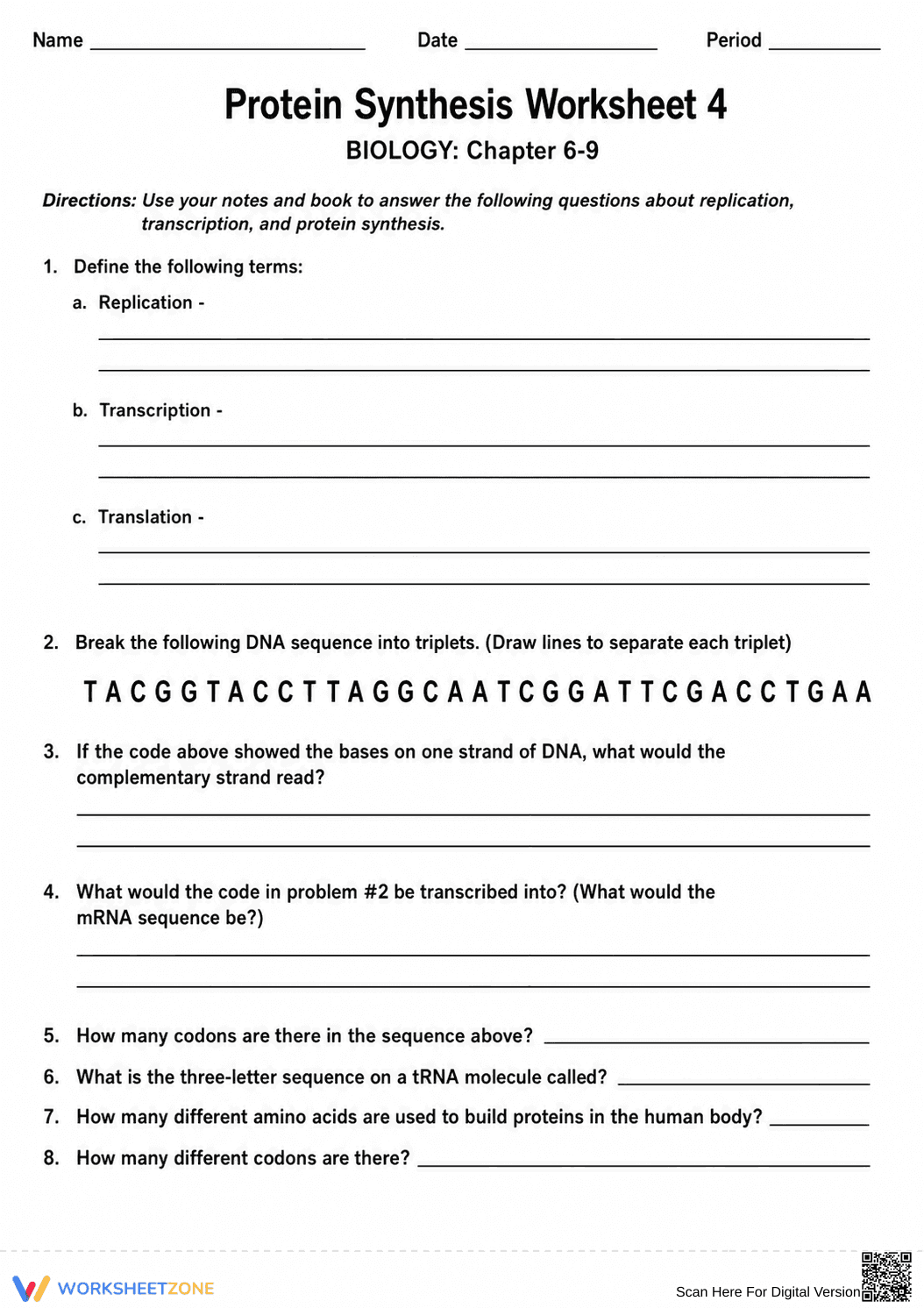

Printable Protein Synthesis Worksheet | HS Biology
Paste this activity's link or code into your existing LMS (Google Classroom, Canvas, Teams, Schoology, Moodle, etc.).
Students can open and work on the activity right away, with no student login required.
You'll still be able to track student progress and results from your teacher account.
This high school biology worksheet provides focused practice on the core mechanisms of protein synthesis, ensuring students can accurately model DNA replication, transcription, and translation. By working directly with nucleotide sequences, learners solidify their understanding of how genetic information is converted into functional proteins.
At a Glance
- Grade: 9-12 · Subject: Biology
- Standard:
HS-LS1-1— Explain how DNA structure determines protein structure- Skill Focus: Transcription and Translation
- Format: 1 page · 8 problems · Answer key included · PDF
- Best For: Independent practice or review
- Time: 15–20 minutes
This single-page resource features eight targeted questions guiding students through the central dogma of molecular biology. Tasks begin with vocabulary definitions before moving into sequence manipulation. Students break a DNA sequence into triplets, determine the complementary strand, and transcribe an mRNA sequence. The worksheet concludes with analytical questions regarding codon counts, tRNA terminology, and amino acid totals, complete with an answer key.
Zero-Prep Workflow
This resource is designed for immediate classroom implementation with under two minutes of total teacher prep time.
- Print (1 minute): Generate copies of the single-page PDF for your roster.
- Distribute (1 minute): Hand out the worksheet as a warm-up, exit ticket, or primary independent task.
- Review (5 minutes): Use the included answer key to quickly verify student sequences and definitions.
Because the instructions are self-explanatory, this worksheet functions perfectly as an emergency sub plan or a quiet independent study assignment.
Standards Alignment
This practice aligns with HS-LS1-1: Construct an explanation based on evidence for how the structure of DNA determines the structure of proteins which carry out the essential functions of life through systems of specialized cells. It directly supports students in mapping the physical translation of genetic code. Both standard codes can be copied directly into lesson plans, IEP goals, or district curriculum mapping tools.
How to Use It
Deploy this worksheet immediately after direct instruction on the transcription and translation processes to reinforce the mechanical steps of sequence conversion. Alternatively, use it as a targeted review activity before a unit exam. As students work, observe how they group the DNA sequence into triplets; if they struggle to identify the correct reading frame or mix up uracil and thymine during mRNA transcription, pause for a quick whole-class redirection. Expected completion time ranges from 15 to 20 minutes.
Who It's For
This material is optimized for high school biology students mastering basic genetics and molecular biology. It provides clear, structured scaffolding for learners who need concrete practice manipulating nucleotide bases. Pair this worksheet with a visual anchor chart of a cell showing the nucleus and ribosome to help students connect these abstract sequence exercises to physical cellular locations.
Mastering the mechanics of genetic expression requires repeated, structured interaction with nucleotide sequences. When students actively transcribe and translate codes, they build a more robust mental model of molecular biology. This worksheet directly supports HS-LS1-1 by having learners explain how DNA structure determines protein structure through applied sequence manipulation. According to ScienceDirect TpT Analysis, providing students with concrete, step-by-step sequence exercises significantly improves their retention of abstract genetic concepts compared to passive reading strategies. By breaking down the central dogma into discrete, manageable tasks—from defining key terms to identifying complementary strands and counting specific codons—educators can pinpoint exact areas of student misunderstanding. This targeted instructional approach ensures that foundational gaps in transcription or translation are addressed early, leading to higher achievement on summative genetics assessments and a deeper overall comprehension of complex cellular functions.


