




























Views
Downloads



Essential Arrays Worksheet: Columns & Rows — Grade 2 Math

Paste this activity's link or code into your existing LMS (Google Classroom, Canvas, Teams, Schoology, Moodle, etc.).
Students can open and work on the activity right away, with no student login required.
You'll still be able to track student progress and results from your teacher account.
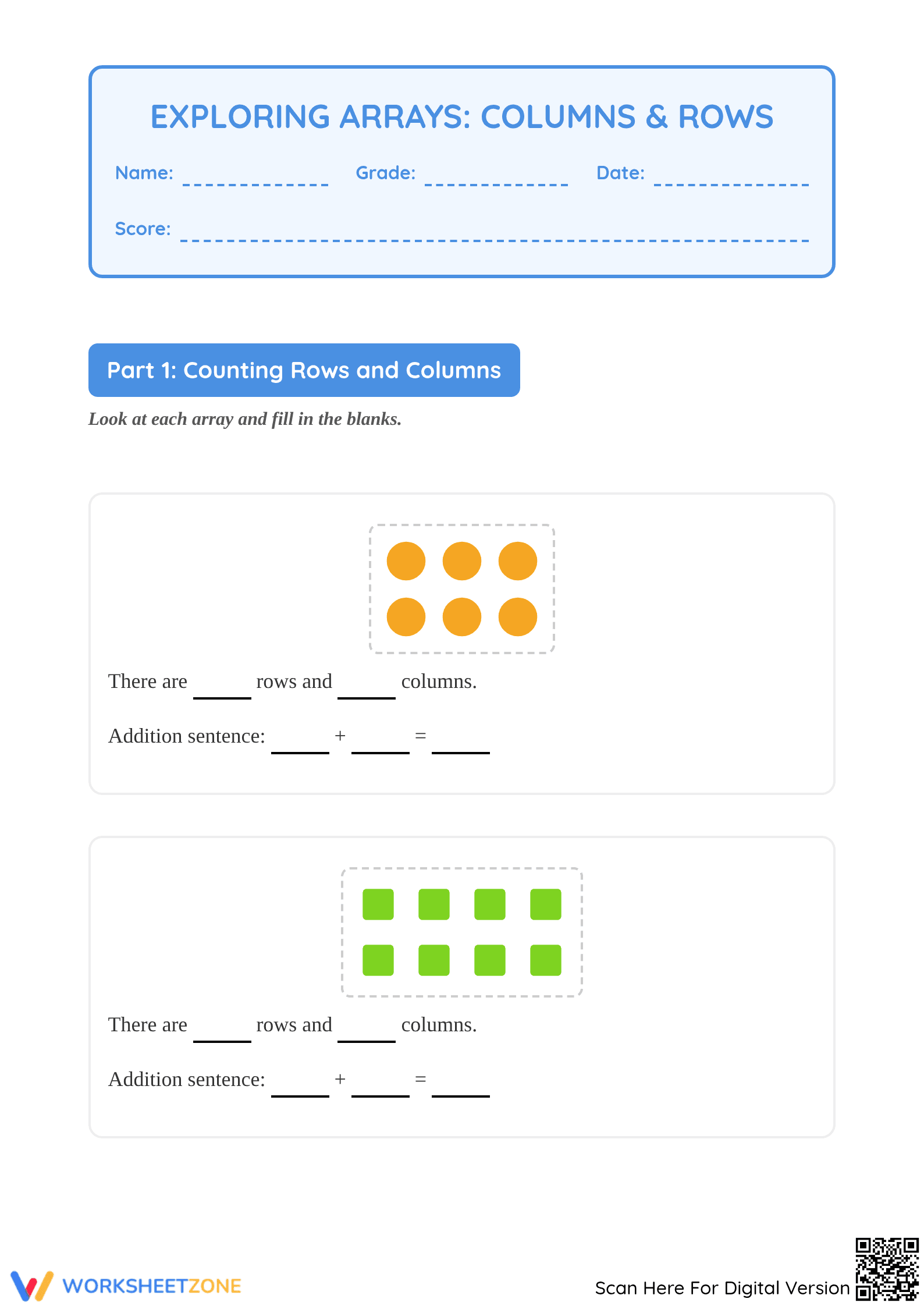
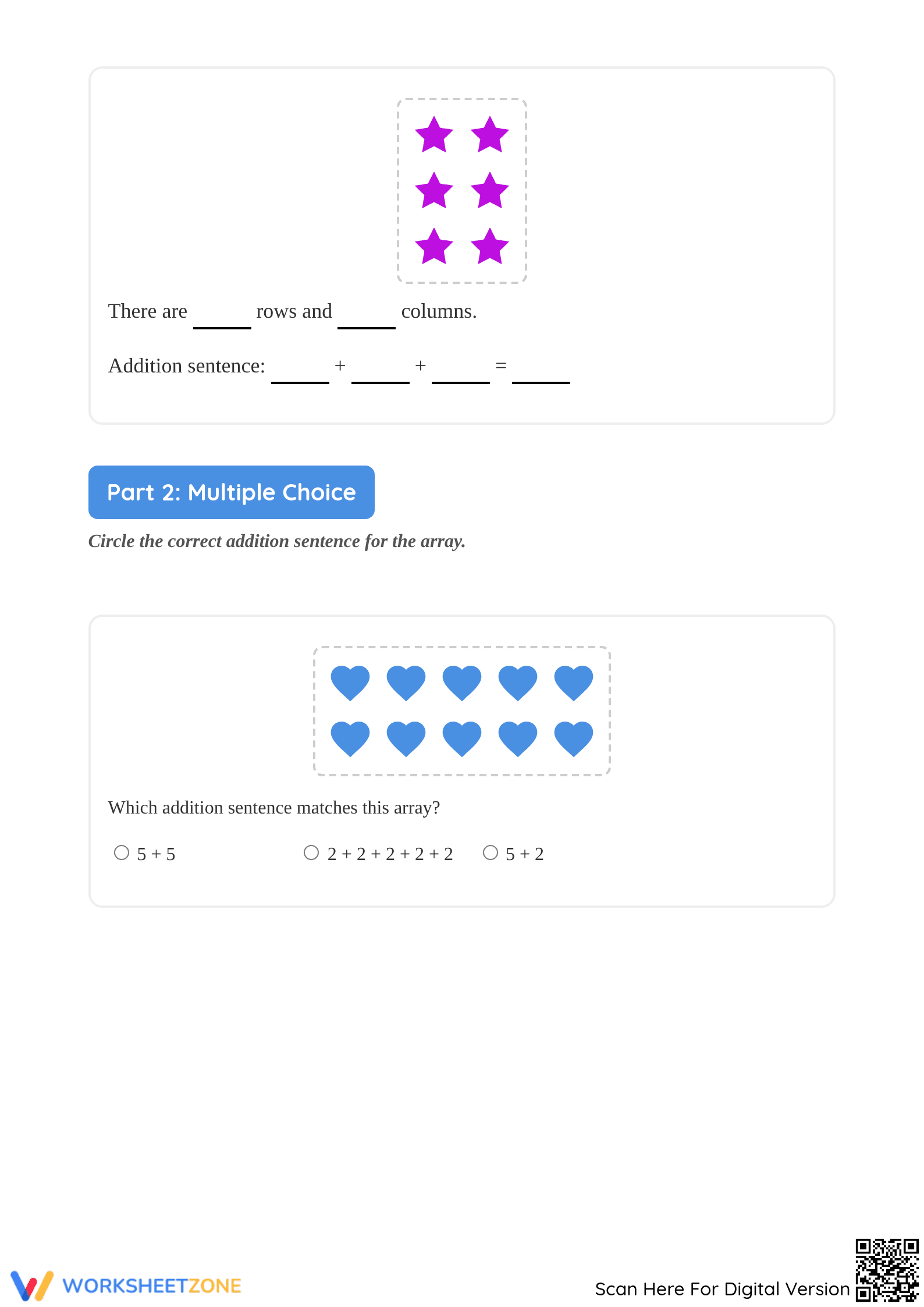
This worksheet introduces rectangular arrays through visual exploration and repeated addition. By identifying rows and columns in various shapes, learners bridge the gap between counting and early multiplication. Students will calculate totals and write matching addition sentences, ensuring a solid grasp of spatial math structures and numerical foundations.
At a Glance
- Grade: 2 · Subject: Math
- Standard:
CCSS.MATH.CONTENT.2.OA.C.4— Use addition to find the total number of objects arranged in rectangular arrays- Skill Focus: Identifying rectangular arrays, rows, columns, and repeated addition
- Format: 4 pages · 8 problems · Answer key included · PDF
- Best For: Early multiplication concepts, repeated addition practice, and math centers
- Time: 20–30 minutes of focused classroom work
What's Inside
This resource features eight tasks across four sections. It includes identification exercises, a multiple-choice check for conceptual understanding, a creative drawing section for student-generated arrays, and a challenge section with larger grids. A full answer key is provided to facilitate quick grading or student self-correction during math centers or independent practice.
Skill Progression
- Guided practice: Three initial problems provide sentence stems helping students distinguish between horizontal rows and vertical columns while writing simple addition sentences with visual cues.
- Supported practice: Three problems, including multiple-choice and drawing prompts, challenge students to translate numerical descriptions into visual representations with moderate scaffolding.
- Independent practice: Two complex challenge problems require students to analyze larger arrays and independently construct multi-addend equations without prompts.
This progression ensures students move from recognition to application using the "I Do, We Do, You Do" instructional framework.
Standards Alignment
This worksheet is aligned with `CCSS.MATH.CONTENT.2.OA.C.4`. It targets the requirement to use addition to find totals in rectangular arrays and write equations as sums of equal addends. This standard code can be copied directly into lesson plans, IEP goals, or district curriculum mapping tools for easy reporting and alignment verification.
How to Use It
This resource is ideal for guided practice during lessons on repeated addition. After using manipulatives, distribute this to solidify the transition to representational math. For a formative assessment tip, observe students during Part 3; struggles with alignment may indicate a need for grid paper or instruction on spatial organization. Completion takes about 25 minutes, making it perfect for a focused math station.
Who It's For
Designed for second-grade students, this is also useful for first-grade enrichment or third-grade remedial support. The visual nature makes it accessible for English Language Learners and students with IEPs who benefit from concrete representations. It pairs naturally with an "Arrays" anchor chart or a short introductory video on rectangular grids and equal groups.
Research highlights the role of arrays in developing multiplicative reasoning. According to Fisher & Frey (2014), providing structured visual scaffolds, such as the rectangular grids used in this `CCSS.MATH.CONTENT.2.OA.C.4` worksheet, allows students to internalize the relationship between spatial arrangement and numerical value. This worksheet supports the development of "equal groups" thinking, a prerequisite for grade-level fluency in multiplication and division. By requiring students to articulate these relationships through repeated addition sentences, the resource reinforces the conceptual link between counting and algebraic operations. The NAEP framework emphasizes that students who can accurately represent arrays are better prepared for higher-order area models and geometric reasoning in later grades. Integrating this focused practice into the math block provides the high-dosage exposure needed for students to achieve mastery in early number theory and operations, ensuring a smooth transition to third-grade math.


