


























Views
Downloads


Essential Matching Arrays Worksheet | Grade 2 Math
Paste this activity's link or code into your existing LMS (Google Classroom, Canvas, Teams, Schoology, Moodle, etc.).
Students can open and work on the activity right away, with no student login required.
You'll still be able to track student progress and results from your teacher account.
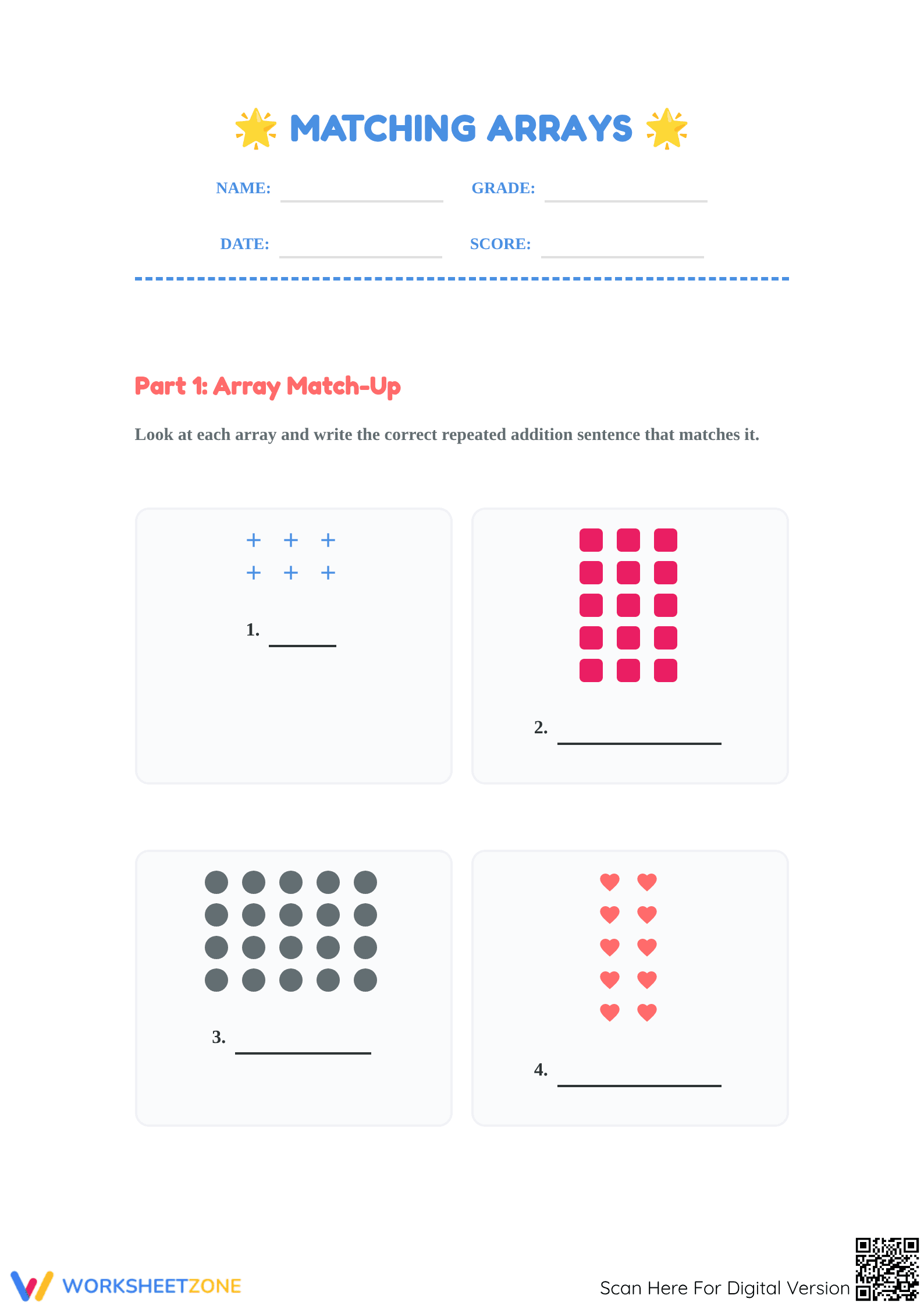
This matching arrays worksheet helps Grade 2 students connect visual rectangular arrays with repeated addition sentences. By identifying rows and columns to find total counts, learners build a concrete foundation for multiplication. Students will practice matching, drawing, and solving real-world word problems using equal groups, ensuring they internalize the relationship between visuals and equations.
At a Glance
- Grade: 2 · Subject: Math
- Standard:
CCSS.MATH.CONTENT.2.OA.C.4— Use addition to find total objects in rectangular arrays up to 5x5- Skill Focus: Arrays and Repeated Addition
- Format: 3 pages · 12 problems · Answer key included · PDF
- Best For: Independent practice or formative assessment
- Time: 15–25 minutes
What's Inside
This three-page resource is divided into three logical progression steps. Part 1 features eight matching tasks where students identify the repeated addition sentence that corresponds to a provided array of shapes. Part 2 moves to drawing, where students translate equations like 5 + 5 + 5 into a visual model. Part 3 concludes with two word problem challenges that require students to build their own arrays from scratch. A full answer key is included for effortless grading.
Skill Progression
- Guided practice: The first eight matching tasks provide clear visual arrays with simple shapes to help students identify the relationship between equal groups and their sums.
- Supported practice: Drawing tasks for equations require students to construct their own models, bridging the gap from visual recognition to conceptual abstraction.
- Independent practice: The word problem challenge at the end requires students to parse text, draw the array, and find the total independently.
This sequence follows a gradual-release model of instruction to ensure students move from visual recognition to independent application.
Standards Alignment
This worksheet is aligned to CCSS.MATH.CONTENT.2.OA.C.4. Students use addition to find the total number of objects arranged in rectangular arrays with up to 5 rows and up to 5 columns. This includes writing an equation to express the total as a sum of equal addends. Both standard codes can be copied directly into lesson plans, IEP goals, or district curriculum mapping tools.
How to Use It
Assign this worksheet as a primary practice set during the independent work phase of a lesson on equal groups. For a quick formative assessment, observe if students are counting every individual object by ones or if they are using the "row plus row" or "column plus column" logic to calculate the total. Most students will complete the 12 problems in approximately 20 minutes.
Who It's For
This resource is designed for Grade 2 students. It also serves as an excellent intervention tool for Grade 3 or Grade 4 students who need to reinforce their understanding of multiplication foundations. Naturally pair this with physical counters or array anchor charts for added support.
The transition from addition to multiplication is a critical milestone in early elementary mathematics. According to Fisher & Frey (2014), the use of visual models like rectangular arrays provides the necessary scaffolding for students to grasp the concept of equal groups before moving to abstract symbols. This worksheet aligns with CCSS.MATH.CONTENT.2.OA.C.4 by requiring students to not only find the total number of objects but also to write the corresponding addition sentences that represent the rows and columns. By engaging in matching, drawing, and solving word problems, students reinforce their understanding of the additive property within structured groups. Research from EdReports 2024 highlights that high-quality instructional materials must bridge the gap between concrete representation and symbolic math. This resource ensures that learners internalize the spatial logic of arrays, facilitating a smoother transition to third-grade multiplication standards while building confidence through varied task types.


