


























Views
Downloads
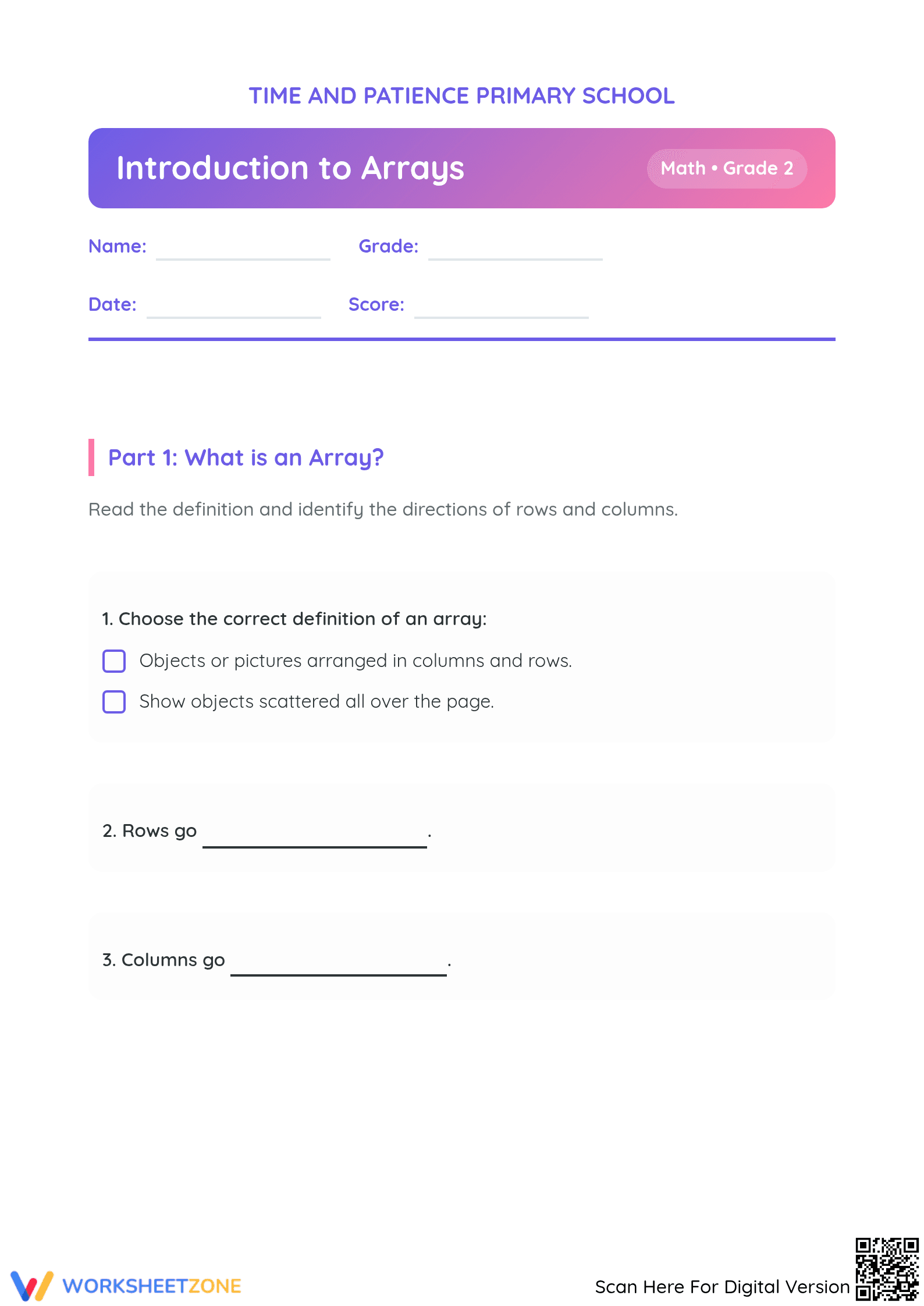



Essential Introduction to Arrays Worksheet | Grade 2 Math
Paste this activity's link or code into your existing LMS (Google Classroom, Canvas, Teams, Schoology, Moodle, etc.).
Students can open and work on the activity right away, with no student login required.
You'll still be able to track student progress and results from your teacher account.
This Essential Introduction to Arrays worksheet provides second-grade students with a comprehensive foundation for multiplicative reasoning. By identifying rows and columns through 19 structured tasks, learners build the spatial awareness required for later division and multiplication concepts. Students move from basic definitions to creating their own models, ensuring a deep understanding of rectangular arrangements.
At a Glance
- Grade: 2 · Subject: Math
- Standard:
CCSS.MATH.CONTENT.2.OA.C.4— Use addition to find the total number of objects arranged in rectangular arrays- Skill Focus: Introduction to Arrays
- Format: 5 pages · 19 problems · Answer key included · PDF
- Best For: Initial instruction and independent skill practice
- Time: 30–45 minutes
This five-page packet features 19 distinct problems organized into five clear parts. The content begins with foundational vocabulary checks for rows and columns, moves into counting dots and real-world objects like apples and donuts, and progresses to drawing custom arrays. A complete answer key is provided to facilitate rapid grading or student self-correction during independent work periods.
Zero-Prep Workflow
This resource is designed for a seamless, under-two-minute setup. Teachers simply print the five-page PDF, which takes roughly sixty seconds. Distributing the packets to students requires another minute, and the clear instructions allow learners to begin immediately without verbal teacher directions. This efficiency makes the packet an ideal choice for emergency sub plans or quick transitions between math centers.
Standards Alignment
The primary focus of this worksheet is CCSS.MATH.CONTENT.2.OA.C.4, which requires students to use addition to find the total number of objects in rectangular arrays with up to 5 rows and 5 columns. By asking students to write equations and identify row-column relationships, the tasks directly address the transition from additive to multiplicative thinking. This standard code can be copied directly into lesson plans.
How to Use It
Use this packet as a primary instructional tool during the "we do" phase of a lesson on repeated addition. Teachers can project the first page to model identifying rows versus columns before allowing students to complete the remaining parts independently. For formative assessment, observe students during Part 4 to see if they can accurately translate "3 rows and 2 columns" into a visual model.
Who It's For
This worksheet is perfect for second-grade students starting their multiplication units and third graders who need a refresher on visual models. The scaffolded instructions and large visuals support English Language Learners and students with IEPs by reducing linguistic load while maintaining rigorous mathematical demands. Pair this with a collection of physical manipulatives like counters or tiles for a multi-sensory math station.
Aligned with CCSS.MATH.CONTENT.2.OA.C.4, this worksheet targets the critical development of rectangular array identification, a precursor to formal multiplication. Research from Fisher & Frey (2014) emphasizes that gradual release of responsibility—moving from definitions to creation—enhances long-term retention of spatial math concepts. By solving 19 problems across 5 pages, students solidify their understanding of rows and columns as organized structures rather than scattered groups. The inclusion of word problems in Part 5 ensures that students can apply these visual models to real-world contexts, a key indicator of mathematical mastery. This systematic approach allows educators to capture clear evidence of student progress while providing a classroom-ready tool that minimizes preparation time and maximizes instructional efficiency.


