


























Views
Downloads

Essential Letter Y Beginning Sound Worksheet | Grade K-1
Paste this activity's link or code into your existing LMS (Google Classroom, Canvas, Teams, Schoology, Moodle, etc.).
Students can open and work on the activity right away, with no student login required.
You'll still be able to track student progress and results from your teacher account.
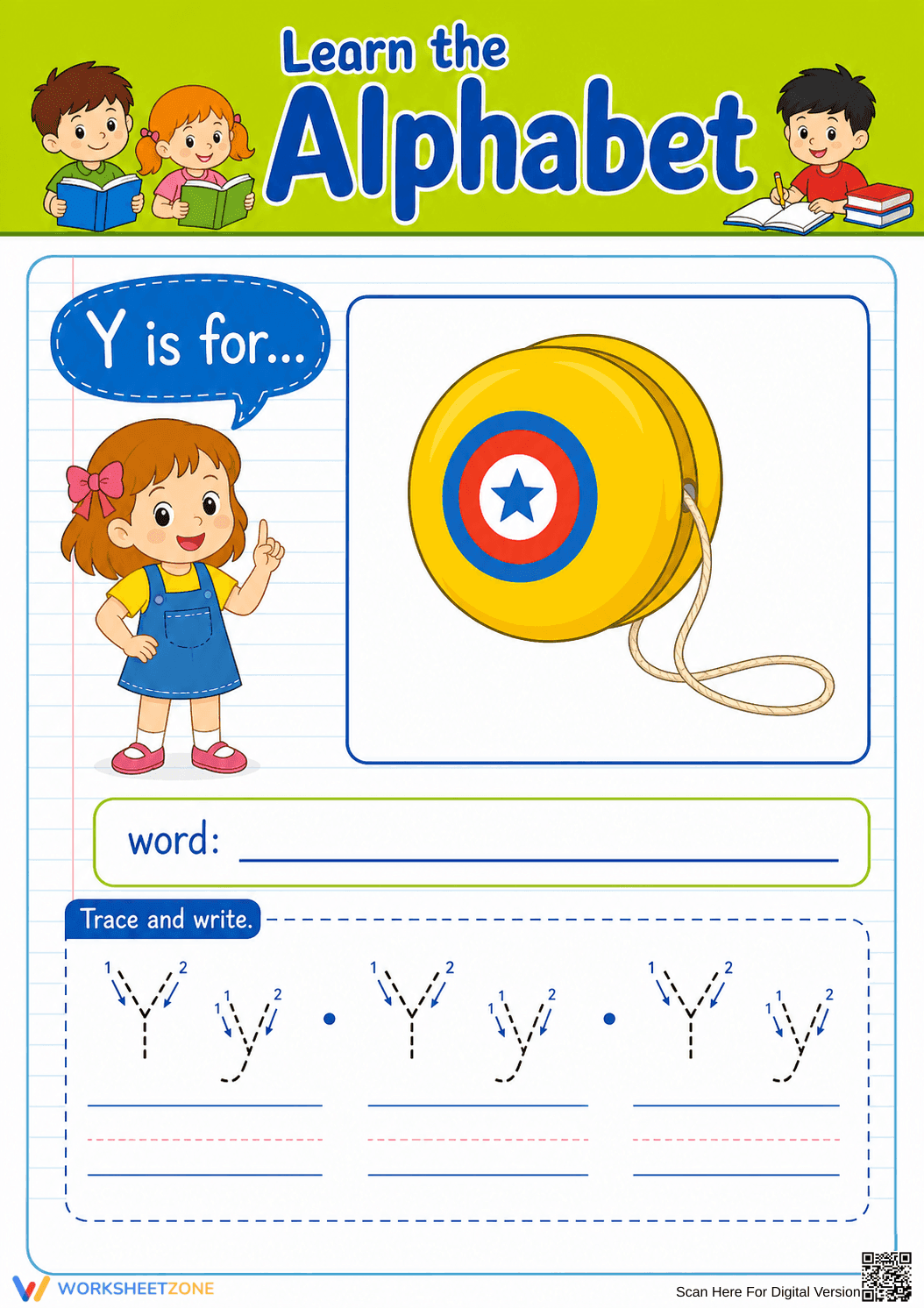
This essential Letter Y beginning sound worksheet helps early learners master phonemic awareness and letter formation. Students identify the initial sound in "yo-yo," practice writing the word, and follow guided tracing paths for both uppercase and lowercase Y. It provides a clear, structured path toward alphabet mastery and foundational reading readiness.
At a Glance
- Grade: Kindergarten · Subject: ELA Phonics
- Standard:
CCSS.ELA-LITERACY.RF.K.3.A— Produce the primary sound for the letter Y and identify initial sounds- Skill Focus: Letter Y Sound and Formation
- Format: 1 page · 10 tasks · Answer key included · PDF
- Best For: Morning work or phonics centers
- Time: 10–15 minutes
What's Inside: This single-page PDF features a large visual anchor (a yo-yo) to reinforce the "y" sound. It includes a dedicated line for word writing and a "Trace and Write" section with 6 guided tracing pairs. The layout uses numbered arrows to show proper stroke order, ensuring students develop correct muscle memory for both capital and lowercase letters across 10 distinct interaction points.
Zero-Prep Workflow: Teachers can implement this resource in three simple steps. First, print the single-page PDF (30 seconds). Second, distribute the sheets to students during phonics block or as a transition activity (1 minute). Third, review the letter formation and sound identification as a whole group or during small-group rotations (5 minutes). It is an ideal sub-plan addition for early childhood classrooms.
Standards Alignment: The primary focus is `CCSS.ELA-LITERACY.RF.K.3.A`, which requires students to demonstrate basic knowledge of one-to-one letter-sound correspondences. It also supports `CCSS.ELA-LITERACY.L.K.1.A` regarding printing letters. Both standard codes can be copied directly into lesson plans, IEP goals, or district curriculum mapping tools to ensure compliance with state frameworks.
How to Use It: Use this worksheet during the "You Do" phase of a gradual release model after introducing the letter Y. It works perfectly as a formative assessment tool; observe students as they trace to identify those struggling with fine motor control or top-to-bottom stroke direction. Expected completion time is 10 to 15 minutes depending on student writing proficiency.
Who It's For: This resource is designed for Kindergarten students, though it serves as excellent remediation for Grade 1 or 2 students needing phonics support. It pairs naturally with an alphabet anchor chart or a short reading passage featuring "y" words like "yellow" or "yak" to reinforce the sound in context for English Language Learners.
According to the RAND AIRS 2024 report, consistent exposure to multisensory phonics instruction—combining visual cues, auditory sound production, and kinesthetic tracing—is vital for early literacy development. This worksheet addresses these needs by providing a clear visual anchor (yo-yo) alongside structured handwriting practice. By aligning with CCSS.ELA-LITERACY.RF.K.3.A, the resource ensures that students are not just memorizing shapes but are actively connecting the grapheme "Y" to its phoneme. Research from Fisher & Frey (2014) emphasizes that such guided practice facilitates the transition from letter recognition to fluent decoding. With 10 specific interaction points, this worksheet offers the repetition necessary for cognitive retention without overwhelming young learners. It serves as a reliable tool for building the foundational skills required for more complex reading tasks in later primary grades, making it a staple for any evidence-based Kindergarten phonics curriculum.


