


























Views
Downloads
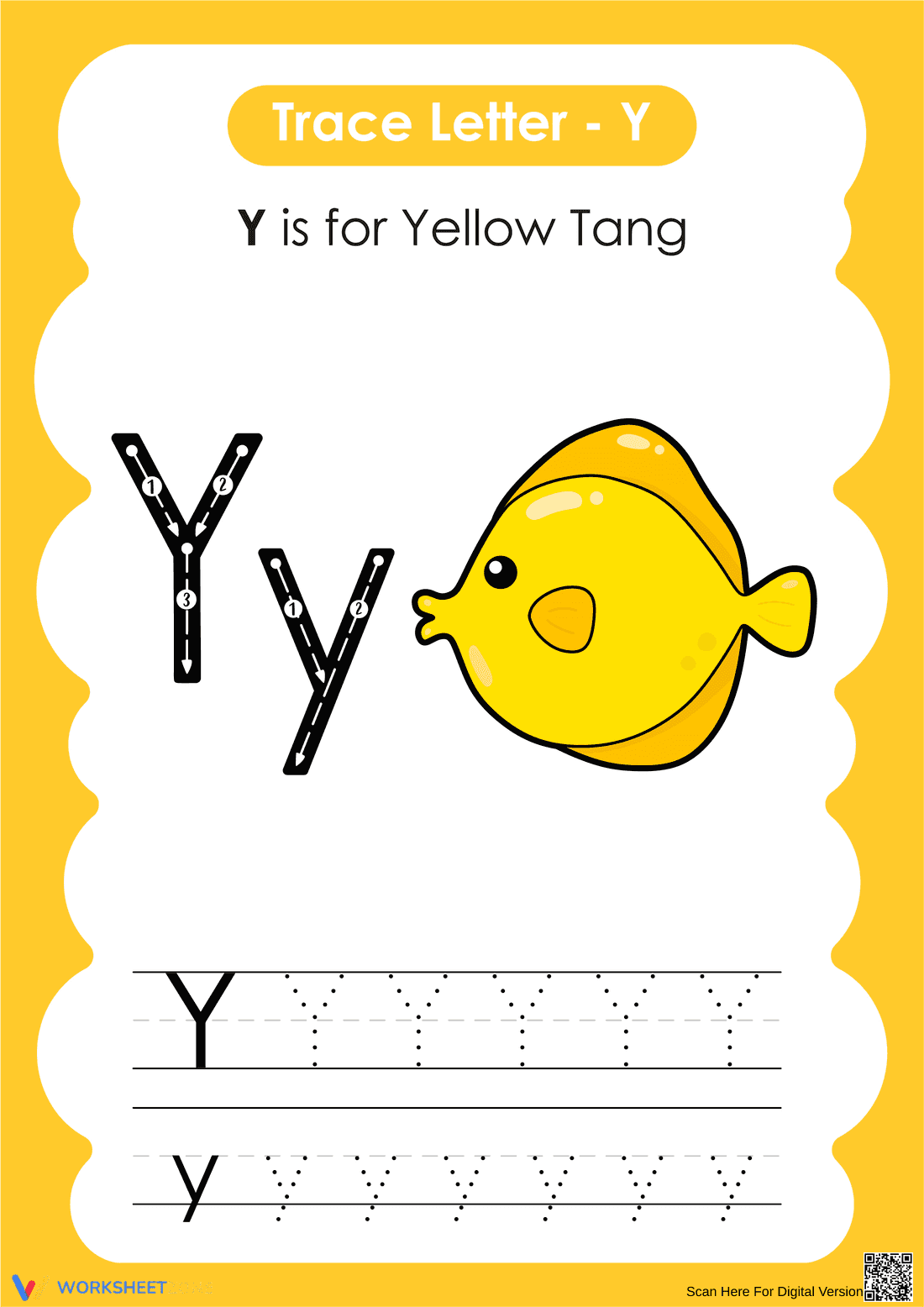

Letter Y Tracing Worksheet | Essential Grade K Practice
Paste this activity's link or code into your existing LMS (Google Classroom, Canvas, Teams, Schoology, Moodle, etc.).
Students can open and work on the activity right away, with no student login required.
You'll still be able to track student progress and results from your teacher account.
This Letter Y tracing worksheet provides early learners with a structured path to mastering letter formation and recognition. By combining visual cues with tactile tracing, students develop the fine motor control necessary for legible handwriting while reinforcing the phonetic connection between the letter Y and the "Yellow Tang" fish.
At a Glance
- Grade: Kindergarten · Subject: ELA
- Standard:
CCSS.ELA-LITERACY.L.K.1.A— Print upper- and lowercase letters accurately using correct stroke sequences- Skill Focus: Letter Y Formation
- Format: 1 page · 14 tasks · No answer key needed · PDF
- Best For: Morning work or literacy centers
- Time: 10–15 minutes
Inside this 1-page PDF, you will find two large instructional letters featuring numbered directional arrows to guide stroke order. Below these, two dedicated rows provide 12 tracing opportunities—six for uppercase 'Y' and six for lowercase 'y'—set on primary ruled lines to ensure proper letter height and baseline placement.
Skill Progression
- Guided Practice: Students begin by tracing two large-format letters with explicit numbered arrows (1-2-3 for uppercase, 1-2 for lowercase) to establish correct muscle memory.
- Supported Practice: Six uppercase tracing tasks allow students to refine their vertical and diagonal strokes on standard primary lines.
- Independent Practice: Six lowercase tracing tasks challenge students to maintain consistent sizing and descender placement for the letter 'y'.
This sequence follows a gradual-release model, moving from large-scale motor movements to refined handwriting control.
Standards Alignment
This resource is specifically aligned to `CCSS.ELA-LITERACY.L.K.1.A`, which requires students to print many upper- and lowercase letters. It also supports foundational phonics by linking the letter to a specific vocabulary word. Both standard codes can be copied directly into lesson plans, IEP goals, or district curriculum mapping tools.
How to Use It
Use this worksheet during the "You Do" phase of a handwriting lesson. After demonstrating the stroke order on a whiteboard, distribute the page for quiet independent practice. For a formative assessment, observe if students follow the numbered arrows or if they write the letters from the bottom up. Completion typically takes 10 to 15 minutes.
Who It's For
This worksheet is designed for Preschool, Kindergarten, and Grade 1 students who are beginning their literacy journey. It is particularly effective for students requiring fine motor intervention or English Language Learners (ELLs) building basic vocabulary. Pair this with a "Yellow Tang" picture book or an alphabet anchor chart for a complete lesson.
According to the RAND AIRS 2024 report on early literacy, explicit instruction in letter formation is a critical precursor to reading fluency and orthographic mapping. This worksheet addresses the foundational need for repetitive, guided tracing to build the neural pathways required for automaticity in writing. By focusing on a single letter, the resource prevents cognitive overload, allowing students to concentrate on the specific diagonal strokes unique to the letter Y. Research from Fisher & Frey (2014) emphasizes that such focused practice, when combined with visual anchors like the "Yellow Tang," significantly improves long-term retention of letter-sound correspondences. This 1-page resource provides the exact dosage of practice needed for mastery of CCSS.ELA-LITERACY.L.K.1.A without overwhelming young learners with extraneous visual clutter.


