


























Views
Downloads
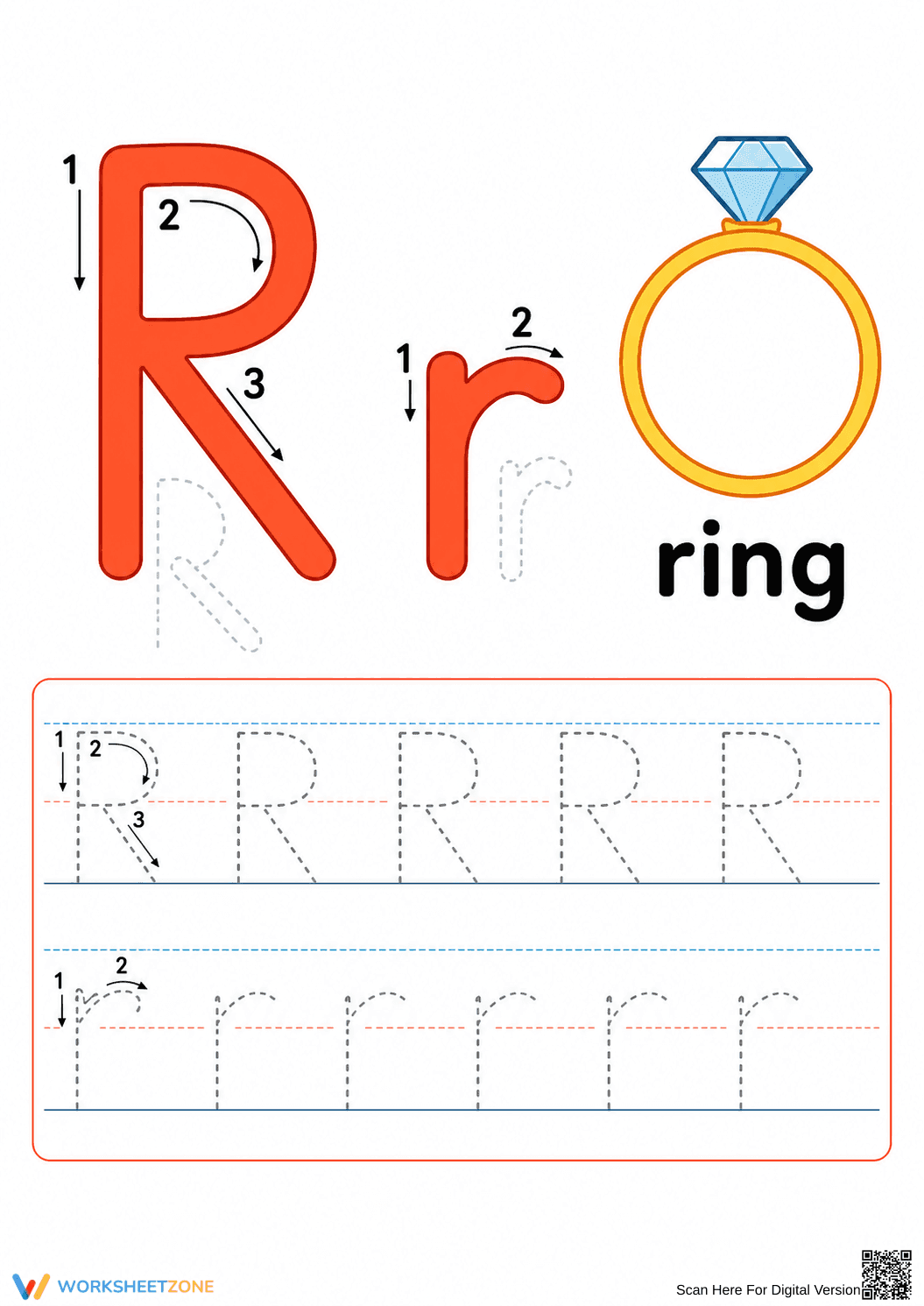

Letter R Tracing Printable Worksheet | Grade K ELA
Paste this activity's link or code into your existing LMS (Google Classroom, Canvas, Teams, Schoology, Moodle, etc.).
Students can open and work on the activity right away, with no student login required.
You'll still be able to track student progress and results from your teacher account.
This foundational handwriting worksheet helps early learners master the letter R through guided tracing exercises. Students practice proper stroke order for both uppercase and lowercase forms, reinforcing fine motor control and letter recognition. The visual anchor of a ring connects the letter symbol to its beginning sound.
At a Glance
- Grade: K · Subject: ELA
- Standard:
CCSS.ELA-LITERACY.L.K.1.A— Print many upper- and lowercase letters- Skill Focus: Letter R Tracing and Formation
- Format: 1 page · 12 problems · No answer key needed · PDF
- Best For: Independent practice centers
- Time: 10–15 minutes
Inside this single-page resource, educators will find a structured approach to letter formation. The page features large, numbered directional arrows for initial stroke guidance, followed by standard primary dashed lines for independent tracing. Students complete twelve specific tracing tasks, including five uppercase and five lowercase letters, alongside a vocabulary-building illustration of a ring to reinforce phonics connections.
This resource is designed for a highly efficient, zero-prep classroom workflow:
- Print (1 minute): Generate copies directly from the PDF file without any special formatting or resizing required.
- Distribute (1 minute): Hand out the sheets during morning work or literacy center rotations. The clear visual instructions mean students can begin immediately.
- Review (1 minute): Quickly scan student work to ensure proper stroke direction and line adherence. Total teacher prep time is under two minutes, making this an excellent addition to any emergency sub plan.
This activity is directly aligned to CCSS.ELA-LITERACY.L.K.1.A, requiring students to print many upper- and lowercase letters. It also supports foundational phonics skills by connecting the written symbol to a spoken word. Both standard codes can be copied directly into lesson plans, IEP goals, or district curriculum mapping tools.
Deploy this worksheet during morning arrival as a calm, focused entry task that establishes routine. Alternatively, place it in a literacy center alongside tactile letter-building materials like playdough or sand trays. While students work, teachers can conduct quick formative assessments by observing pencil grip and stroke sequence, correcting any bottom-to-top tracing habits before they become ingrained. Expect students to complete the page in ten to fifteen minutes.
This printable is ideal for Kindergarten students developing early literacy and fine motor skills. It serves as an excellent intervention tool for first graders who need targeted handwriting remediation. Pair this tracing sheet with a read-aloud focused on the /r/ sound or an anchor chart displaying other words starting with the letter R to maximize instructional impact.
Effective handwriting instruction remains a critical component of early literacy development. According to research from Fisher & Frey (2014), explicit instruction in letter formation significantly impacts a student's broader writing fluency and reading comprehension. When young learners can automatically recall and produce letter shapes, their cognitive load is freed to focus on phonemic awareness, spelling, and vocabulary acquisition. This resource supports that essential automaticity by targeting CCSS.ELA-LITERACY.L.K.1.A, ensuring students can accurately print many upper- and lowercase letters. By combining clear directional cues with repetitive tracing tasks, the worksheet bridges the gap between visual recognition and fine motor execution. Early intervention with structured tracing activities prevents the development of inefficient handwriting habits, establishing a strong, reliable foundation for future academic success across all subject areas.


