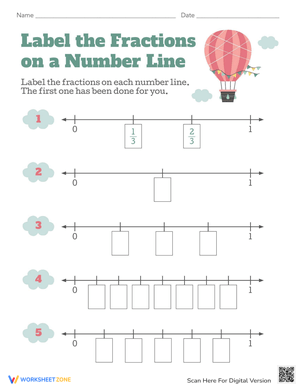
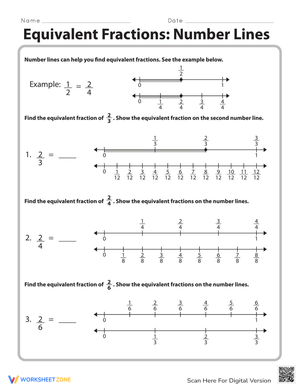
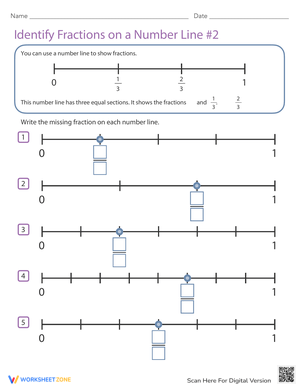
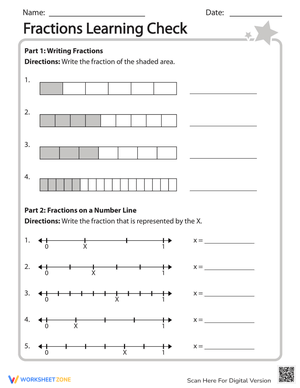
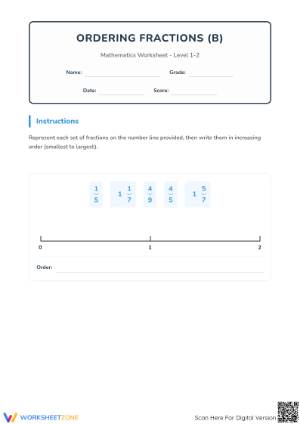
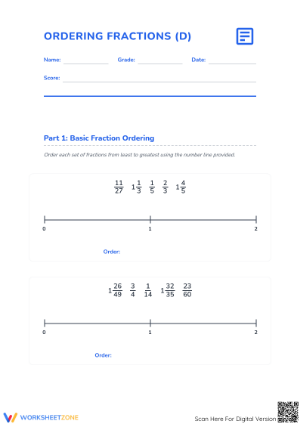
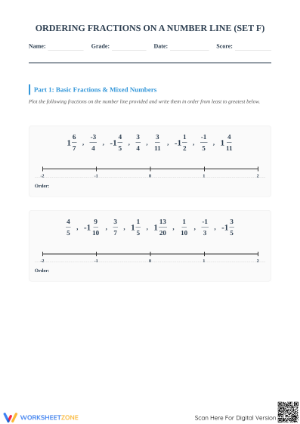
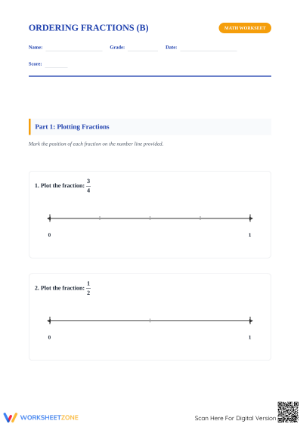
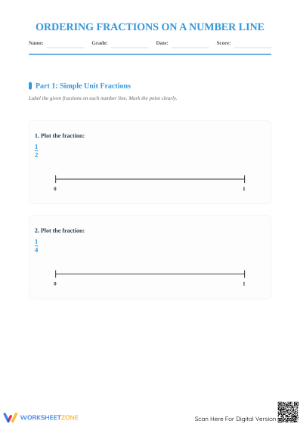
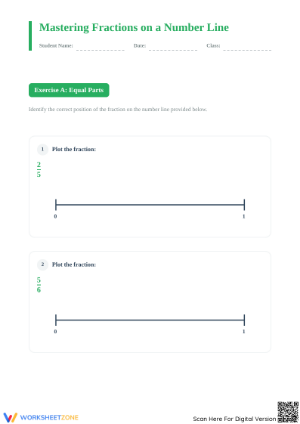
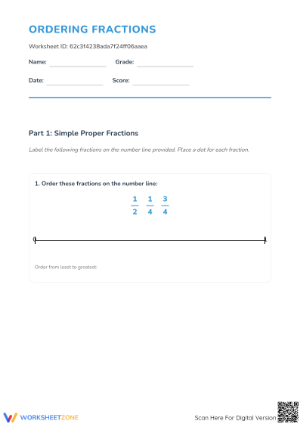
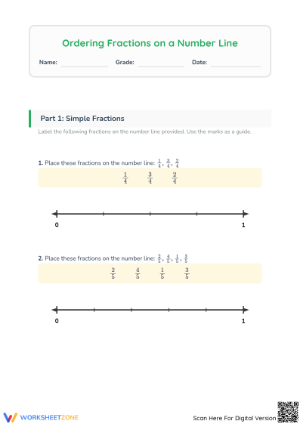
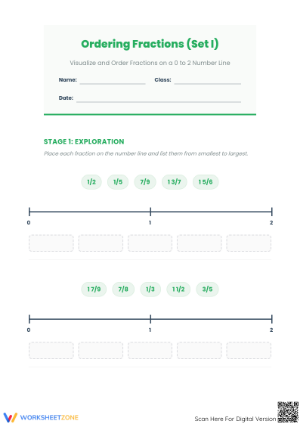
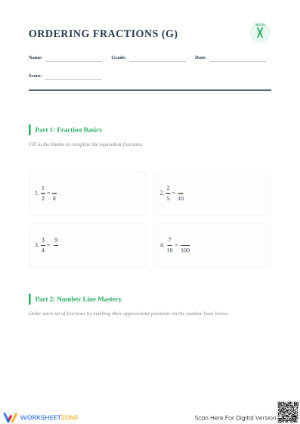
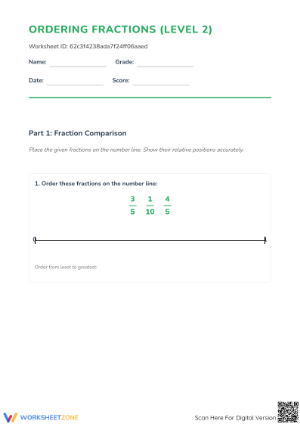
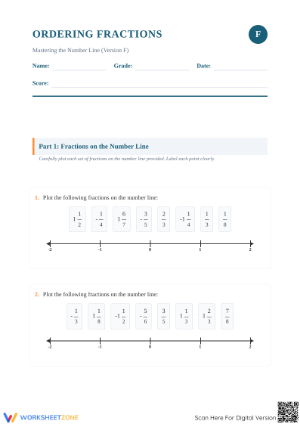
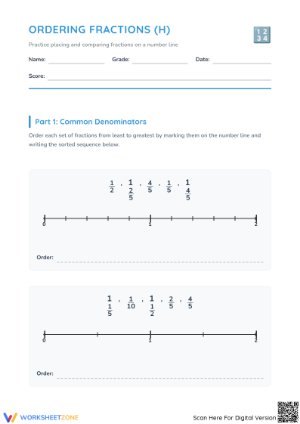
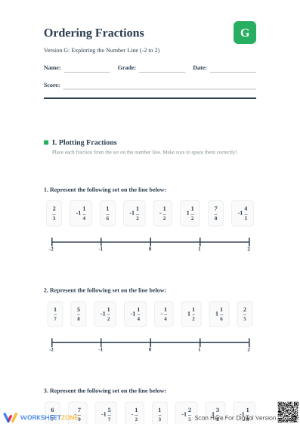
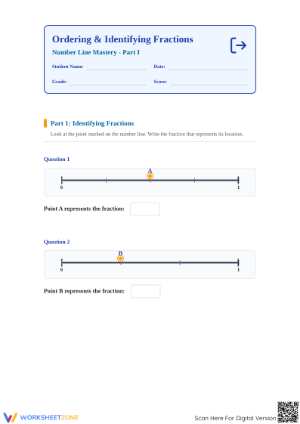
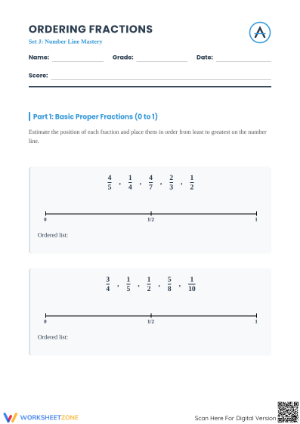
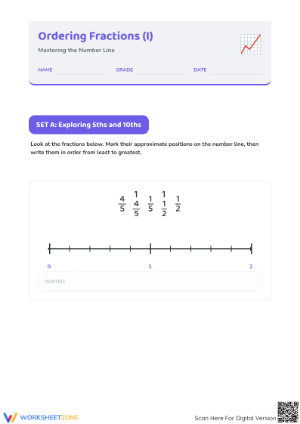
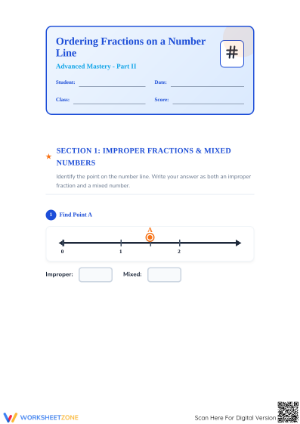
These fractions on a number line worksheets for 3rd grade give teachers a printable set that moves students through the full arc of what Grade 3 fraction standards require — from reading a marked point on a pre-divided line to drawing equal partitions on a blank segment from 0 to 1. Every denominator in the Grade 3 standard is represented: halves, thirds, fourths, sixths, and eighths.
Skills These Worksheets Build
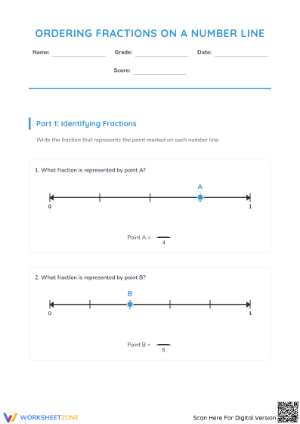
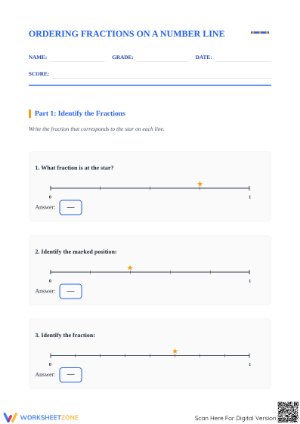
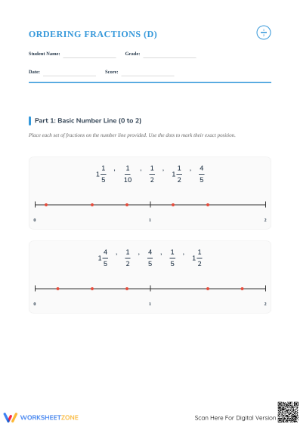
The set works across four task types, and the progression matters. Students start by identifying fractions on pre-partitioned number lines — a point is marked, they write the fraction. That task is the most accessible entry point because students only need to count existing intervals and locate the marked space. The reversal — giving students a fraction and asking them to place the point — demands more because it requires connecting a written symbol to a precise linear position rather than reading one off a line.
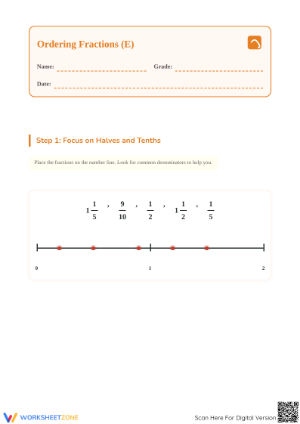
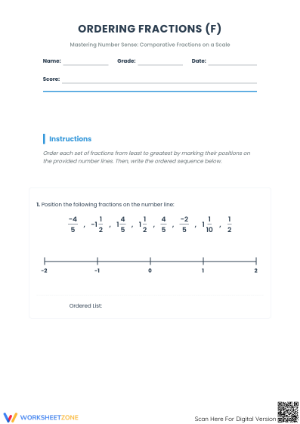
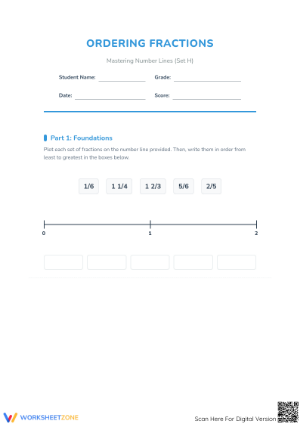
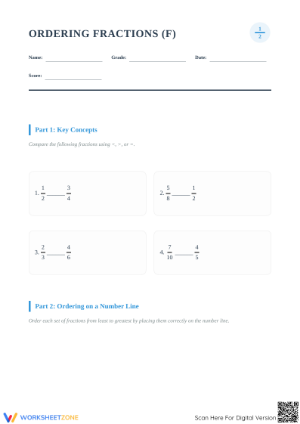
The third task type asks students to partition a blank number line themselves. This is the skill most directly named in the standard, and it's where the most errors appear. Students must draw equal intervals, then label them — a two-step job that exposes whether they truly understand that the intervals are the units, not the tick marks. The fourth task type extends the number line past 1, introducing values like 3/2 and 1 1/2 as a preview of later units, without formally naming mixed numbers yet.
Errors That Surface Predictably With This Skill
The tick-mark-versus-interval confusion is the defining misconception of this topic at this grade. On a number line partitioned into fourths, a student counts the marks at 0, 1/4, 2/4, 3/4, and 1 — five marks — and writes 3/5 for the third mark because they counted five total. The answer looks almost reasonable, which is why it slips past during whole-class work. Catching it requires checking the denominator, not just the numerator. Teachers who consistently call the spaces "equal parts" or "jumps" rather than "lines" see this error drop faster than those who use tick-mark language interchangeably.
The second reliable error comes on partitioning tasks. When students draw their own intervals on a blank line, the first one is almost always too wide — students draw left-to-right without planning, so early intervals consume more space than later ones. Having students mark the halfway point first, regardless of the denominator, and then work inward reduces uneven partitioning more reliably than any reminder to "make them equal."
Putting These Worksheets to Work in Your Week
The identification worksheets work well as a Monday warm-up during the fractions unit — about eight minutes, and the papers give teachers an immediate read on which students have held onto prior instruction. The partitioning worksheets are better positioned mid-unit, after at least one lesson using physical materials like paper-folding or fraction strips alongside the printed line.
For small-group intervention, the most effective approach with fractions on a number line worksheets for 3rd grade is to pair the printed worksheet with a sentence frame. After students plot or identify a fraction, they complete: "I know ___ is here because the line is divided into ___ equal parts and I counted ___ from 0." A correct plot with a garbled explanation reveals a procedural answer built on shaky understanding — and the sentence frame surfaces that in the moment rather than after the unit ends.
For math centers, arrange the worksheets in a folder that runs from identification to plotting to partitioning, with an answer key for self-checking. Students move through at their own pace while the teacher runs guided groups elsewhere.
Sequencing Denominators Across the Unit
Halves and fourths belong first. Students arrive with informal exposure to both — halves from everyday language, fourths from clock faces and quarter-dollar references — so placing them on a number line builds on existing knowledge rather than introducing two new ideas at once. Thirds and sixths come next. The connection between them is worth making explicit: sixths are thirds split in half again, so students who can partition thirds will find sixths more intuitive than they expect. Eighths arrive last; the intervals are small enough to create real measurement challenges even with a ruler, and they demand the most precision of any denominator in the set. These fractions on a number line worksheets for 3rd grade follow that ordering across the set, so teachers can assign them in sequence without rearranging.
Standard Alignment
The worksheets align to CCSS.MATH.CONTENT.3.NF.A.2, which requires students to understand a fraction as a number on the number line and to represent fractions on a number line diagram. Standard 3.NF.A.2a addresses defining the interval from 0 to 1 as the whole and partitioning it into equal parts; 3.NF.A.2b addresses marking off a lengths of 1/b from 0 to represent a/b. The partitioning worksheets in this set address 3.NF.A.2a directly. The identification and plotting worksheets address 3.NF.A.2b. Extension worksheets that reach past 1 build readiness for the comparison and equivalence work in 3.NF.A.3. In most Grade 3 pacing guides, this cluster falls in the second or third unit of the year, after students have worked with area models — making that the natural moment when fractions on a number line worksheets for 3rd grade produce lasting understanding rather than surface recall.
Adjusting the Set for Different Learners
Students who are still shaky on whole-number counting benefit from starting with halves only — one worksheet, one denominator, both the identify and plot tasks. Keeping the denominator fixed removes one variable while the linear model itself is still new. Students who move through the identification and plotting work quickly can tackle the extension worksheets that go past 1, or they can write their own number line problems for a partner — a task that requires understanding the structure rather than just executing it.
For students with fine motor challenges, the partitioning worksheets are genuinely hard because drawing equal intervals under time pressure is difficult. Providing a pre-printed ruler guide along the bottom of each worksheet, or allowing a physical ruler, removes the motor barrier without changing the math.
Frequently Asked Questions
Why do students count five marks on a line divided into fourths and write 3/5?
Counting objects is the default for third graders, and tick marks are objects — intervals are not. Students count what they can point to. The fix is to make the interval visible: have students shade or color each space before counting. Once an interval has a fill color, it becomes a countable unit rather than empty space between lines.
When in the unit should number line work come relative to area models?
Area models belong first. Shaded circles and rectangles are concrete enough for most 8-year-olds to interpret without much setup. Number lines become most productive after students can reliably shade and name fractions on area models — typically the second or third week of a fractions unit. Introducing the linear model before the part-whole concept is stable tends to produce confusion rather than connection.
Can these worksheets support the equivalent fractions standard?
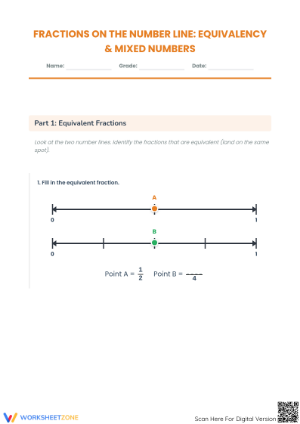
Yes. The most direct approach is to use worksheets that place two number lines with different denominators side by side — one divided into thirds, one into sixths. Students can see that 1/3 and 2/6 fall at the same position on their respective lines, which builds a more compelling case for equivalence than a procedure about multiplying numerator and denominator. Several worksheets in the set include exactly that stacked-line format.













 Interactive Worksheet Maker
 Quiz Maker
 Word Search Maker
 Crossword Puzzle Maker
 Word Scramble Generator
 Sentence Scramble Generator
 Handwriting Worksheet Generator
 Name Tracing Generator
 Fill In The Blank Generator