


























Views
Downloads




Ordering Fractions Worksheet | Grade 4 Math Printable
Paste this activity's link or code into your existing LMS (Google Classroom, Canvas, Teams, Schoology, Moodle, etc.).
Students can open and work on the activity right away, with no student login required.
You'll still be able to track student progress and results from your teacher account.
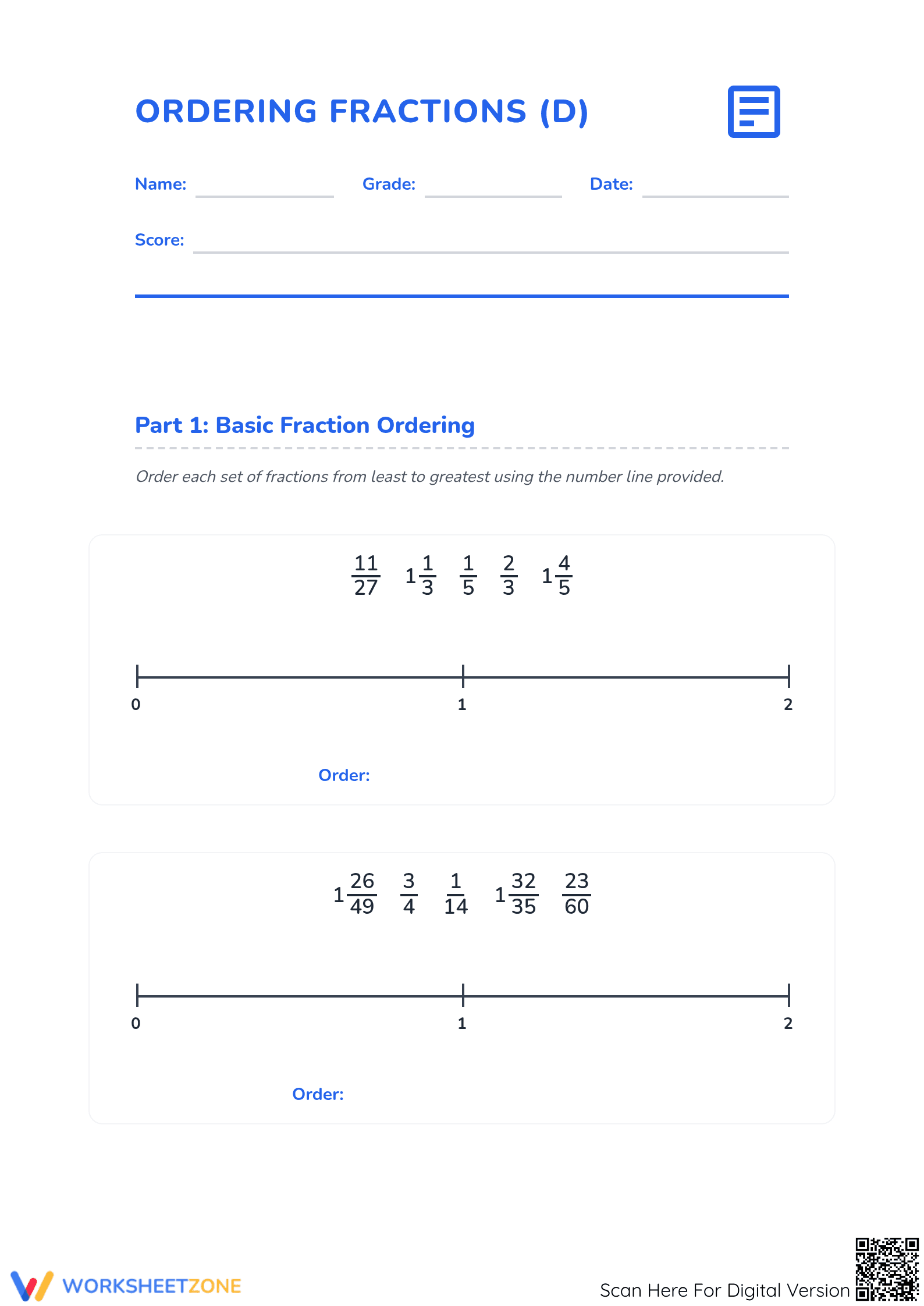
This comprehensive Grade 4 math worksheet helps students master the critical skill of ordering fractions using visual number line models. By placing proper fractions, improper fractions, and mixed numbers onto a 0-2 scale, learners build a deep conceptual understanding of magnitude and relative value. Students transition from basic identification to complex comparisons with ease.
At a Glance
- Grade: 4 · Subject: Math
- Standard:
4.NF.A.2— Compare two fractions with different numerators and different denominators by creating common denominators- Skill Focus: Ordering fractions on a number line
- Format: 5 pages · 12 sets · Answer key included · PDF
- Best For: Small group instruction or independent practice
- Time: 25–40 minutes
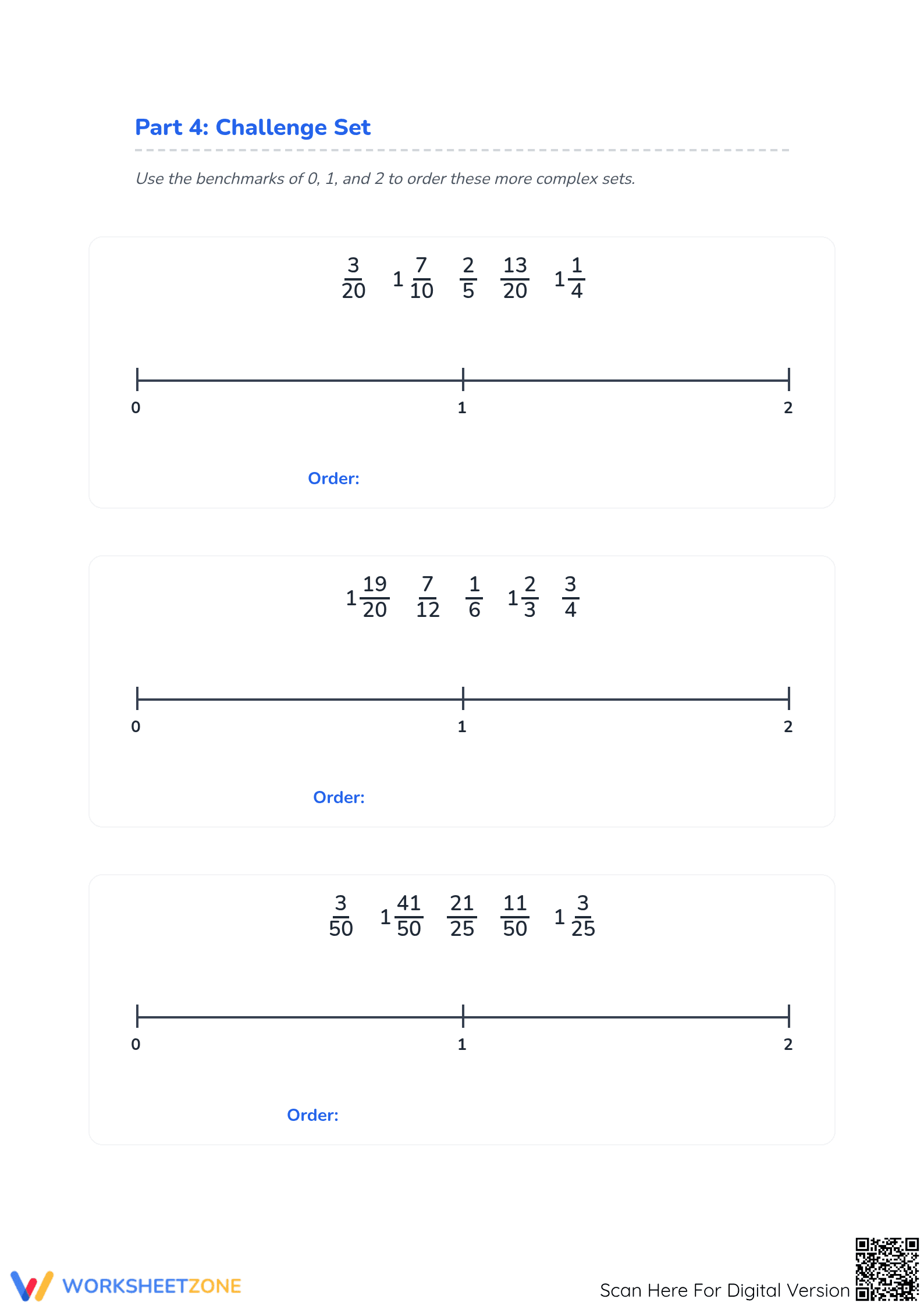
Inside this 5-page PDF, you will find twelve distinct problem sets organized into four pedagogical phases. The layout provides ample space for students to plot points on number lines ranging from 0 to 2. It includes a full answer key for rapid grading and covers various fraction types, including mixed numbers and fractions with like and unlike denominators.
Skill Progression
- Guided Practice: Part 1 introduces basic ordering where students use number lines to visualize the placement of mixed numbers and proper fractions across two initial task sets.
- Supported Practice: Part 2 and 3 focus on fractions with like denominators and mixed comparisons, requiring students to use benchmarks like 1/2 and 1 across four sets.
- Independent Practice: The Challenge Sets in Parts 4 and 5 present complex fractions with large, unlike denominators, testing students' ability to use estimation and conversion skills.
This sequence supports a gradual-release model, moving from basic recognition to higher-order comparative thinking.
Standards Alignment
This resource is explicitly aligned to 4.NF.A.2, which requires students to compare two fractions with different numerators and different denominators. It also supports 3.NF.A.2 by emphasizing the representation of fractions on a number line. Both standard codes can be copied directly into lesson plans, IEP goals, or district curriculum mapping tools.
How to Use It
Use this worksheet during the independent practice phase of a lesson after students have explored fraction strips or circular models. It works exceptionally well as a formative assessment; observe students as they plot the Challenge Set to identify who relies on common denominators versus those using benchmark logic. Expected completion time is approximately 30 minutes.
Who It's For
This resource is designed for Grade 4 and 5 students but provides excellent remediation for middle schoolers struggling with number sense. It pairs naturally with a lesson on common denominators or a digital fraction visualization tool. Differentiation is built-in through the escalating difficulty of the challenge sets provided on the final pages.
According to the RAND AIRS 2024 report, visual representations like number lines are foundational for developing the fractional number sense required for success in middle school algebra. This Grade 4 ordering fractions worksheet utilizes the number line as a cognitive tool to bridge the gap between concrete models and abstract symbolic comparison. By requiring students to place fractions on a 0-2 scale, the tasks force an engagement with both the part-whole relationship and the measurement interpretation of fractions. Research from Fisher & Frey (2014) emphasizes that such structured practice, when moving from like to unlike denominators, supports long-term retention of mathematical concepts. This 12-task set provides the necessary repetition for students to internalize benchmark strategies (0, 1/2, 1, 2) which NAEP data suggests is a major differentiator in student performance across elementary math standards. This standalone summary highlights the pedagogical value of alignment to 4.NF.A.2 standards for student growth.


