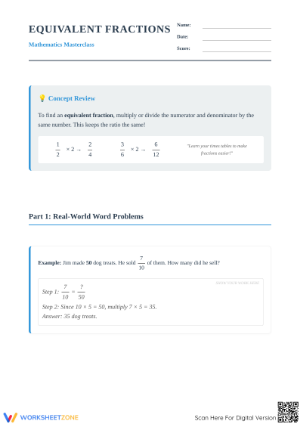
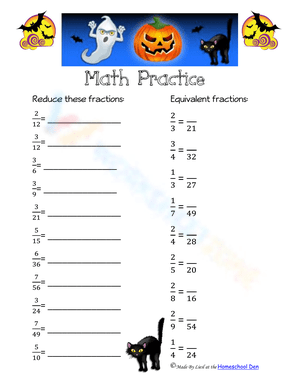
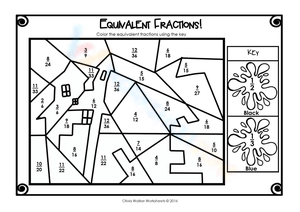
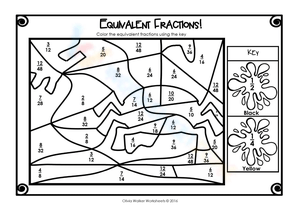
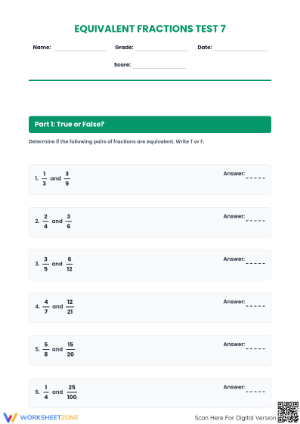
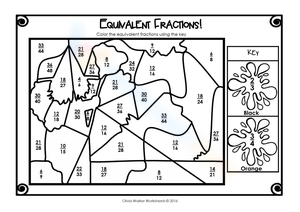
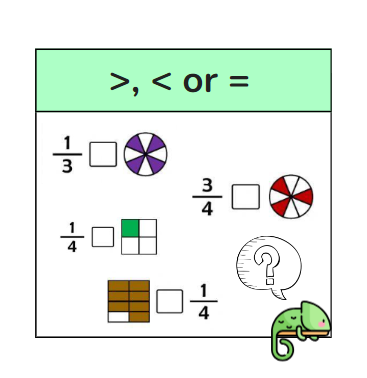
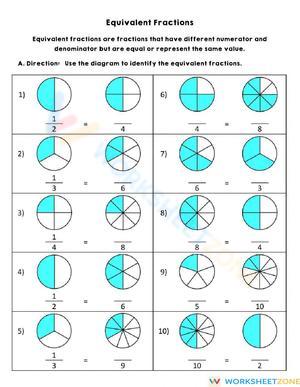
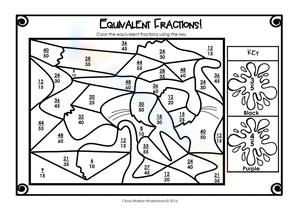
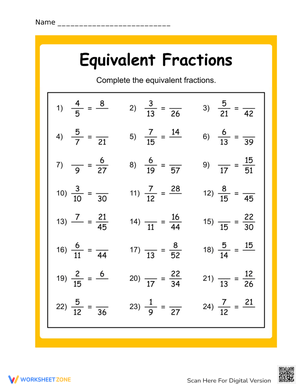
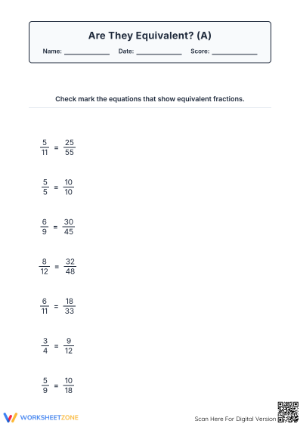
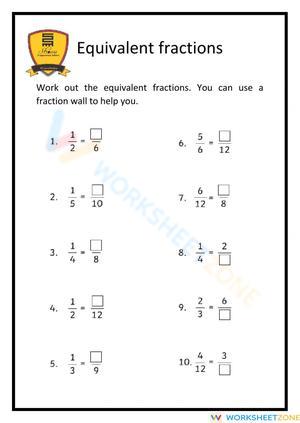
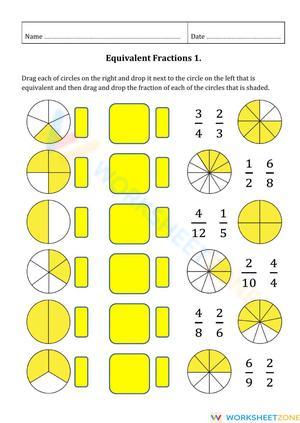
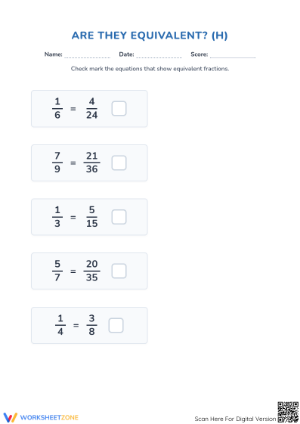
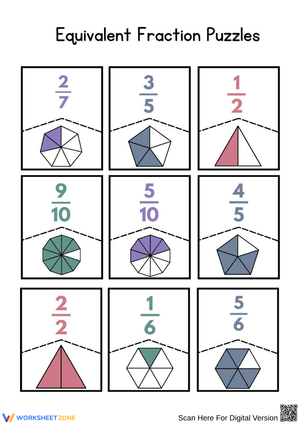
These 3rd grade equivalent fractions worksheets give teachers print-and-use practice materials that move students from visual confirmation to independent fraction reasoning — without introducing multiplication rules that don't belong at this grade level. Denominators stay within 2, 3, 4, 6, and 8, a deliberate limit that keeps cognitive load manageable while still producing enough variation to surface the misconceptions that reliably appear in third-grade fraction work.
What's Inside the Set
The worksheets draw on three model types: area models using rectangles and circles, fraction bar comparisons, and number-line exercises. Each type asks students to do genuinely different cognitive work, which is why all three appear in the set.
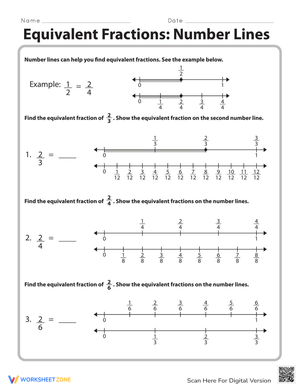
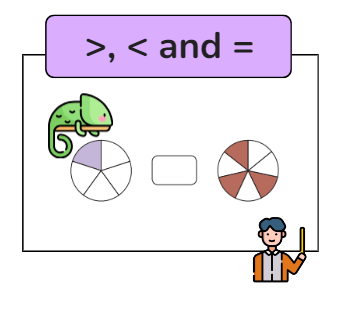
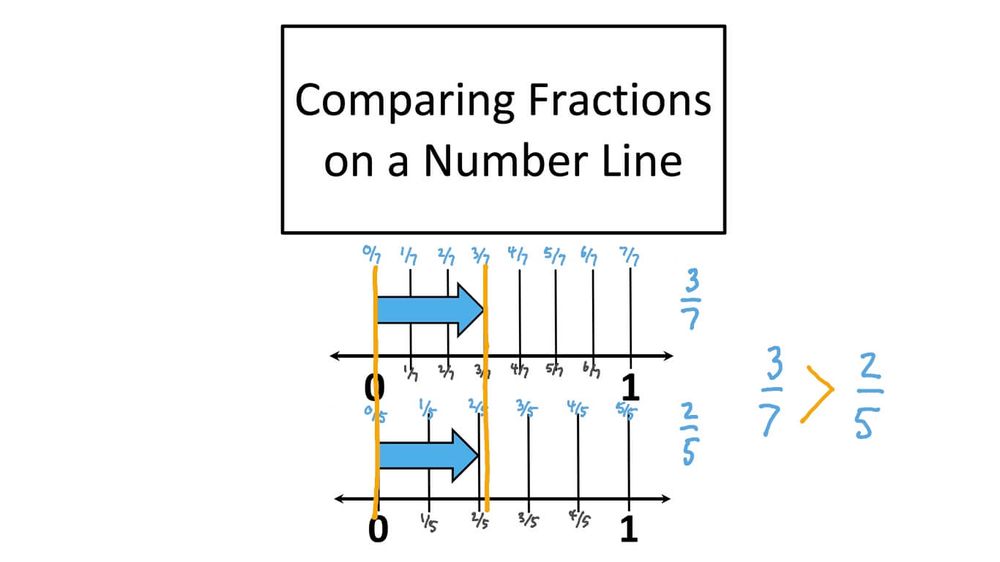
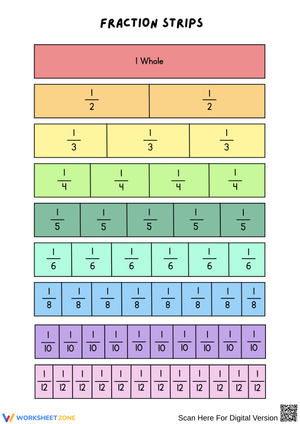
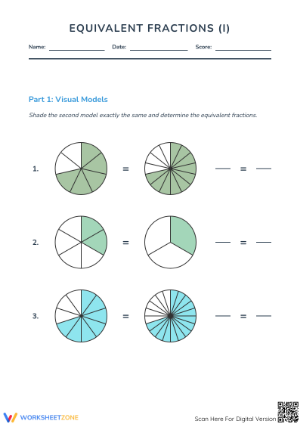
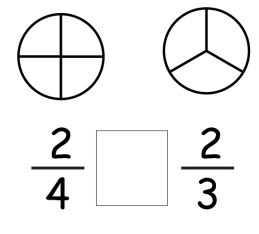
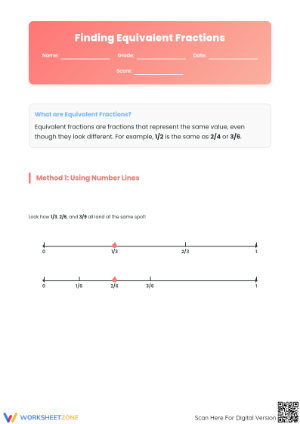
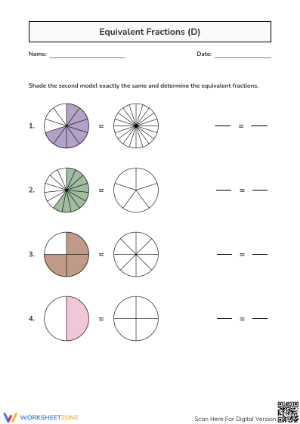
On the area-model worksheets, students shade regions in pre-partitioned shapes, annotate the fraction each region represents, and confirm that two shaded areas are equal. The fraction-bar worksheets stack bars of equal length partitioned into different denominators — one bar into thirds, the bar directly below it into sixths — so students see that two-sixths aligns exactly with one-third without needing any verbal explanation. The number-line worksheets plot fractions on parallel lines and ask students to identify which pairs share a location, a task that demands different reasoning than comparing shaded areas.
Across the set, task formats include:
- underlining fractions that name the same amount
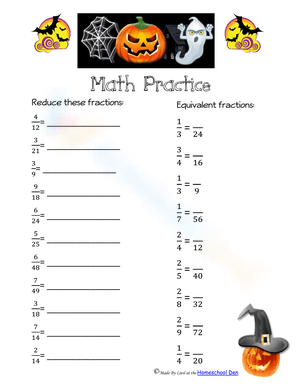
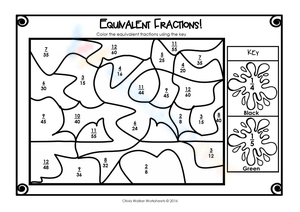
- rewriting a given fraction as an equivalent
- circling matching pairs from a mixed list
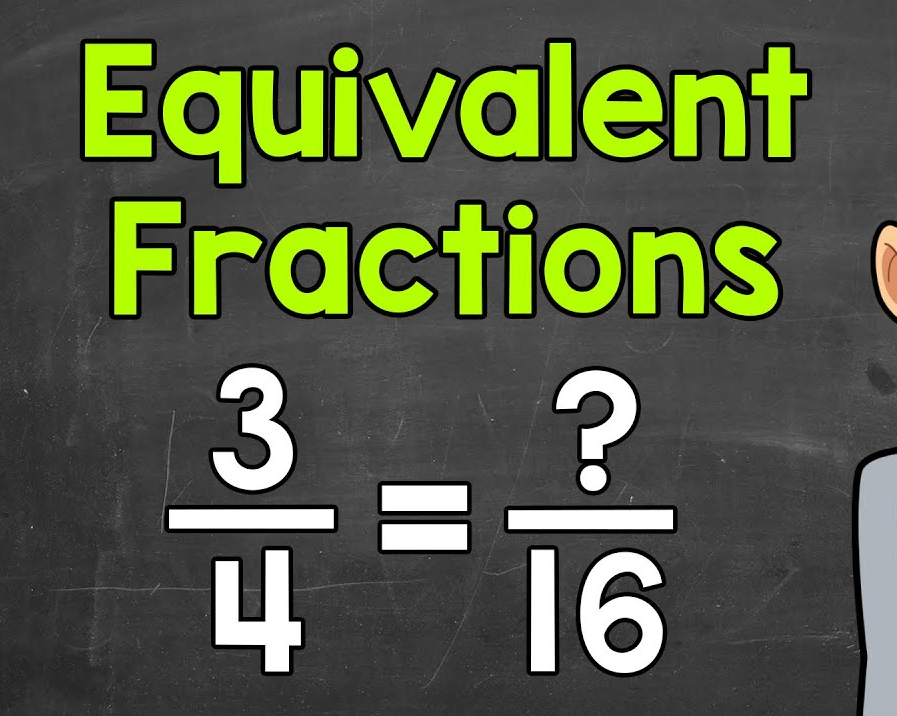
- filling in the missing numerator or denominator in statements like 1/2 = ?/4
That variety matters. Students who succeed at matching shaded circles often freeze when asked to complete a missing-number statement, and the worksheets surface that gap early.
Frequent Student Errors Worth Anticipating
The most persistent error isn't misidentifying equivalent fractions — it's comparing fractions from different-sized wholes. Show students two circles, one the size of a dinner plate and one the size of a quarter, both shaded to show one-half, and many will say those halves are equal. They're applying the rule correctly ("same fraction, same amount") but haven't registered that the rule only holds when the wholes are identical. Name this explicitly before students begin any area-model work.
A second error appears specifically on number-line worksheets. Students who confidently mark 1/2 on a number line will sometimes place 2/4 at the 2 mark rather than the halfway point, treating the numerator as a whole-number count rather than a ratio. When that shows up in student work, the correction is to have them partition the same number line into fourths first, then point to the second tick mark — they can see it and the halfway mark occupy the same position.
Students also consistently insist that a larger denominator signals a larger fraction. A student who correctly identifies that 1/2 equals 2/4 will still sometimes claim that 4/8 is "more" because the numbers look bigger. Ask that student to look at the shaded area and describe what they notice — the visual resolves this faster than any verbal explanation of denominator relationships.
How to Work These Worksheets Into Your Fraction Unit
The most effective placement for this set is after students have handled physical fraction tiles or circles and before they are expected to generate equivalent fractions on their own. That middle phase — where students can recognize equivalence given a visual but cannot yet produce it without one — is exactly where structured worksheet practice earns its time in the lesson.
For small-group rotations, the area-model worksheets work well as independent practice because the directions are self-evident once students understand the format. Number-line worksheets need a brief whole-class orientation first; the parallel-lines layout confuses some students on first contact. Plan for about three minutes of shared modeling before releasing students to those worksheets independently.
Exit tickets built from one area-model problem and one missing-number problem give enough information in the final eight minutes of class to sort students into those who still need visual support and those who are ready to move toward generating equivalents without a model. That read is faster and more actionable than grading a full worksheet the following morning.
A 3rd grade equivalent fractions worksheets collection also works well as a pre-unit diagnostic. Running the area-model worksheet before instruction shows immediately which students arrived from second grade with solid part-whole understanding and which are still treating the numerator and denominator as two unrelated whole numbers.
Standard Alignment
Third-grade fraction equivalence falls under CCSS.MATH.CONTENT.3.NF.A.3, which requires students to explain equivalence using visual fraction models and recognize that two fractions are equivalent only when they refer to the same-sized whole. The sub-standards 3.NF.A.3a and 3.NF.A.3b address generating simple equivalent fractions and explaining why they are equal — both with an explicit emphasis on the visual model as evidence rather than assertion.
Instructionally, this standard lands mid-unit, after students have worked through 3.NF.A.1 (unit fractions as parts of a whole) and 3.NF.A.2 (fractions on a number line). The area-model and fraction-bar worksheets address 3.NF.A.3a directly; the missing-numerator tasks push toward the generative reasoning 3.NF.A.3b requires. Teachers working through this standard will find that a well-sequenced 3rd grade equivalent fractions worksheets collection covering all three model types satisfies the visual-explanation requirement 3.NF.A.3a explicitly calls for.
Differentiating the Worksheets Across Ability Levels
Students who are still consolidating part-whole understanding benefit most from area-model worksheets where the shapes are already partitioned. The task becomes: identify the fraction shown, then shade the equivalent amount in the adjacent model. Removing the partitioning step — which is a separate spatial skill — lets those students focus entirely on the equivalence relationship rather than dividing their attention between two challenges at once.
For students ready to move beyond recognition, the number-line and missing-number worksheets provide a natural step up. A useful modification for that group: after completing the shading on an area-model worksheet, have them cover the model with a sticky note and write the equivalent fraction from memory. That small constraint pushes toward the fluency 3.NF.A.3 expects by year's end.
For students who finish early, a brief written prompt alongside any worksheet yields useful information: "How do you know these fractions are equal? Explain without using the words 'same number.'" Students who genuinely understand equivalence describe how the size of each piece relates to the whole and why a greater count of smaller pieces can equal a lesser count of larger ones. Students who are still pattern-matching tend to re-describe the picture without explaining the underlying reason.
Frequently Asked Questions
How do I explain equivalent fractions without teaching the multiply-top-and-bottom shortcut?
That shortcut belongs in fourth and fifth grade. At this level, keep everything rooted in the visual: two fractions are equivalent when they shade exactly the same amount of the same-sized whole, or land on the same point on a number line. The money analogy works well here — four quarters and one dollar bill look entirely different but buy the same thing. On these worksheets, the pre-partitioned models carry this argument visually; students see the shaded areas match before they record the equivalence statement.
Do students need prior fraction instruction before using these worksheets?
Yes. Students need working knowledge of the basic vocabulary — numerator, denominator, equal parts — before the worksheets are productive. A quick check: ask students to shade 1/4 of a blank rectangle. Students who partition the rectangle into four equal parts and shade one are ready. Students who shade one of however many sections looks roughly right are not yet at a point where equivalence instruction will stick.
Which model type should I assign first — area models, fraction bars, or number lines?
Start with area models. Students have more informal experience dividing shapes than locating fractions on a scale, so the circle and rectangle worksheets tend to click faster. Move to fraction bars next — they introduce comparison by length rather than area, which bridges toward number-line thinking. Save the number-line worksheets for last; once students are comfortable with the concept, parallel number lines become a powerful confirmation rather than a confusing new format.
How do I use these worksheets with students who already grasp equivalence and need extension?
The most productive modification is to remove the pre-drawn model. Give those students a blank rectangle and ask them to partition and shade it themselves to prove a given equivalence. Generating the model rather than completing a provided one surfaces a gap that appears more often than expected: students who correctly identify 2/4 = 1/2 from a picture sometimes struggle to explain why when they have to construct the picture from scratch. For further extension, pair any worksheet in this 3rd grade equivalent fractions worksheets set with a written justification prompt that asks students to explain the equivalence without pointing to the picture.













 Interactive Worksheet Maker
 Quiz Maker
 Word Search Maker
 Crossword Puzzle Maker
 Word Scramble Generator
 Sentence Scramble Generator
 Handwriting Worksheet Generator
 Name Tracing Generator
 Fill In The Blank Generator