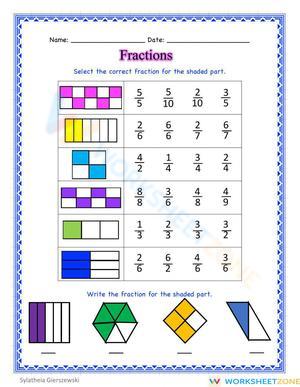
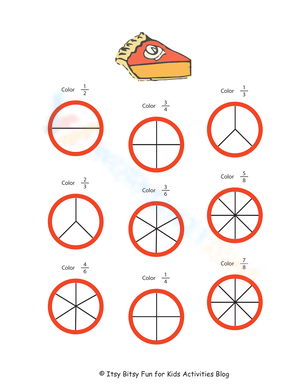
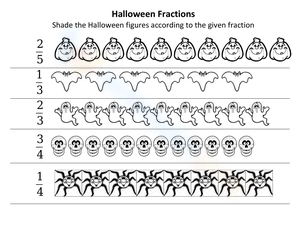
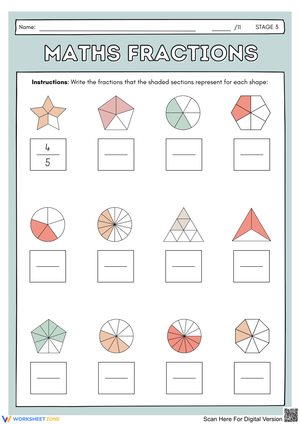
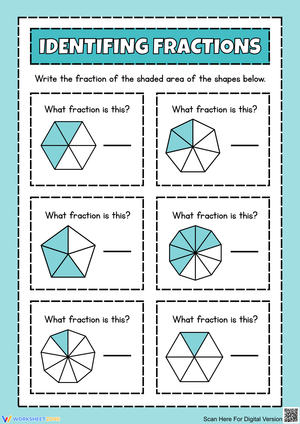
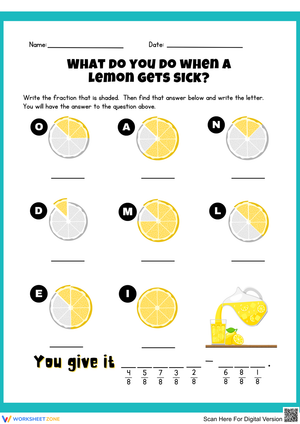
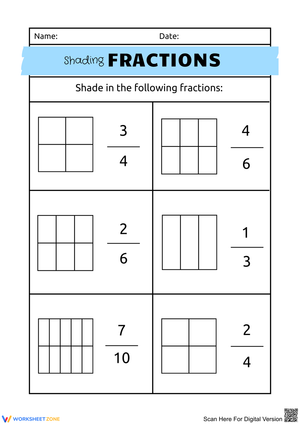
These shaded fractions worksheets for 3rd grade build the visual foundation students need before fraction concepts become abstract — specifically, the moment when a number like ¾ has to mean something beyond a symbol on a page. Each worksheet uses area models (circles, rectangles, and squares) to connect the written fraction to a shaded region students can see and count.
What Each Worksheet Has Students Do
The activities across this set move in both directions: students read a shaded model and write the fraction, and they read a fraction and shade the correct number of parts. That second direction matters more than it might seem. Writing "3/4" after counting shaded pieces is a recognition task. Shading three parts of a four-part rectangle on a blank model requires students to hold the meaning of numerator and denominator simultaneously and act on it — a meaningfully harder cognitive demand.
Additional tasks include identifying whether a shape has been partitioned into equal parts (some models in the set are intentionally incorrect), matching written fractions to corresponding models, and working with unit fractions like 1/2, 1/3, and 1/4 before progressing to non-unit fractions. The equal-partitioning identification exercises are worth lingering on — third graders consistently accept unequal divisions as valid without direct instruction otherwise.
Standard Alignment
These worksheets address CCSS 3.NF.A.1, which defines a unit fraction 1/b as the quantity formed when a whole is partitioned into b equal parts, and extends that understanding to fractions m/b as m copies of 1/b. In classroom terms, that standard has two instructional phases: first, students understand what b means (equal parts of the whole — the denominator work), and second, they understand what m means (how many of those parts — the numerator work). This set addresses both phases explicitly, with early worksheets emphasizing denominator identification and later worksheets requiring students to coordinate both values when shading or writing fractions.
Mistakes Students Make That These Worksheets Help You Catch
The most persistent error is denominator confusion — not the classic "flipping numerator and denominator" mistake, but something subtler. A student looks at a circle divided into six parts with two shaded and writes 2/4, counting only the unshaded pieces for the denominator. They have internalized "bottom number = leftover parts" rather than "bottom number = total equal parts." This shows up in worksheet work as a fraction that always has a smaller denominator than the total number of regions visible. Once you know to look for it, you see it constantly in third grade.
A second error appears when students encounter fully shaded models. A shape with all four parts shaded often gets labeled "1" or left blank — students who have only seen fractions as partial shadings assume the fraction disappears when the whole is filled. Including fully shaded models in practice (this set does) surfaces that gap before it becomes a problem on a unit assessment.
Fitting These Worksheets Into the Lesson Sequence
The strongest use pattern is a four-day gradual release: manipulatives and paper folding on day one, teacher-led whole-group work with one worksheet on day two, small-group rotation with two worksheets (one on reading models, one on shading them) on day three, and independent practice on day four. Skipping day one — going straight to paper — is the move that tends to produce the denominator confusion described above, because students never physically hold "the whole" before they start counting parts of it.
For the small-group rotation on day three, the reading-model worksheet works well as a station students can run independently, while the shading worksheet benefits from teacher proximity. That's where the errors become visible in real time: a student shading four parts of a six-part rectangle when shown 2/6 is telling you they are reading the denominator as the shading instruction. That's a five-minute conversation that changes the trajectory of the unit for that student.
These worksheets also hold up as Monday warm-ups after a weekend gap, particularly mid-unit when students have the concept but not the automaticity. Two or three problems at the start of math block, done silently, give you a fast read on who retained the prior week's work before you build on it.
Adjusting the Worksheets for a Range of Learners
Students who are still shaky on equal partitioning work best with the rectangle and square models, where they can use a ruler to verify equal parts before they count. Removing the circle models temporarily is not a shortcut — it's an appropriate scaffold that keeps the lesson focused on the fraction relationship rather than the geometry of the shape.
For students who have the basic identification task in hand, the equal-partitioning identification exercises become extension work: ask them to redraw an incorrectly partitioned shape correctly, or to explain in writing why the model shown does not represent the labeled fraction. That explanation task is a meaningful challenge even for students who are otherwise breezing through the set.
Students who work with fraction manipulatives as a support can use physical tiles alongside any worksheet in the set without disrupting the intended task — the area models on these worksheets correspond directly to standard fraction tile proportions.
Frequently Asked Questions
My students keep writing the count of unshaded parts as the denominator. How do I address this?
This is one of the more stubborn third-grade fraction errors, and it usually persists because students are pattern-matching rather than reasoning. The fix is to use a worksheet that includes a model where the shaded and unshaded counts happen to be equal — say, 3/6 — and ask students to identify both. When both numbers are the same, students can't rely on "whichever number is different goes on the bottom." That forces them back to the actual definition: denominator equals total equal parts, always.
Do these worksheets work for introducing fractions, or are they better as review?
Both, depending on where you place them in the sequence. The early worksheets in the set — unit fractions on rectangles — are appropriate for introduction after a hands-on lesson with manipulatives. The later worksheets, particularly the ones that include non-unit fractions and fully shaded models, are better suited for mid-unit consolidation or end-of-unit review.
Should I use circles or rectangles first?
Rectangles first, consistently. The equal-partitioning principle is easier to verify on a rectangle, and students can partition a rectangle into equal parts themselves with a pencil and ruler — a task that reinforces the concept kinesthetically. Circles appear later in the set once students have the concept and need exposure to varied representations. This sequencing matches what the research on area models suggests: start with the shape where equal parts are easiest to produce and verify.
What do I do with students who finish quickly?
The equal-partitioning identification worksheets double as extension tasks when paired with a writing prompt: "This shape is labeled 1/3, but the partition is incorrect. Draw it correctly and explain what makes your version show thirds." That task requires students to apply the definition generatively rather than just recognize examples of it — a different and harder skill.













 Interactive Worksheet Maker
 Quiz Maker
 Word Search Maker
 Crossword Puzzle Maker
 Word Scramble Generator
 Sentence Scramble Generator
 Handwriting Worksheet Generator
 Name Tracing Generator
 Fill In The Blank Generator